
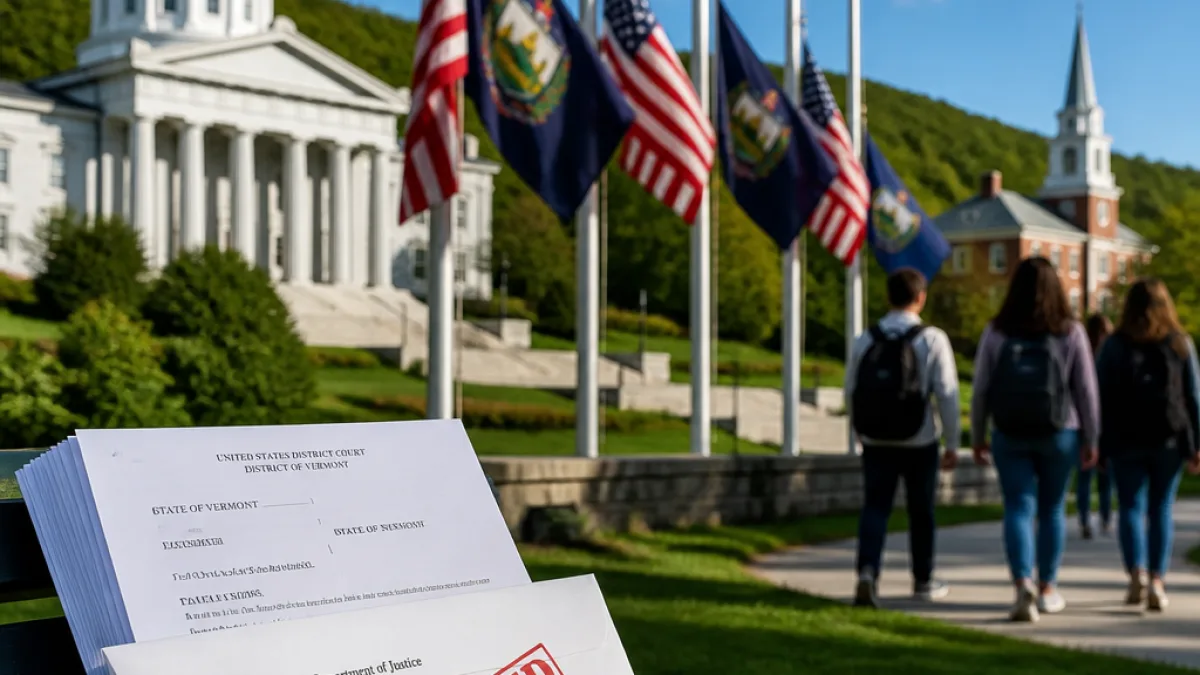
The U.S. Department of Justice has filed a lawsuit challenging Vermont’s law that allows certain noncitizens to qualify for in-state college tuition rates and other post-secondary financial benefits, joining similar actions against New York and Connecticut.
Federal challenge centers on constitutionality and supremacy
The federal complaint contends that statutes in the three states unlawfully favor noncitizens in ways that conflict with federal immigration law. According to the filing, the states’ policies grant benefits not available to some U.S. citizens living outside those states, creating an asserted clash with the Constitution’s Supremacy Clause.
The Department of Justice’s action arrives as a continuation of broader federal scrutiny of state policies affecting undocumented immigrants. In its statement accompanying the suits, the Justice Department framed the legal claim as rooted in federal primacy over immigration policy.
Responses from other states named in the suit
Officials in the other two states named in the litigation pushed back publicly. A spokesperson for New York Governor Kathy Hochul said the state’s statute is lawful and indicated it would be defended in court.
“While our office is currently reviewing the lawsuit, we are confident New York’s statute is lawful and will be upheld,”
Connecticut officials offered a stronger verbal rebuke. State Attorney General William Tong characterized the federal move as an intrusion into state education policy and vowed defense of Connecticut’s approach, which has been in place for more than a decade.
“Note to Trump—stay out of Connecticut. How we run our schools and teach our kids is none of your business and you have no authority to force the sovereign State of Connecticut to deny our kids a future,”
And in a broad statement regarding the lawsuits, Associate Attorney General Stanley Woodward said, in effect, federal law does not allow states to place undocumented immigrants ahead of U.S. citizens.
“Congress long ago made clear that States cannot put illegal aliens over our nation’s own citizens,”
What the suits target and immediate implications
While the complaint targets statutes in all three states, the specific legal issue is the eligibility of certain noncitizens—sometimes described in state statutes as qualifying noncitizen residents—for reduced tuition rates and state financial aid. Traditionally, states set residency rules for in-state tuition; these suits assert those rules cannot conflict with federal immigration law.
For Vermont students and families, the litigation could have practical consequences if courts ultimately rule in the federal government’s favor. Potential outcomes range from a judicial affirmation of state statutes to injunctions or rulings that require the states to revise eligibility criteria for in-state tuition and state-funded aid.
What to watch next
- Whether Vermont officials issue a formal response or legal defense outlining the state’s rationale for allowing certain noncitizen residents to access in-state tuition and aid.
- How courts interpret the interaction between state residency rules for education and federal immigration statutes and constitutional principles.
- The timetable for litigation and any early motions for emergency relief or preliminary injunctions.
Legal challenges of this nature can take months or longer to move through district and appellate courts. Until there is further court action or an explicit statement from Vermont’s government, the state’s existing laws will remain in effect.
Context and background
States across the country vary in how they treat noncitizen students for education benefits. Some states extend in-state tuition or limited state financial aid to qualifying noncitizen residents, while others limit such benefits to U.S. citizens or lawful residents only. The federal lawsuit highlights an ongoing national debate about immigration policy, state sovereignty and access to higher education.
| State | Federal action | Public response (from source) |
|---|---|---|
| New York | Sued | Governor’s office: statute is lawful and will be defended |
| Connecticut | Sued | Attorney General: criticized federal intrusion; vow to defend |
| Vermont | Sued | No response quoted in source |
As litigation proceeds, Vermont higher-education institutions, students and families will be watching for clarifications about who qualifies for in-state status and whether state financial-aid rules may need to change. The case also may prompt state lawmakers and legal advisers to evaluate existing statutes and prepare defenses if they choose to vigorously contest the federal challenge.
This report is based on the Department of Justice’s legal filing and public statements reported by news organizations about responses from New York and Connecticut officials. Vermont officials’ comments were not included in the original reporting cited here.

















