
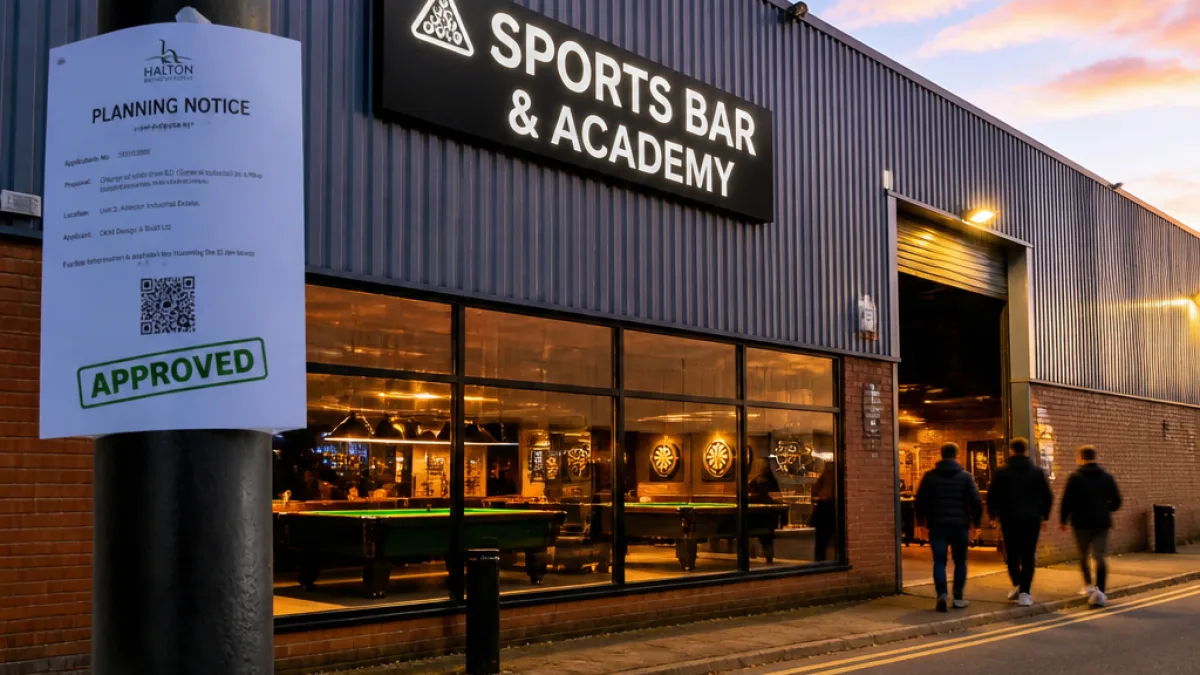
Halton Borough Council has given retrospective planning permission for McNamara’s Sports Bar and Academy at Arkwright Road on the Astmoor Industrial Estate, securing the future of the venue after it had already been operating for some time.
Council backs change of use despite policy conflict
Members of the authority’s development management committee accepted officers’ recommendations to approve the application, even though a planning report acknowledged the proposal conflicted with policy by resulting in a loss of employment floorspace previously identified for B8 warehousing use.
The venue, which has been converted to provide indoor leisure facilities including pool, snooker and darts, operates both as a recreational space for casual users and as a dedicated training academy offering structured coaching and skills development in those sports. The company runs other sites in Crosby, Ormskirk and St Helens.
“The development utilises the existing building footprint and internal accommodation with no external alterations,” the application stated.
Officers cite weak demand for warehousing
While the planning officer’s report highlighted the policy conflict, it also noted that there was ‘weak demand’ for warehousing in the area. That lack of market interest was cited as a material consideration that weighed in favour of approving the leisure use.
Officers concluded that, taken together with the economic and community benefits of the sports academy, the balance of considerations supported the change of use. The report added that the site benefits from its siting in a commercial area with established access, parking provision and connections to the local highway network.
- Location: Arkwright Road, Astmoor Industrial Estate, Runcorn
- Use: indoor leisure and training academy (pool, snooker, darts)
- Planning decision: retrospective permission granted by Halton Borough Council
What this means for the area
For residents, the decision brings certainty that the venue can remain open long term. That stability matters for regular visitors, academy trainees and local staff who rely on the business for recreation and, in some cases, employment. The site’s continued use as a leisure facility also broadens the town’s offer for sports coaching and casual social activity.
For planning watchers and businesses, the case underlines how councils balance rigid policy aims—such as protecting employment land—with real-world market signals. Where demand for a designated industrial or warehousing use is weak, councils may take a pragmatic view if an alternative use provides clear community and economic benefits.
| Issue | Council finding |
|---|---|
| Loss of employment floorspace | Recognised as policy conflict |
| Market demand for B8 use | Assessed as weak |
| Community/economic benefit | Considered material; supported approval |
Neighbours and businesses on Astmoor will now be watching how the venue operates under the formal consent. The application emphasised that visitor demand is spread through day and evening and includes casual users, organised participants and academy trainees—suggesting a continual, rather than peak-only, presence.
Retrospective applications are not unusual in busy commercial districts, but they can be contentious when they change the function of industrial land. In this case, councillors accepted officers’ assessment that the leisure operation delivers tangible community value and that its continued occupation of the building is preferable to leaving the premises underused in a challenging market.
The decision secures McNamara’s place in Runcorn’s leisure scene and gives the business a platform to grow its coaching offer locally, while prompting fresh debate about employment land protection and the most effective ways to support local jobs and facilities.














