Major timetable shake-up aims to ease crowding and link jobs, shops and shift patterns
Transport for Greater Manchester (TfGM) is rolling out a wide-ranging package of changes to Bolton’s bus services from 30 August, promising improved frequency, better links to employment sites and retained late-night provision on a key corridor. The measures form part of what TfGM has described as the “biggest set of improvements ever made in one go” across Greater Manchester.
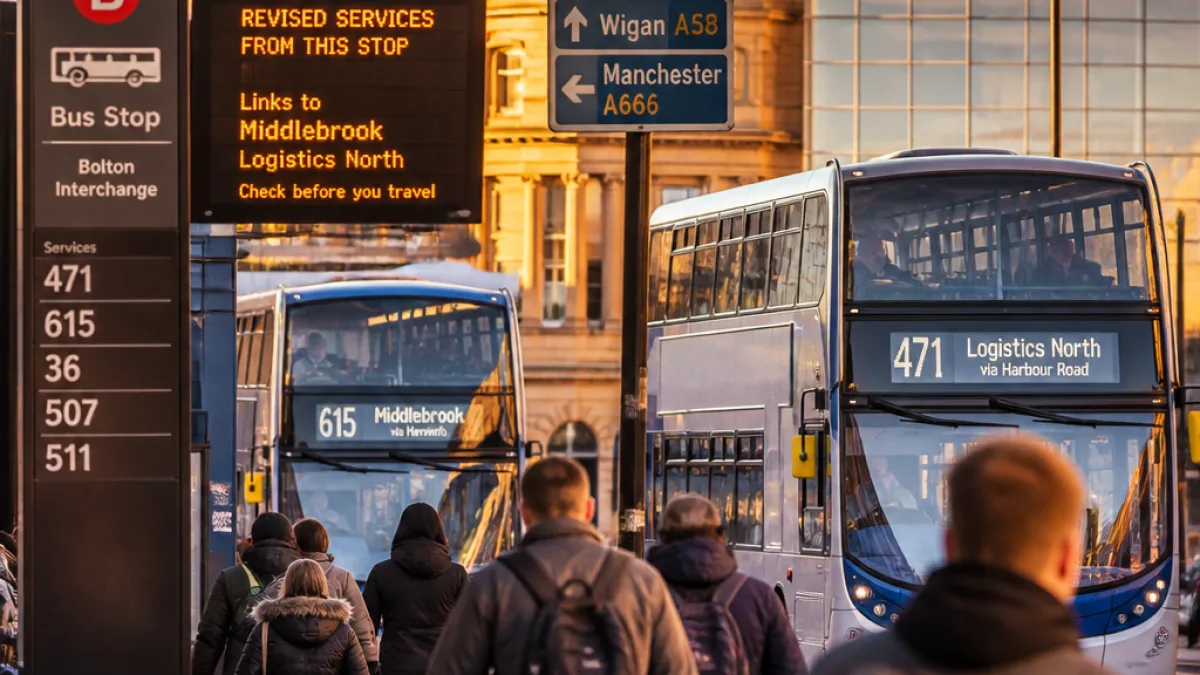
The overhaul affects several services that matter to commuters and shoppers across the borough. Operators will adjust timetables and routes to support connections to Middlebrook, Logistics North, Wigan and Manchester city centre, and to better align with shift patterns at large employers.
“The biggest set of improvements ever made in one go”
What’s changing for Bolton passengers
Key points from TfGM’s announcement include increased daytime frequency on the 471 to address capacity issues and improve links between Bury, Bolton and Rochdale. That route will see extra buses early morning, in the evening and on Sundays to support access to shopping, health services and jobs.
The 36 night bus between Bolton and Manchester will continue to operate 24 hours on Thursday, Friday and Saturday, with some additional late-night mid-week trips retained. That provision will be important for people working late shifts and those travelling to the city in the evenings.
- 471 – extra buses daytime, early morning, evenings and Sunday to improve performance and capacity.
- 36 – 24-hour night service to continue Thursday–Saturday, with some extra late-night mid-week trips.
- 507/511 – timetables updated to align with shift patterns at Logistics North.
- 575 – four buses per hour between Bolton and Blackrod Monday–Saturday; two per hour continue to Wigan; Sunday daytime half-hourly with double-deckers.
- 576 – will call at Middlebrook and operate a half-hourly service seven days a week, served by double-deckers.
- 615 – extended to run from Middlebrook through to Bolton town centre, shifting from hourly to half-hourly daytime frequency.
TfGM said the combined changes to 575, 576 and 615 will strengthen links between Wigan, Middlebrook and Bolton, aiming to improve access to retail, leisure and employment locations and to build capacity where demand is highest.
Practical implications for commuters and employers
The update specifically mentions aligning some timetables with shift patterns at Logistics North, a sign the changes are intended to support employers with large, non-standard working hours. The use of double-deck buses on several services points to an attempt to tackle overcrowding on busy sections while preserving rural and cross-town links.
For Bolton residents this means:
- Better direct access from town centre to Middlebrook shopping and employment park for the first time on service 615.
- More frequent daytime services on trunk routes serving Wigan and Blackrod, and additional capacity at peak times.
- Continued late-night travel options to Manchester for weekend and some mid-week travellers on the 36.
The changes are pitched as a single, borough-wide uplift in services rather than piecemeal adjustments. TfGM’s maps and timetables will be published ahead of the roll-out so passengers can plan journeys in the run-up to the new schedules.
| Route | Main change |
|---|---|
| 36 | 24-hour night service Thu–Sat; additional late-night mid-week trips |
| 471 | Extra buses daytime, early morning, evenings and Sunday |
| 507 / 511 | Timetables updated to match Logistics North shift patterns |
| 575 | Four per hour Bolton–Blackrod Mon–Sat; two per hour to Wigan; Sunday half-hourly with double-deckers |
| 576 | Calls at Middlebrook; half-hourly seven days; double-decker operation |
| 615 | Extended from Middlebrook to Bolton town centre; frequency increased to half-hourly daytime |
Passengers are advised to check the updated TfGM maps and operator timetables before travelling. The uplift aims to make bus travel a more reliable and practical option for more people across Bolton — from shoppers and students to the growing workforce at nearby logistics sites.
Local campaigners and residents will be watching closely in the weeks after 30 August to see whether the promised improvements translate into shorter waits, less crowding and better connections for routine journeys around the borough.