
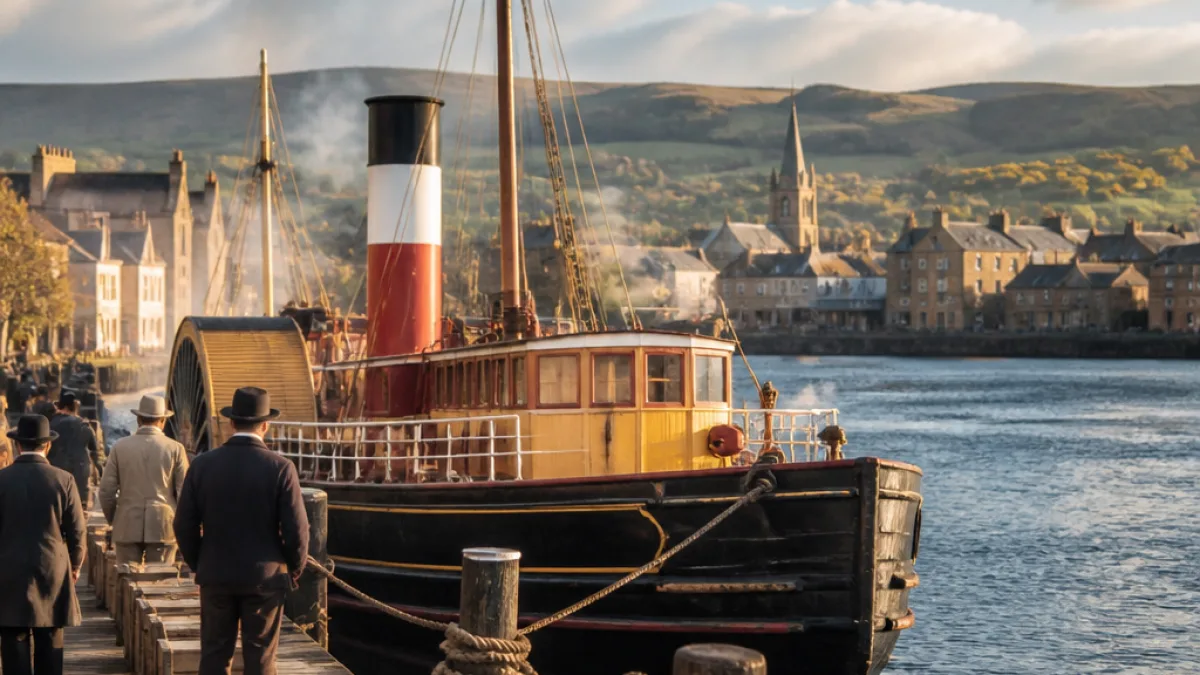
The maritime history of Alloa has been given fresh life in a new work of historical fiction that centres on the Morning Star, a paddle steamer commissioned in 1815 to serve the River Forth. The vessel, which once connected Alloa with Leith, is a focal point in Robert Ferguson’s upcoming novel The Disappearance of Pollyanna Brodie, bringing a near-forgotten chapter of local transport history back into public view.
Design and local routes
The Morning Star was built by Ralph Rae of Kincardine and intended specifically for the challenges of the Forth. Its most distinctive feature was a fiddle-shaped hull — a narrowed midsection that allowed the bulky side-paddle wheels and their protective boxes to be inset flush with the ship’s maximum beam. That design, Ferguson says, helped the vessel negotiate narrow river channels and tight berths at ports that included Alloa, Kincardine and Stirling.
- Commissioned: 1815 by the Alloa Steamship Company
- Builder: Ralph Rae of Kincardine
- Principal route: Alloa – Leith (via River Forth)
Comfort and competition
For passengers of the period the Morning Star offered a surprising level of comfort. Contemporary descriptions referenced elegantly furnished cabins and plush seating, with refreshments reportedly including ginger beer mixed with brandy. The vessel measured nearly 98 feet in length and had an approximate displacement of 100 tons, figures that underline its significance among early steamers working the Forth.
"I have written a short piece on its history and showing that I have included the boat in my upcoming novel," Robert Ferguson said.
In 1818 the vessel was re-engined by noted marine engineer Robert Napier, an upgrade that improved performance as steam navigation rapidly evolved. The Morning Star continued as a regular presence on the river for more than two decades, changing hands several times and contending with growing rivalry from other steamers such as the Lady of the Lake.
Incident and local cultural resonance
The ship’s operational history also included occasional oddities. In September 1819 the Morning Star suffered a breakdown when an Atlantic salmon was discovered blocking the raw-water intake pipe — an anecdote that highlights the practical hazards of early steam navigation on riverine routes.
Beyond its engineering interest, the Morning Star made an impression on the cultural life of the time. The celebrated Scottish writer James Hogg, the Ettrick Shepherd, is said to have mentioned the vessel in prose and dedicated a poem titled The Steamboat of Alloa to it, underlining the steamer’s place in local memory and literature.
Why this matters for Alloa
The inclusion of the Morning Star in Ferguson’s novel will sharpen attention on Alloa’s maritime past at a moment when local heritage projects and community interest in industrial history remain strong. The story connects engineering innovation and everyday travel, and it provides a tangible link between the town’s industrial-era waterfront and the wider cultural currents of early 19th-century Scotland.
| Specification | Detail |
|---|---|
| Year commissioned | 1815 |
| Builder | Ralph Rae, Kincardine |
| Length | Nearly 98 feet |
| Approx. displacement | ~100 tons |
| Re-engined | 1818 by Robert Napier |
Readers with an interest in local history may find the novel a welcome prompt to re-examine Alloa’s river connections and the early decades of steam navigation on the Forth. The book provides a narrative framework that reintroduces the Morning Star as both a technical achievement and a social vessel remembered in poetry and anecdote.














