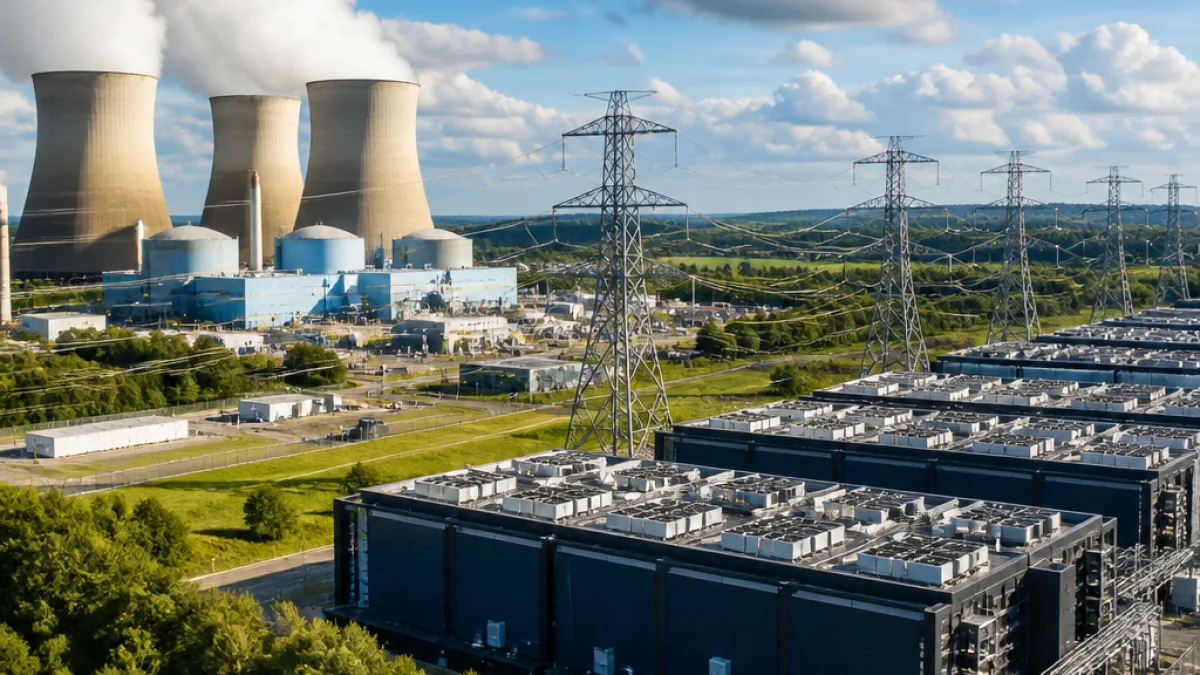
Cloud companies secure long-term nuclear supply
The rapid expansion of artificial intelligence is pushing the technology industry towards a power source it once treated with caution, with Amazon and Google signing long-term agreements for electricity from nuclear reactors in the United States.
Amazon has contracted for 690 megawatts from Constellation’s Calvert Cliffs plant in Maryland. The deal includes 190 megawatts of extra generating capacity expected to become available between 2030 and 2032. Google has signed an agreement covering a further 890 megawatts of nuclear capacity.
Both deals were reached within a week, according to the report, and are designed to secure electricity for cloud computing operations. They do not involve constructing new reactors. Instead, the companies are paying for greater output from facilities already in operation, including reactors that were built before the technology firms themselves.
Existing reactors become strategically important
Constellation plans to spend more than $4.3 billion upgrading 11 reactors across Illinois, Pennsylvania and New Jersey. The investment reflects a shift in the industry’s approach to meeting the electricity needs associated with AI. Rather than waiting for new nuclear stations to be designed and built, companies are turning to plants that can potentially produce more power in the nearer term.
The change marks a reversal from the recent political fortunes of nuclear energy. Accidents at Three Mile Island in 1979, Chernobyl in 1986 and Fukushima in 2011 damaged public and political support for the technology. Germany subsequently ended its use of nuclear power, while Japan shut its reactors after Fukushima before beginning a process of restarting them.
| Company or project | Power or funding | Purpose |
|---|---|---|
| Amazon and Calvert Cliffs | 690MW | Long-term nuclear electricity supply |
| Google agreement | 890MW | Additional US nuclear capacity |
| Constellation upgrades | More than $4.3bn | Work on 11 reactors |
| US Department of Energy | Up to $4.4bn | Loans supporting three plant restarts |
Efficiency has not stopped demand rising
For much of the past decade, the technology sector’s preferred answer to AI’s energy challenge was improved efficiency. More capable chips, smaller models and better cooling systems were expected to deliver more computing work for each unit of electricity consumed.
Those improvements have increased performance per watt, but they have not reduced total demand. Efficiency gains have instead been absorbed by the rapid growth of AI services and the computing infrastructure needed to run them. The result is that electricity supply, rather than processing capability alone, has become a central constraint on the industry’s expansion.
- Amazon has secured 690MW from Maryland’s Calvert Cliffs facility.
- Google has agreed a deal for 890MW of additional nuclear capacity.
- Microsoft is contracted to buy the output from Three Mile Island for 20 years.
- US government loans could support the return of three closed plants, restoring about 2.25 gigawatts.
Restarting closed plants carries its own test
Microsoft has contracted to buy power from an undamaged reactor at Three Mile Island, while the US Department of Energy is offering up to $4.4 billion in loans to support the revival of three shuttered plants. The planned restoration would amount to about 2.25 gigawatts of generating capacity.
One of those facilities is Palisades in Michigan, which closed in 2022. It is expected to generate electricity again by March 2027. If that happens, it would be the first US commercial nuclear plant to restart after entering decommissioning.
The agreements show how the AI boom is changing the argument over energy. The central question is no longer only whether software and computer chips can become more efficient. It is also who will finance the generating capacity required to keep the systems running, and whether existing nuclear infrastructure can deliver it quickly enough.