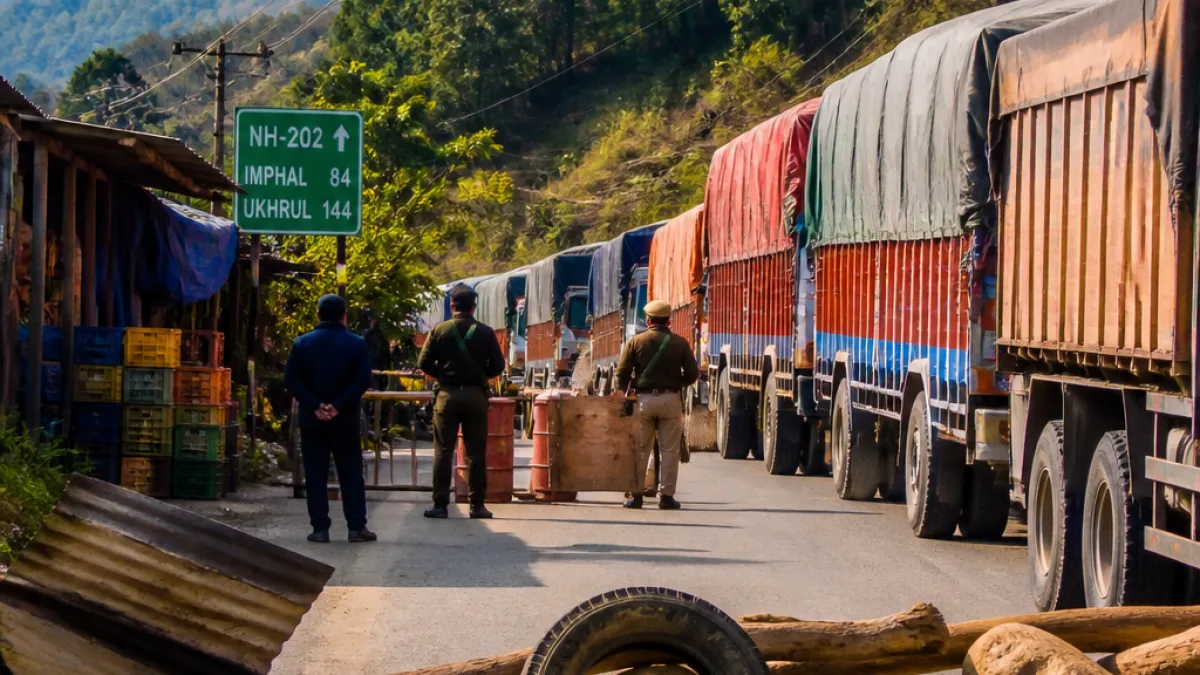
Imphal, Manipur: Hundreds of commercial vehicles remained stranded along National Highway 202 after a series of blockades and counter-blockades by Naga and Kuki groups, authorities and local sources said on Monday. The disruption has sharply driven up prices of essential commodities across the state, with traders reporting an increase of about 140%.
Drivers and transporters said more than 400 trucks were stuck near Litan on the Imphal–Ukhrul route, some of them for nearly three weeks. Several truckers appealed to the state and central governments for assistance to ensure the safe passage of the stranded vehicles.
"Prices of essential commodities have increased by 140% both in the valley and hills," a driver said, adding that they were surviving on limited supplies after being stranded for more than 20–25 days.
Supply disruption and humanitarian concerns
Transporters described acute shortages of fuel, food and drinking water for drivers and helpers who remain marooned on the highway. Local traders and wholesale dealers in Imphal reported rapid increases in retail rates for staples, medicines and other basic items as supplies dwindled.
Government spokesperson Thokchom Radheshyam described the first round of talks between the Manipur government and the United Naga Council (UNC) as an "ice breaker" and said further rounds would be held to seek solutions to issues raised by the Naga apex body. The UNC leadership, however, indicated it would press on with the blockade until its four-point charter of demands was met.
UNC president Ng Lorho said the organisation would continue its blockade along the national highways until its four-point charter of demands was fulfilled.
Official response and outreach
State authorities have held initial parleys to mediate between the parties responsible for the blockades and those affected by them. The first meeting between the government and the UNC was described as "fruitful, cordial" by officials, who said both sides agreed to continue discussions on outstanding issues.
Transport unions and truck drivers have urged expedited action to clear the highways, warning that prolonged disruption will exacerbate shortages and push more supplies out of reach for vulnerable households, particularly in hill districts dependent on road deliveries.
Immediate economic impact
Local traders reported sharp increases in prices across categories. While precise statewide price indices are not yet available, multiple wholesale dealers in Imphal said the cost of staples and other essentials had roughly doubled compared with pre-blockade rates.
- Trucks reported stranded: more than 400 near Litan; transporters estimate up to 500 vehicles affected on NH-202
- Duration: drivers said many vehicles have been stuck for 20–25 days
- Price rise: traders reported essential commodity prices up by 140% in both valley and hills
Table: Key figures reported
| Item | Reported figure |
|---|---|
| Trucks stranded near Litan | 400+ |
| Estimated vehicles affected on NH-202 | 400–500 |
| Duration of stranding | 20–25 days |
| Reported rise in essential prices | 140% |
Analysts and local economists warn that if the blockade persists, shortages may spread to other districts and create secondary market distortions, with informal traders exploiting scarcity to hike prices further. Perishable goods are particularly vulnerable to loss when transport is delayed for extended periods.
Officials have so far not announced a timeline for restoring full traffic flow on NH-202. The government and UNC have agreed to continue discussions, but UNC leaders have reiterated that their demand for a four-point charter must be addressed before blockades are lifted.
For residents and businesses, the immediate consequences are rising household costs and uncertain access to medicines and fuel. Transporters called for clear assurances on security and safe passage to end the humanitarian strain on drivers and to stabilise supply lines across Manipur.
Further developments are expected as talks continue; state and central agencies may consider measures to escort stranded vehicles, arrange alternate routes where feasible, or provide temporary relief supplies to affected communities while negotiations proceed.