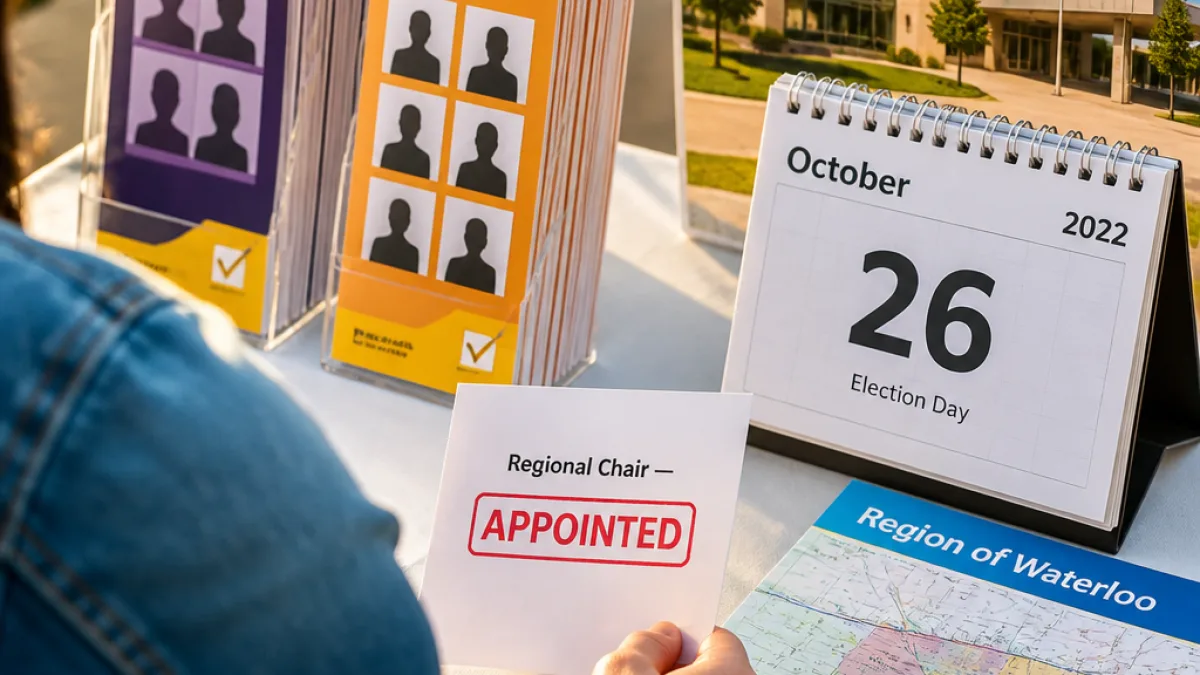
Waterloo residents preparing to vote in the municipal election on Oct. 26 will find a full roster of candidates for mayoral and council positions in the city and across the Region of Waterloo, while the region's chair will not appear on the ballot this year.
What’s on the ballot in Waterloo
The provincial announcement means voters in Waterloo, Cambridge, Kitchener and the surrounding townships will elect municipal councillors and mayors as usual, but they will not vote for the regional chair. The list of candidates for the region and each lower-tier municipality has been published to help people consider how to cast their ballots.
- Election date: Monday, Oct. 26
- Municipalities with mayoral contests: City of Waterloo, City of Kitchener, City of Cambridge and the townships of North Dumfries, Wellesley, Wilmot and Woolwich
- Regional chair: Appointed by the province, not elected
The provincial list of candidates for each municipality is arranged alphabetically by last name. Voters are being asked to review that information as they decide which candidates best represent their priorities on issues such as housing, transit, infrastructure and local services.
Appointment of the regional chair and new powers
Ontario's Minister of Municipal Affairs and Housing, Rob Flack, has moved to make the regional chair an appointed position; the Region of Waterloo is one of eight regions across the province where that change will take effect. The province has said the appointed chairs will receive what it describes as strong chair powers, modelled on the authority of the so-called strong mayor model that exists in some municipalities.
Flack said the move is necessary to have "effective government" and it would be "getting politicians out of the way."
The government says the stronger chair powers will help streamline housing projects and allow mayors — and by extension chairs with those powers — to draft and present budgets. Those are precisely the kinds of tools proponents say can speed approvals for development and coordinate large-scale planning efforts.
Local reaction and implications for Waterloo
Locally, municipal leaders and councillors have expressed reservations about the change. Waterloo city councillors have been reported as unanimously opposing any move to combine the roles of regional chair and mayor — a scenario the province says it will not pursue in the Region of Waterloo but which has raised concerns about concentration of power and reduced local accountability.
Lindsay Jones, executive director of the Association of Municipalities of Ontario, has told CBC News she harbours concerns about the appointment process and its implications for municipal governance. Those worries centre on transparency, democratic accountability and whether appointment rather than election will affect how the chair represents diverse local communities at the regional table.
| Municipality | Chair/mayor on ballot? |
|---|---|
| Waterloo | Mayor — Yes; Regional chair — No (appointed) |
| Kitchener | Mayor — Yes; Regional chair — No (appointed) |
| Cambridge | Mayor — Yes; Regional chair — No (appointed) |
| North Dumfries, Wellesley, Wilmot, Woolwich | Mayors — Yes; Regional chair — No (appointed) |
For many Waterloo-area residents, the immediate consequence is practical: voters will need to weigh candidates for local council and mayoral offices without the check of a directly elected regional chair. The longer-term consequence may be a shift in how regional priorities are set, depending on who the province appoints and the powers granted to that office.
Election officials continue to provide candidate lists and voting information. With the Oct. 26 date approaching, local campaigns are expected to intensify and voters will have opportunities to attend debates, forums and advance polling as scheduled by their municipality.
Developments at Queen’s Park that change the mechanics of local democracy have a direct effect on how municipal government functions in Waterloo and across the region. As the campaign season accelerates, residents will be watching both local candidates and the province's choices for appointed leadership closely.