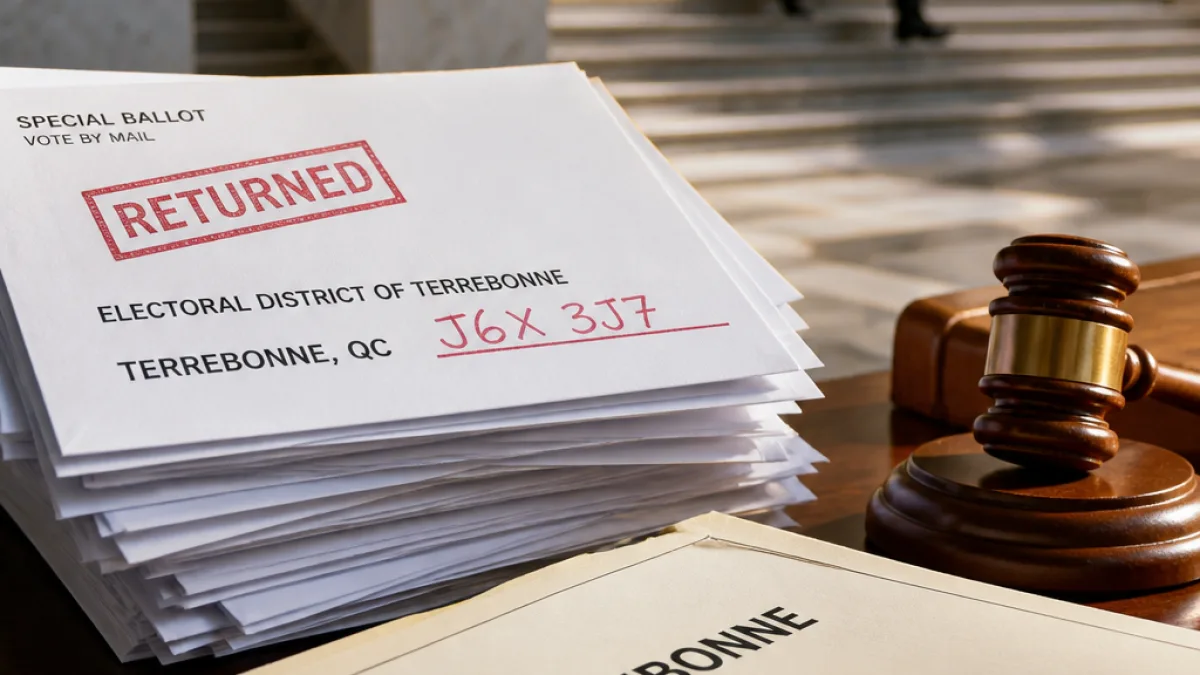
The Supreme Court of Canada has released its reasons for voiding the 2025 federal election result in the Montreal‑area riding of Terrebonne, concluding that an administrative lapse at Elections Canada was serious enough to undermine public confidence in the outcome.
What the court found
In a majority decision written by Justice Mahmud Jamal, the high court ruled that Elections Canada had committed a “serious administrative error” by failing to act after becoming aware that some return envelopes for special (mail‑in) ballots bore an incorrect postal code. The error resulted in at least one special ballot being returned to the voter and never counted — a ballot the court determined could have affected the result in a riding decided by a single vote.
“Elections Canada did not receive or count an elector’s vote because it took insufficient steps to correct the error, despite knowing that it had made a mistake, and despite its expectation th
The case arose after Liberal candidate Tatiana Auguste was initially declared the winner of the April 2025 Terrebonne contest by a margin of one vote over Bloc Québécois candidate Nathalie Sinclair‑Desgagné. The result was challenged after a Bloc supporter, Emmanuelle Bossé, reported that her special ballot had been returned to her mailbox because of an error in the postal code printed on the Elections Canada label.
Sequence that led to the annulment
- An Elections Canada employee preparing address labels mistyped the last three characters of a polling station's postal code.
- The worker noticed the mistake on April 6 but corrected only the kits remaining in the office and destroyed the unused defective labels; he did not inform his supervisor nor contact electors who had already received mislabelled envelopes.
- At least 40 electors were estimated to have received the mislabelled envelopes; one ballot, belonging to Emmanuelle Bossé, was returned and not counted.
- A Quebec Superior Court judge refused to annul the result; the matter proceeded directly to the Supreme Court under provisions allowing an appeal within eight days.
The Supreme Court, in a split 6–3 decision explained in written reasons released by the court, concluded that even an honest clerical mistake can qualify as an irregularity if it is a serious administrative error capable of affecting the integrity of the electoral process.
Local and legal consequences
The court’s ruling vacated the Terrebonne seat in February 2026 and ordered a new vote. A byelection was held on April 13, in which Tatiana Auguste again won the seat. Media reports indicate her margin in the subsequent byelection was substantially larger, on the order of several hundred votes.
| Event | Date |
|---|---|
| Original Terrebonne result (one‑vote margin) | April 2025 |
| Employee noticed labelling error | April 6, 2025 |
| Supreme Court vacated result | February 2026 |
| Byelection won by Tatiana Auguste | April 13, 2026 |
The decision underscores the court’s view that electoral administration must be sufficiently vigilant to prevent known and correctable mistakes from determining outcomes in closely contested races.
What this means for Terrebonne voters
For residents of Terrebonne, the case highlights how small administrative failings can have outsized local consequences. The court’s ruling focused not on fraudulent intent but on the failure of the returning authority to take remedial steps after discovering an error — a point that may influence future supervisory practices within Elections Canada and the handling of special ballots in closely contested ridings.
While the byelection restored representation to the riding, the legal saga has drawn attention to the mechanics of voting by special ballot and the safeguards that must be in place to preserve confidence in close races. Whether Elections Canada will change procedures or internal reporting lines in response to the ruling is a matter of public and parliamentary interest going forward.
The court’s written reasons — released in September 2026 — set a precedent on when administrative errors, even if honest, can justify annulling an election result to protect the integrity of the electoral process.