Municipal governments across Ontario are confronting a sudden surge of interest in large artificial-intelligence data centres, triggering temporary freezes, policy reviews and bylaw changes as communities attempt to balance economic opportunity with concerns about energy demand, land use and local impacts.
Local governments weigh speed and scrutiny
In recent months several Ontario municipalities have adopted different short-term approaches while staff prepare planning studies and assessment frameworks. The spark for the debate is the growth of AI-related infrastructure — massive data centres that can require hundreds of megawatts of electricity and substantial land footprints.
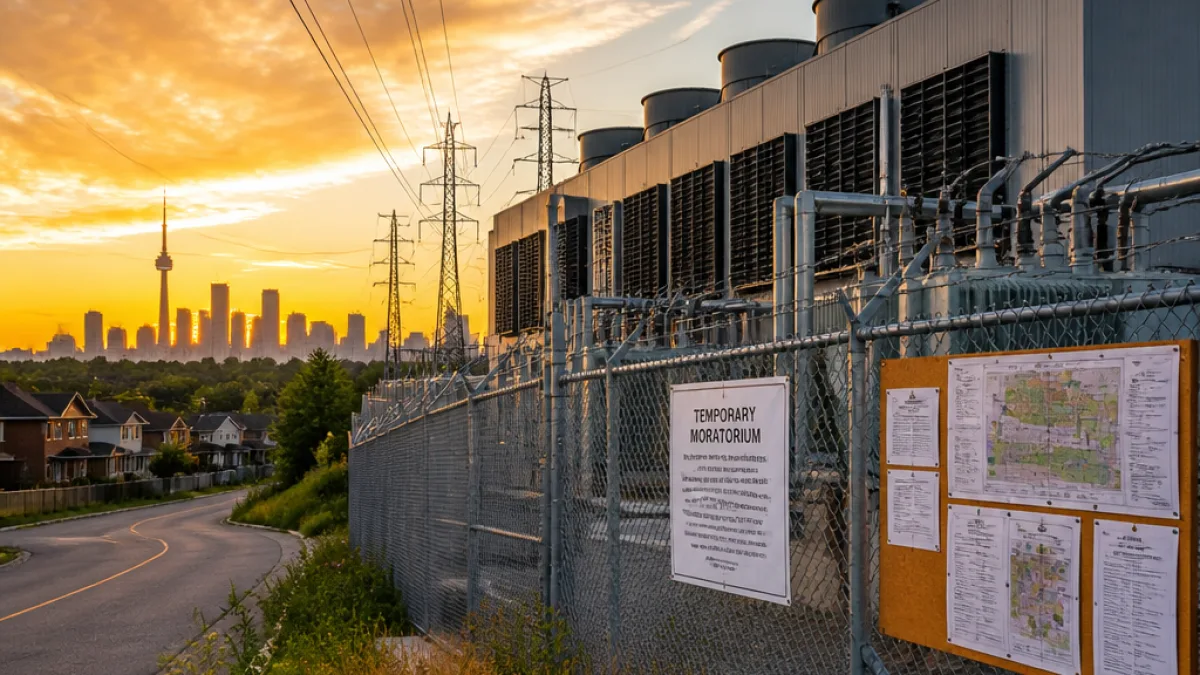
Municipal responses so far have ranged from full moratoriums to proactive zoning amendments. Oakville became the first Ontario town to pass a temporary moratorium on new data centres while staff complete a planning study. Hamilton considered a similar one-year freeze — known as an interim control bylaw — but council rejected it in July following a closed-door session with legal advisers, even though the measure had cleared committee.
Other municipalities are taking a middle path. Toronto council instructed staff in July to review planning policies around data centres, signalling a desire for clearer local guidance and asking the province to develop a broader framework. Ottawa council has likewise directed staff to study and develop an assessment framework, with instructions to advise councillors of any large-scale applications in the interim.
Different tools, similar aims
Municipalities are using a few predictable planning tools as they adapt: temporary moratoriums to pause approvals, interim control bylaws to buy time, and direct amendments to zoning bylaws to explicitly permit or restrict data centres on industrial lands. The approaches seek to answer practical questions about where such facilities can locate, how they will connect to electrical grids, and what community safeguards should be required.
- Oakville – First in Ontario to pass a moratorium pending a planning study.
- Hamilton – Considered a one-year freeze but council voted it down in July after legal advice.
- Sault Ste. Marie – Directed staff to draft a moratorium for centres with demand above 50 megawatts; a vote expected Sept. 21.
- Greater Napanee – Passed a bylaw in February explicitly permitting data centres on industrial lands.
- Toronto – Ordered a review of planning policy and sought provincial direction.
- Ottawa – Commissioned a study to develop an assessment framework and to alert council to major applications.
| Municipality | Action | Immediate aim |
|---|---|---|
| Oakville | Moratorium | Pause approvals while staff study impacts |
| Hamilton | Proposed interim control bylaw (rejected) | Study planning guardrails |
| Sault Ste. Marie | Directed staff to draft moratorium (50 MW threshold) | Target high-energy proposals |
| Greater Napanee | Zoning amendment | Permit on industrial lands |
| Toronto | Policy review | Develop clearer planning rules; press province |
| Ottawa | Assessment framework study | Establish criteria for review; notify council of large applications |
Energy demand is the central concern
At the heart of municipal unease is the question of energy. AI data centres can be extremely energy intensive, leading local officials and residents to raise concerns about where the power will come from and what it will mean for local grids and other customers. Noise, water use, traffic, and the industrial character of host communities are further considerations in planning deliberations.
Some municipalities are already framing moratorium thresholds around megawatt demand: Sault Ste. Marie’s proposed limit would apply to projects seeking more than 50 megawatts. That reflects a desire to differentiate small server farms from large-scale AI facilities that require dedicated grid capacity and long-term infrastructure commitments.
Economic development versus local control
Municipal leaders face a difficult trade-off. Data centres can deliver jobs, investment and tax revenues, and some municipalities have moved to explicitly welcome them on industrial lands. Yet the speed and scale of recent proposals have prompted others to demand a pause to study cumulative effects and ensure local priorities — including sustainability and community impacts — are protected.
Councils are also pushing for provincial involvement. Toronto’s motion asked the Ontario government for an overarching framework, reflecting the reality that electricity planning, grid upgrades and broader climate objectives fall within provincial or federal jurisdiction.
What happens next
Expect more municipalities to debate interim tools this fall as developers and utilities advance proposals. Many councils have signalled they will not decide substantive policy until staff complete planning studies and assessment frameworks, but they are moving quickly to ensure they are not caught off guard by large-scale projects.
For communities, the choices ahead will shape land use, local infrastructure and energy planning for years. Municipalities are positioning themselves to either accommodate a new industrial player or to dial back approvals until guardrails are in place — a tension that will play out across Ontario in the months to come.