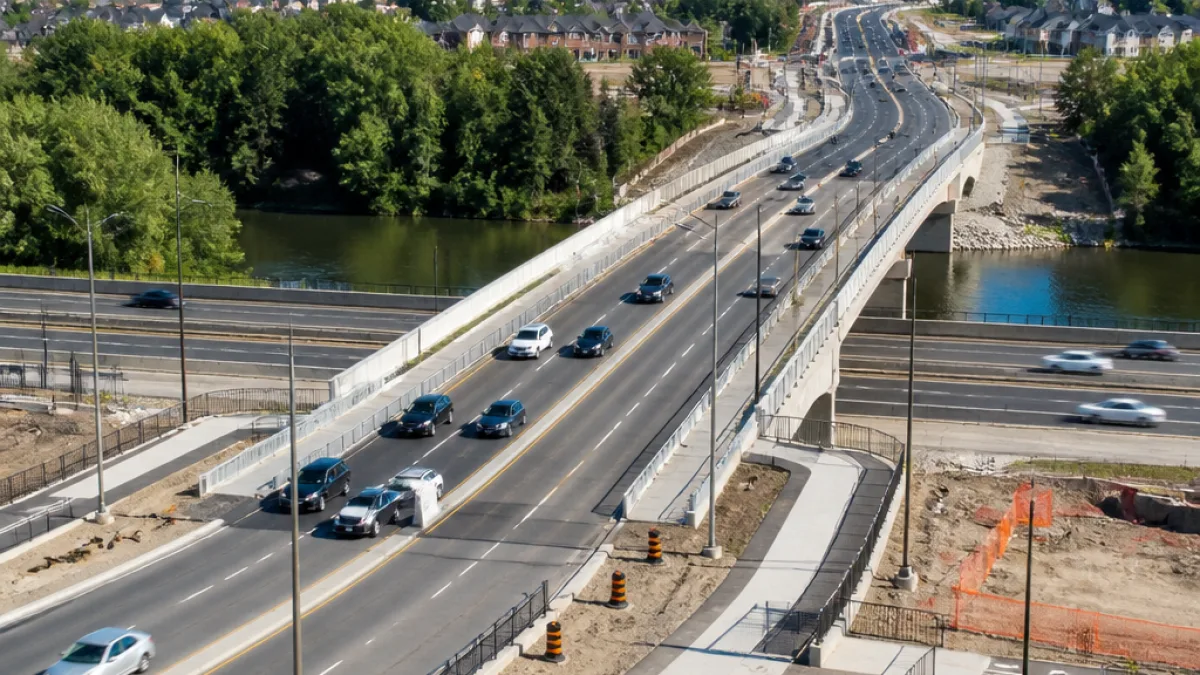
York Region celebrated the opening of a new four-lane road crossing over Highway 404 on Wednesday, creating a direct link between Orlando Avenue in Richmond Hill and Markland Street in Markham. The $110-million project aims to ease pressure on local roads, improve connections between communities and provide safer options for walking and cycling.
Design and features aimed at people and the environment
Construction began in the summer of 2023. The project includes:
- four traffic lanes across the highway;
- multi-use sidewalks and pathways for pedestrians and cyclists;
- a bridge spanning Highway 404 and a separate bridge over the Rouge River;
- an extension of Markham’s Cachet Woods Court to the new crossing;
- environmental plantings to stabilise the riverbank and improve stormwater quality.
Planners and elected officials highlighted the dual focus of moving vehicles more efficiently while adding active-transportation infrastructure. The project’s designers said the paths and sidewalks are intended to encourage safe cycling and walking between the two municipalities.
Who paid for it and what it means locally
The crossing was jointly funded with contributions from the two cities and York Region: $65 million from Markham, $28 million from Richmond Hill and $17 million from York Region. York Region chair Eric Jolliffe said big infrastructure takes time to plan and build, but delivers benefits for decades.
“As our communities continue to grow, so does the need for infrastructure that keeps people, goods, and services moving safely and efficiently,”
Jolliffe added that the crossing is an example of the region’s ongoing commitment to long-term planning.
| Item | Detail |
|---|---|
| Total cost | $110 million |
| Funding partners | Markham $65M; Richmond Hill $28M; York Region $17M |
| Major components | Four-lane road, two bridges, multi-use pathways, Cachet Woods Court extension, environmental plantings |
Regional context and community impact
Markham mayor Frank Scarpitti framed the opening as more than a new road. He noted the municipality asked for an additional highway crossing in 2012 to relieve congestion along key corridors and said the new link will make travel quicker and safer for thousands of residents across York Region.
“A connection that will help thousands of residents in York Region get to where they need to go more quickly, more safely and more efficiently,”
He also described the crossing as creating economic opportunities and as infrastructure that strengthens the foundation for future generations.
For Richmond Hill, the crossing is likely to shift some local traffic patterns. City planners have for years sought ways to reduce the volume on collector and neighbourhood roads that run parallel to the highway. Officials say the new crossing should provide an alternate route for motorists travelling between east-west corridors in the north-south stretch of York Region.
Next steps and what residents should expect
With the crossing now open, municipal staff will monitor traffic flows and active-transportation use to determine any further adjustments needed at adjacent intersections, signage and pedestrian crossings. The environmental plantings installed as part of the project will be observed in coming seasons to ensure riverbank stabilization and stormwater improvements meet design expectations.
Residents who use the connecting roads are likely to see changes in route choices and congestion patterns. Municipal officials have not released specific projections for travel-time improvements or traffic-volume reductions on particular streets; such data will normally be developed through post-construction traffic monitoring.
This new crossing represents a multi-jurisdictional effort to knit growing suburban communities together while adding pedestrian and cycling facilities often missing from older road projects. For Richmond Hill, it is a tangible piece of infrastructure aimed at balancing vehicle movement with active transportation and environmental enhancements.