Interdisciplinary work probes space, perspective
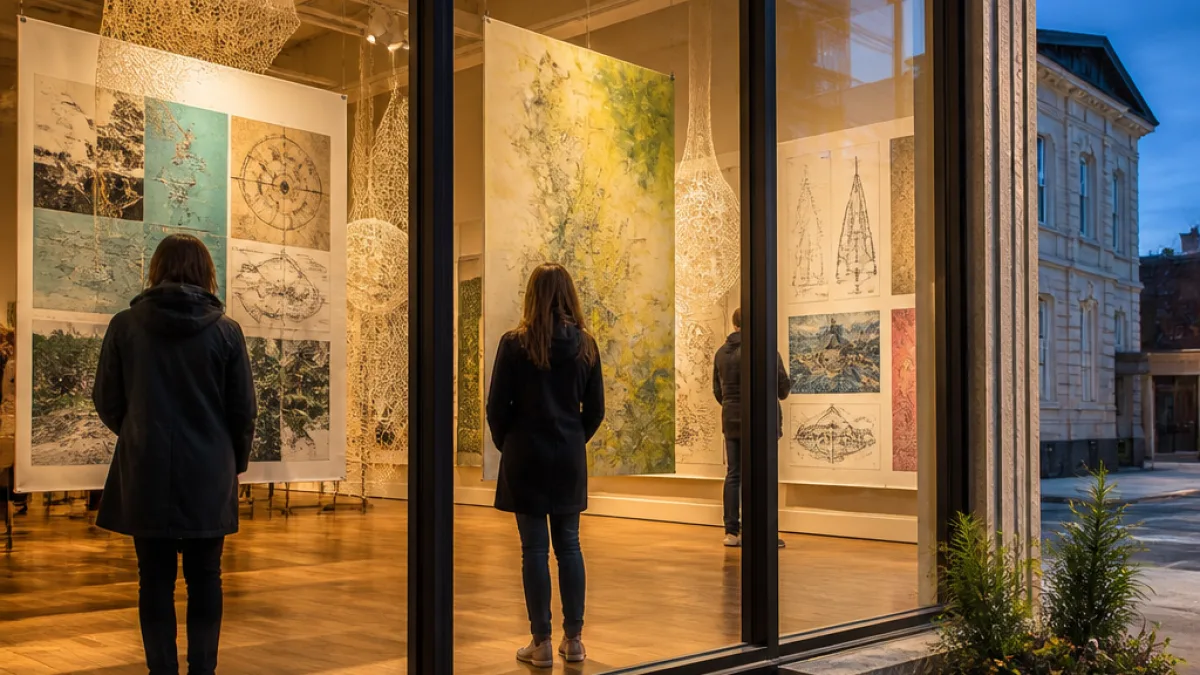
The latest exhibition by New York–based artist Ellen K. Levy, "Displaced: Tears in the Fabric of the Universe," is on view at 68 Prince Street Gallery in Kingston through Sept. 27. The show brings together roughly two decades of Levy’s work that interrogates outer space not as spectacle but as a sustained problem of perspective, drawing on her background in the sciences as well as the visual arts.
Curator Barbara London, in a catalogue essay accompanying the exhibition, frames Levy as an artist who "moves resolutely between art and science." Levy’s training — originally in zoology and later in painting, culminating in a Ph.D. intersecting art and neuroscience — informs a body of work in which documentary source material, scientific imagery and painterly gesture coexist.
The exhibition is anchored by four large painted prints. One of the most striking pieces, titled Space Nets (2026), assembles imagery of satellites from a range of national sources and makes visual connections to woven or net-like structures favoured by contemporary sculptors. In London’s account, those analogies suggest how human-made nets and webs — literal and metaphorical — might read as early frameworks for thinking about human activity beyond Earth.
- Space Nets (2026): large painted print incorporating satellite imagery and net metaphors.
- Simulator (2019): a looping, wireframe funnel in acid yellow with collaged patent diagrams and a floating astronaut figure.
- Other works: a convex, fisheye-rendered painting that imagines the interior of the International Space Station, dense with hardware, railings and fragments of orbiting debris.
One of the exhibition’s larger pieces renders the interior of the International Space Station through a convex, fisheye distortion — a golden, bulging sphere packed with cables, railings and equipment, and ringed by satellite fragments with a slice of Earth visible along the lower rim. That image is deployed to emphasise a mode of seeing described in the catalogue as "topological perspective," a way of privileging connectivity and structural relationships over fixed distances or single viewpoints.
Levy’s painting practice “enacts” non-Euclidean or topological ways of seeing rather than merely depicting them, the catalogue argues.
Another work in the gallery, Simulator (2019), trades the fisheye’s immersive curvature for a spiralling wireframe rendered in sharp, acid yellow. The form resembles a training module or descending funnel; layered into the composition are pages of patent diagrams, used as documentary fragments beneath paint — a technique that links Levy’s work to historical precedents in mixed-media painting and collage.
| Work | Year | Notable elements |
|---|---|---|
| Space Nets | 2026 | Satellite imagery, net metaphors |
| Simulator | 2019 | Wireframe funnel, patent diagrams, floating astronaut |
Levy’s method of integrating technical document fragments — patent pages, diagrams and other appropriated government imagery — with painterly surface work is cited in the catalogue as a through-line across the exhibition. The approach recalls historic examples of combining documentary material with painterly mark-making, situating Levy’s practice within broader currents of contemporary art while foregrounding its scientific references.
For Kingston-area audiences tracking the intersection of art, science and technology, the show presents a sustained example of how contemporary artists translate technical subjects into experiential, pictorial terms. It also speaks to a growing interest among curators in artworks that address infrastructure, systems and the lived implications of technological expansion beyond Earth.
The exhibition is on view at 68 Prince Street Gallery in Kingston through Sept. 27. The catalogue essay by Barbara London and the curatorial notes by Alan Goolman provide expanded context for viewers who wish to dig deeper into Levy’s material sources and the theoretical framework that informs the installation.
For residents in Ontario’s urban and rural communities who follow contemporary visual culture, Levy’s work offers a dense, layered encounter — one that asks viewers to reconfigure ordinary modes of perspective in order to grasp the structural and connective dimensions of life in and beyond Earth’s atmosphere.