Aurora Mobile has signed a three-year memorandum of understanding (MoU) with Exabytes, a digital solutions provider in Southeast Asia, to explore integrating Aurora's AI-first customer engagement tools into Exabytes' business network.
Deal announced at regional AI summit
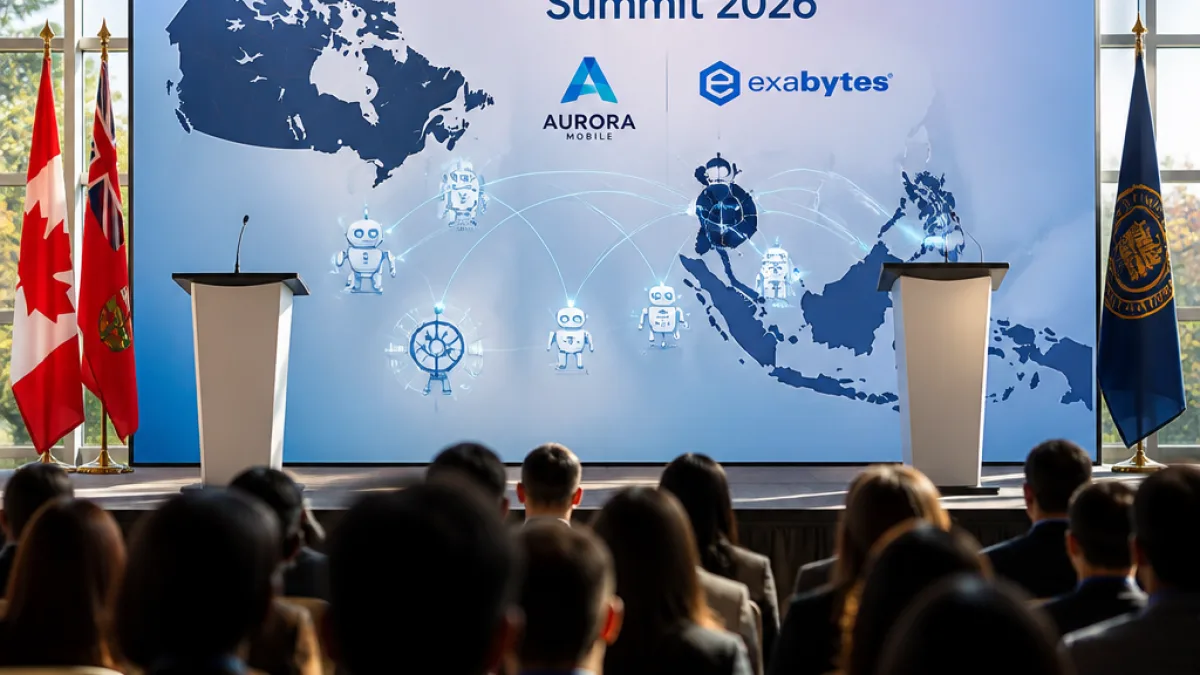
The agreement was announced at the Exabytes GROW AI Summit 2026. According to Aurora Mobile, the MoU focuses on using the company's EngageLab platform and its enterprise-grade AI agent system, GPTBots.ai, to create localized customer service solutions and hybrid AI infrastructures across Exabytes’ clients.
Exabytes has set a stated goal to "empower one million businesses with AI by 2030," and the companies said the collaboration is intended to assist with that ambition by addressing execution challenges within enterprise AI projects.
"[The partnership] bridges the gap between AI ambitions and actual implementations," Aurora Mobile’s CEO, Mr. Weidong Luo, said at the summit, according to the announcement.
What the MoU covers
The announcement lists several focal points that both companies will explore during the three-year period:
- Integration of Aurora Mobile's EngageLab platform into Exabytes’ business network.
- Deployment of GPTBots.ai to create enterprise-grade AI agents and hybrid AI infrastructures.
- Development of localized smart customer service solutions tailored to markets in Southeast Asia.
The companies said they aim to confront the well-documented gap between AI strategy and operational deployment — a common issue for firms trying to translate generative AI promise into reliable, scalable tools for frontline customer service.
Details at a glance
| Item | Detail |
|---|---|
| Agreement type | Three-year Memorandum of Understanding |
| Platforms named | EngageLab; GPTBots.ai |
| Announced | Exabytes GROW AI Summit 2026 |
| Stated target | Support Exabytes’ goal to empower 1,000,000 businesses with AI by 2030 |
| Audience at announcement | Over 500 industry leaders (per company statement) |
Local relevance and broader context
For Aurora residents and local businesses, the announcement is another sign of how AI vendors are forging international partnerships to scale customer-engagement technologies. While the MoU is focused on Southeast Asia, the themes are familiar to Canadian enterprises weighing the costs and complexities of adopting generative-AI systems: localization, hybrid architectures and moving from pilots to production.
MoUs are exploratory rather than binding contracts. The companies described the deal as a framework to identify and develop collaboration opportunities rather than a firm commitment to specific deployments or financial terms. That means concrete services, timelines or investment levels were not disclosed in the announcement.
Still, the collaboration highlights two ongoing industry dynamics. First, platform providers are attempting to address a persistent gap between AI proof-of-concept work and stable operational tools that can be relied on by customer-service teams. Second, vendors are increasingly partnering across regions to combine local market reach with third-party AI capabilities.
For municipal leaders and business owners in Ontario, tracking such international partnerships can offer insight into product road maps and vendor approaches that may arrive in Canadian markets later. Technology procurement teams often cite localization — language support, regulatory compliance and integration with legacy systems — as critical hurdles. The stated emphasis on "localized smart customer service solutions" in this MoU directly speaks to those challenges.
The deal also underscores the ongoing commercialisation of AI beyond headline-grabbing generative tools: vendors are positioning specialised platforms, like EngageLab and GPTBots.ai, as turnkey mechanisms for enterprises to deploy AI agents and customer-engagement automation at scale.
As the MoU matures, Aurora Mobile and Exabytes are expected to publish further details if pilot programs move to deployment. Until then, the agreement stands as an example of cross-border AI collaboration aiming to translate ambitious targets into operational outcomes for a wide network of businesses.