
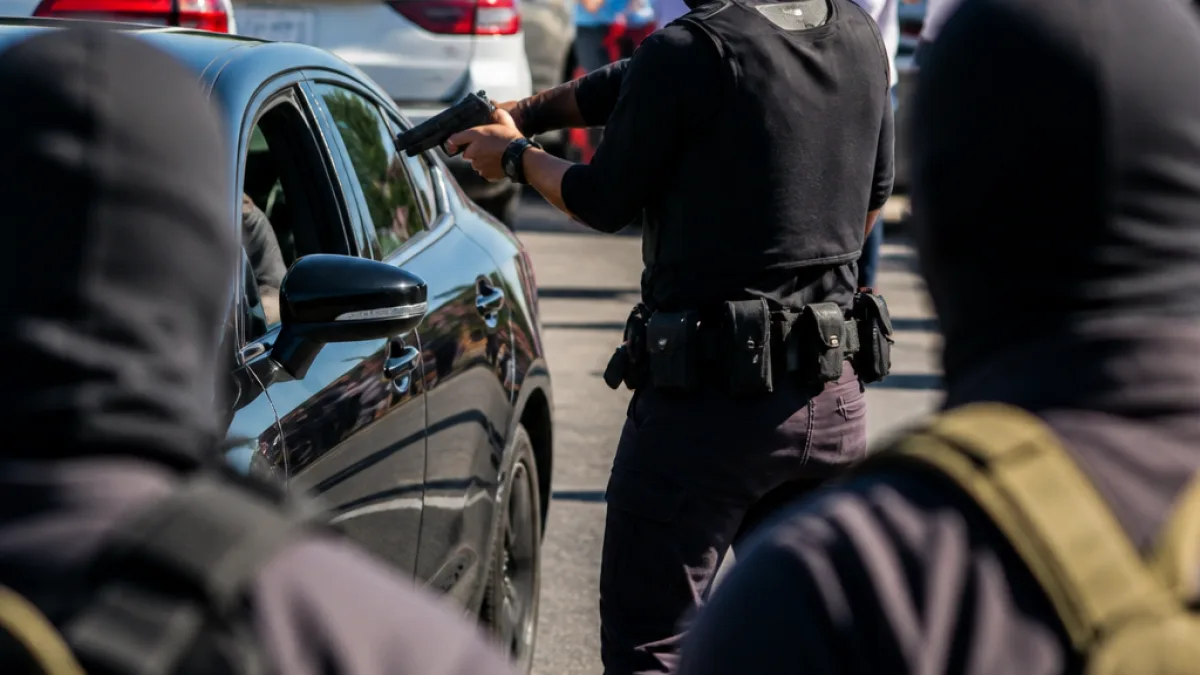
FALLS CHURCH — New video footage of an interaction between Immigration and Customs Enforcement officers and a Virginia woman has renewed scrutiny of federal enforcement tactics after a plainly visible ICE officer drew his handgun and pointed it at the woman during a tense parking-lot standoff.
The video, recorded by the woman identified as Carolina Molina, 36, shows several masked ICE officers surrounding her vehicle as she sits behind the wheel. At one point, an officer is seen pulling his firearm and aiming it toward Molina's window while telling her she nearly ran them over and warning, "I will arrest you. Keep it up."
"I was looking down a barrel, and he could have shot me, and he could have gotten away with it," Molina told a CNN affiliate.
Conflicting accounts from Molina and DHS
Molina, a licensed mental health counselor who works with people navigating the immigration system, told WUSA9 she denied trying to hit officers with her car and that she began recording because she felt threatened. She said the portion of the encounter captured in her recording shows her vehicle stationary while officers approached.
Department of Homeland Security officials offered a different version. In a statement, DHS characterized the woman as "an anti-ICE agitator" and said she "drove her vehicle in circles around our ICE officers and then attempted to harm officers by weaponizing her vehicle against them—all in an attempt to help illegal aliens get away." The DHS account was broader than the short video clip and asserted the woman had tried to endanger officers.
Authorities declined to charge the woman; video raises accountability questions
Molina was not taken into custody and has not been charged, she and the local media report. The encounter has prompted immediate questions from local leaders and civil liberties advocates about ICE tactics and the agency's use of force, particularly when interactions involve people recording law enforcement activity.
Rep. Don Beyer (D-Va.), whose district includes Falls Church, publicly criticized the officers' conduct. His statement, echoed by other local officials, called for an investigation into the incident and for clarity about enforcement procedures used by federal immigration officers operating in the area.
- What the video shows: several masked ICE officers surrounding a stationary vehicle; an officer pointing a handgun at the driver.
- DHS claim: the driver endangered officers by attempting to weaponize her vehicle; labeled the woman an "anti-ICE agitator."
- Outcome: the officers left without arresting Molina; she has not been charged.
Timeline and key details
| Element | Known detail |
|---|---|
| Location | Falls Church parking lot |
| Subject | Carolina Molina, 36, licensed mental health counselor |
| Agency | Immigration and Customs Enforcement (ICE), Department of Homeland Security |
| Footage | Video recorded by Molina; shows officer pointing firearm |
| Charges | No charges reported against Molina |
Advocates for immigrants and civil-liberties groups say the encounter exemplifies broader tensions between federal immigration enforcement and communities that host them. Recording officers in public has become a frequent flashpoint; courts have repeatedly affirmed that citizens may record police activity, but the boundaries of lawful behavior during an active enforcement operation are often contested.
Local residents who viewed the video expressed alarm. "I was looking down a barrel," Molina told the news outlet, emphasizing she believed the officer might have shot her. Others have called for a transparent review of the incident, including any body-camera or vehicle-camera footage the agency might possess that could show events preceding the portion Molina captured.
ICE and DHS have faced recurrent criticism for their enforcement methods and for lack of transparency in internal reviews. Federal oversight mechanisms can include internal DHS inquiries, the DHS Office for Civil Rights and Civil Liberties, and congressional oversight by members of Virginia's congressional delegation.
Officials did not immediately provide additional video or a detailed timeline explaining the moments prior to the available recording. The disagreement between the two accounts — Molina's and DHS's — leaves key factual questions unresolved about whether any attempt to use a vehicle against officers actually occurred, or whether the interaction escalated after officers approached a stationary car.
As local officials press for answers, the incident underscores the broader need for clearer protocols and accountability when federal enforcement actions occur in public spaces. Community members and elected officials are watching to see whether DHS or Congress will pursue an independent review, and whether the agency will release more footage or documentation to clarify the events captured in Molina's recording.
Further developments in the case, including any official findings or disciplinary actions, will be reported as they become available.

















