
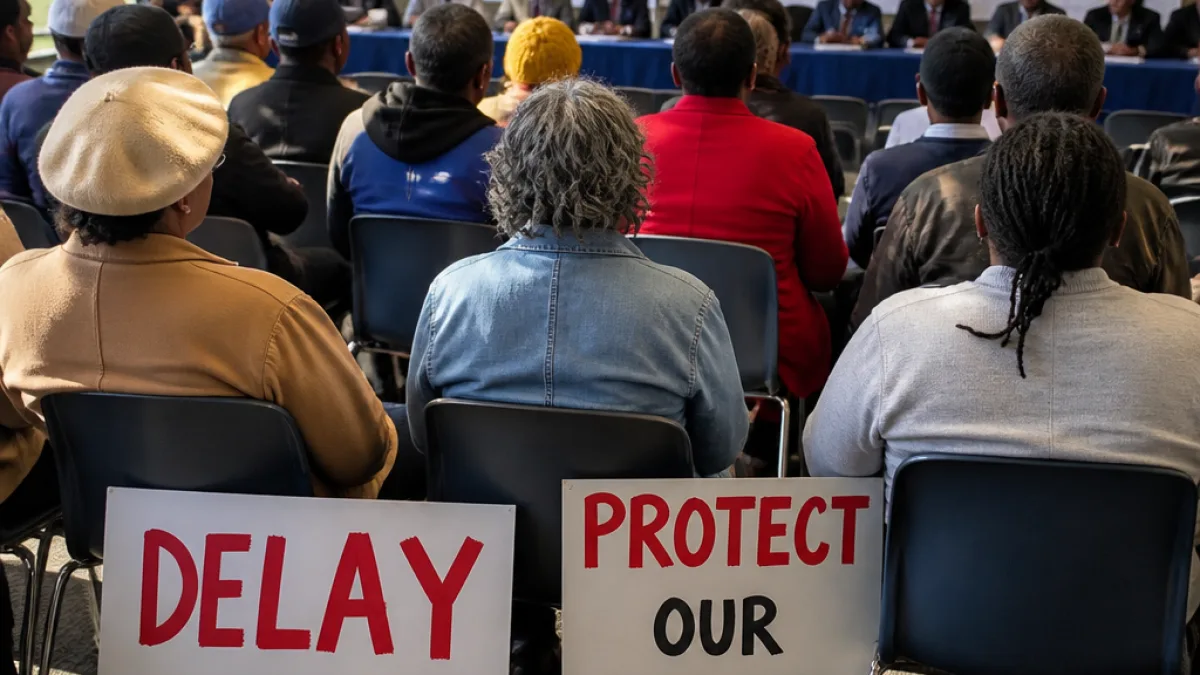
More than 100 people — most of them Black — packed a conference room at Itawamba Community College in Belden on Aug. 18 to press state lawmakers to delay any redistricting until after the 2030 census.
The gathering was the first in a series of public hearings the joint legislative redistricting committee plans to hold statewide as it fleshes out possible new maps. Nine of the 20 committee members sat across from attendees to collect public comment.
Concerns about representation and timing
Speakers at the Tupelo meeting repeatedly warned that moving forward now would risk diluting Black voting power and reverse gains made in recent years. Most of those who testified urged members of the committee to pause the process until after the next decennial census, arguing that doing so would produce fairer maps and protect minority representation.
Walter Jones, who moved to Mississippi from Chicago a few years ago, told lawmakers he decided to relocate because the state had changed for the better — and he feared new maps could send Mississippi back in the wrong direction.
"Mississippi had a bad rap of how people were mistreated all these years," Jones said. "I came down here because things had changed. Mississippi was becoming a great place to stay."
Jones warned that redrawing districts in a way that removes Black representatives from their communities would undo hard-won progress. "If this is what y'all want to do to Mississippi, after all the hurt and struggles we've dealt with to get to where we are today, then I made a bad decision," he said.
Legal and political context
Several speakers referenced ongoing legal and political pressures that have prompted Republican-led states to push for map changes. At least one local pastor, the Rev. Jeffery Gladney of Shannon, challenged the rationale for rushing to redraw boundaries now, pointing to the Callais case and arguing the state is not required to act immediately.
"There is nothing in the Callais case that says Mississippi has to redraw maps or redistrict in any way," the Rev. Jeffery Gladney said.
Some residents took a more pointed view of the hearings themselves, questioning whether the public process would meaningfully shape the committee’s decisions or if the sessions were largely performative. That skepticism reflects broader tensions in Mississippi and other states where redistricting has become heated and highly consequential.
Who showed up and what they asked for
The turnout in Belden demonstrated local interest and anxiety about the future of representation. About a dozen residents from the Tupelo area provided remarks during the session; several asked lawmakers to delay action until after 2030, while others warned of practical harms if Black voters were drawn out of existing districts.
- More than 100 people attended the Tupelo hearing at Itawamba Community College.
- Nine of the 20 joint redistricting committee members were present to collect public input.
- Most speakers urged lawmakers to postpone redistricting until after the 2030 census.
| Detail | From the hearing |
|---|---|
| Location | Itawamba Community College, Belden (near Tupelo) |
| Attendance | More than 100 people |
| Committee presence | Nine of 20 joint redistricting committee members |
What comes next
The Tupelo meeting marked the start of a statewide series intended to gather voter input on potential map changes. Lawmakers who serve on the joint committee will collect comments from hearings across Mississippi and are charged with translating that feedback into proposed maps.
While the committee’s timeline and next steps were not detailed at the hearing, the clear message from most speakers was a request for patience: allow the 2030 census to provide updated population data before undertaking a redrawing that could affect communities’ political power.
Concerns voiced in Belden mirrored worries heard in many parts of the state: that premature redistricting could disproportionately affect Black representation and undermine the progress some residents say Mississippi has recently made toward a more welcoming and inclusive reputation.
The redistricting process will continue with additional public hearings in other communities. Lawmakers on the joint committee will consider the testimony as they shape draft maps that could determine the political landscape for years to come.
Curtis Whitfield, State Correspondent

















