
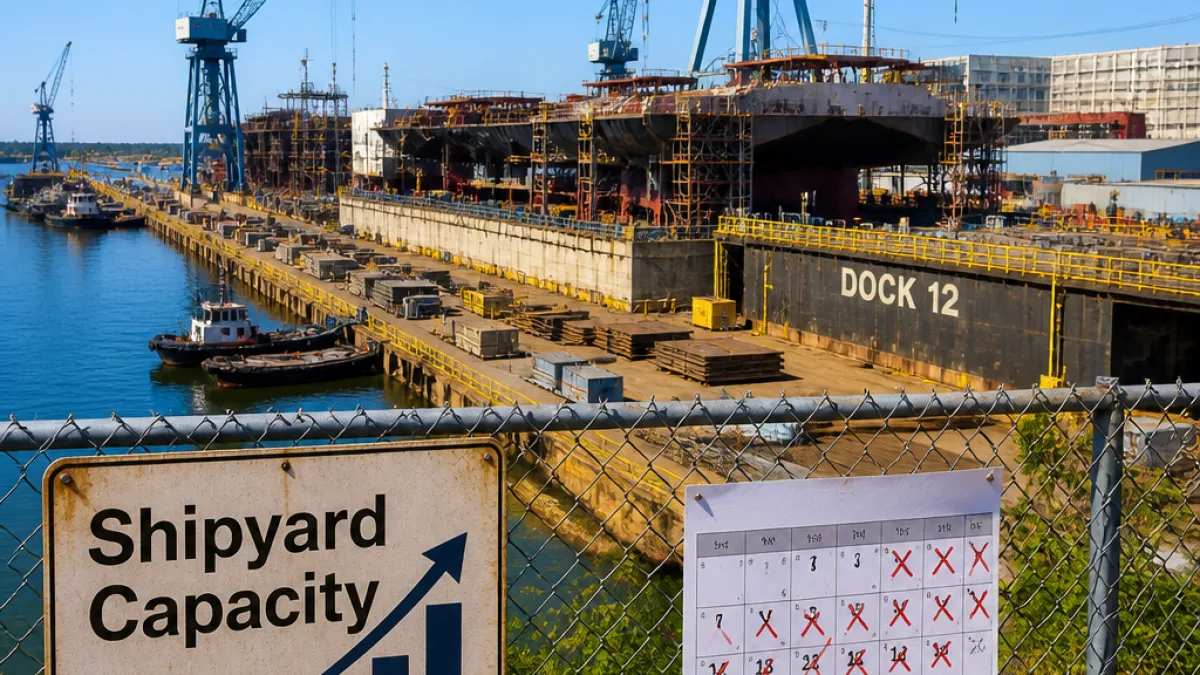
Capacity and cost concerns put spotlight on Newport News Shipbuilding
The Congressional Budget Office has raised major questions about the feasibility of the administration’s plan to build a new class of battleships, findings that place Newport News Shipbuilding at the center of a debate over capacity, schedule and cost that could reverberate across the local economy.
The CBO estimates the first ship in the proposed class would cost roughly $10 billion more than a Ford-class aircraft carrier and projects the program could require at least $275 billion overall. The analysis also suggests construction of the first vessel is unlikely to begin before 2028 and that the earliest possible launch could be in the late 2030s, significantly later than the administration’s public timeline.
Only Newport News Shipbuilding — a division of Huntington Ingalls Industries and the largest industrial employer in the region — currently has the facilities to construct nuclear-powered surface ships, the CBO noted. That capability narrows the field for where a battleship could be built, but it also highlights a logistical obstacle: Dock 12 at the Newport News yard is committed to constructing the next three Ford-class carriers, projects that are already behind schedule.
"Only Newport News Shipbuilding is set up to build nuclear-powered surface ships," the CBO report says.
Local implications: dock availability, workforce and timelines
The CBO analysis implies several near-term and long-term effects for Newport News. In the near term, Dock 12’s current commitments make it difficult to start battleship construction without altering carrier schedules or expanding industrial capacity. In the longer term, a multibillion-dollar program could reshape local supply chains and employment, but much depends on Congressional funding decisions and the Navy’s design choices.
- Dock capacity: Dock 12 is engaged for the next several years building Ford-class carriers.
- Design and technology: Proposed ships include weapons and propulsion systems not yet fully developed, increasing technical risk and cost uncertainty.
- Budget and timing: Design money appears in the administration’s proposed defense budget, but that budget remains stalled in Congress.
Costs, schedule and program scope
The CBO report contrasts sharply with the administration’s public schedule. While the White House has described an aggressive timeline — including delivery of the first two ships by the end of the president’s term — analysts say that, after standard design and build cycles, the first ship might not reach the water until 2037 to 2039. The agency also forecasts per-ship costs falling after the lead vessel but still averaging at least $18 billion each, with the full program of 15 ships totaling around $275 billion.
| Item | CBO Estimate / Note |
|---|---|
| First-ship additional cost vs. Ford-class | $10 billion more than a Ford-class carrier |
| Per-ship cost (long run) | At least $18 billion |
| Program total (15 ships) | About $275 billion |
| Earliest possible launch | 2037–2039 (per analysts) |
The CBO also notes design complexity is high: the ships are proposed to be nuclear-powered and equipped with systems such as rail guns that remain under development. Those unknowns raise the likelihood of overrun and delay, according to the analysis.
Political and industrial context
The battleship proposal has encountered mixed support. Design funding appears in the administration’s proposed $1.5 trillion defense budget, but that proposal is stalled in Congress. The Navy has previously stated the new ships would be nuclear-powered, a capability that restricts construction to yards with nuclear infrastructure — primarily Newport News.
Huntington Ingalls Industries, which owns Newport News Shipbuilding, is expected to be a central player if the program proceeds. The company also faces potential competition to help with design work. The political dynamics shifted in April when the administration fired the Navy secretary who had been an early proponent of the plan, a development the CBO says further complicates the program.
For Newport News, the debate is not merely theoretical. The shipyard’s schedule already affects local suppliers, contractors and workforce planning. Any shift to accommodate a new class of surface combatants would require difficult trade-offs on timing, investment and workforce allocation.
With Congressional action unresolved and technical hurdles to overcome, the path from announcement to keel-laying for the proposed battleships remains uncertain. For now, Newport News Shipbuilding sits at the intersection of a high-profile national initiative and the practical limits of existing shipyard capacity.
















