Artist-in-residence blends craft revival with family history in Newport News
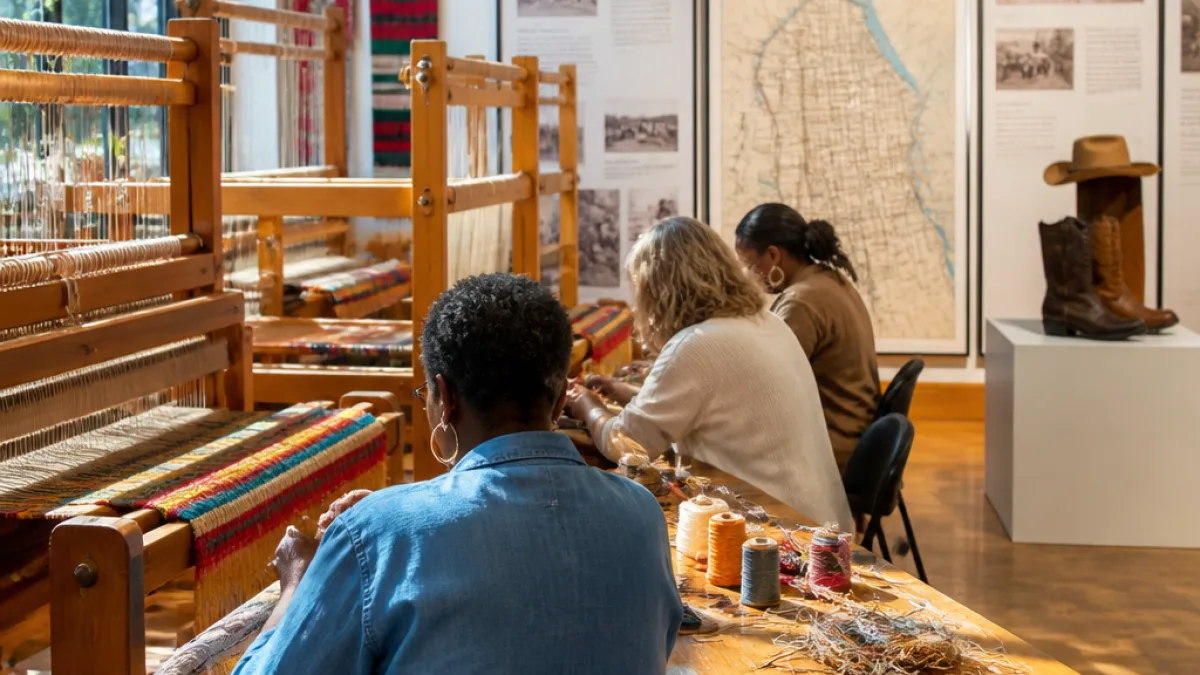
NEWPORT NEWS, Va. — A new artist-in-residence position at the Downing-Gross Cultural Arts Center has become a nexus for arts education, community engagement and the rediscovery of local Black history. Hampton Roads-based artist Christopher Diont’e returned to his home region and stepped into the center’s first-ever residency as the institution looks to revive its fiber arts program.
City arts officials and program leaders said the residency was shaped to be mutually beneficial: a way to rebuild a program for residents while providing studio space and public exposure for an emerging local artist. Cindy Johnson, Newport News Parks and Recreation program supervisor, said organizers crafted the position so it could serve the institution, the city and the artist.
Diont’e framed his time at Downing-Gross as a “full circle” moment. The center sits down the street from his grandmother’s home, and he recalled the moment his grandmother photographed the billboard announcing him as the first artist-in-residence. That personal connection is central to the residency’s public-facing work, which blends workshops, exhibitions and storytelling anchored in fiber arts traditions.
“In those conversations I was having with my grandmother who stays still down the street, saw me down there on the billboard down there, where my face was as the first artist-in-residence, took a picture of that, was like, ‘these are the conversations we used to have,’”
The residency’s content grew from Diont’e’s broader investigations into identity and place. For years he said he felt an inexplicable draw to rural life and work with horses and cattle. That curiosity led him to research the history of African American cowboys and ultimately to his own family history in Virginia.
While tracing the presence of men of color who worked as cowboys in Virginia, Diont’e discovered the surname Callis — his family’s name — and a story that connects his present work with a post-Civil War landholding. According to Diont’e, his third great-grandfather, Ira Callis, and his brother Ruffin were enslaved in Louisiana for nearly three decades. Their enslaver was killed during the Civil War, and the brothers were promised an inheritance. They marched for 10 days from Louisiana to Virginia and purchased 1,500 acres they named Freeman, Virginia. The land remained in the family, and Diont’e now owns a portion of it.
That discovery has shaped Diont’e’s artistic themes and community programming at Downing-Gross, where the fiber arts revival is now linked with conversations about labor, land and lineage. The artist’s work and the center’s renewed offerings aim to engage residents across generations, creating pathways for young people to see art as a form of cultural memory and civic participation.
Local impact and next steps
Program leaders said the residency is intended to strengthen the center’s role as a neighborhood arts anchor. By reintroducing fiber arts — a discipline with deep craft traditions and practical applications — Downing-Gross hopes to expand class offerings, host collaborative projects and attract visitors to its galleries.
- Revival of the fiber arts program at Downing-Gross
- Community workshops and public exhibition opportunities
- Local history and genealogical connections informing artistic work
The residency also underscores broader conversations about representation in the arts. Highlighting Black cowboy history and multigenerational land ownership challenges narrow narratives about who participates in rural and agricultural traditions. For Newport News, those stories have local resonance: they link contemporary arts programming with the lived histories of families who have long called the region home.
As the Downing-Gross Cultural Arts Center moves forward with the program, organizers and participants will monitor how renewed offerings affect public participation and youth engagement. For residents who pass the center on their way to other errands or who remember it from earlier community programs, Diont’e’s work brings both continuity and new perspectives to a familiar local institution.
| Artist | Institution | Program focus |
|---|---|---|
| Christopher Diont’e | Downing-Gross Cultural Arts Center | Fiber arts revival, exhibition, community workshops |
The residency represents a practical investment in arts infrastructure and a symbolic return for an artist whose work traces family history back to land purchased after the Civil War. For many in Newport News, that blend of cultural practice and historical reclamation offers a tangible example of how local institutions can support artists while deepening community ties.