
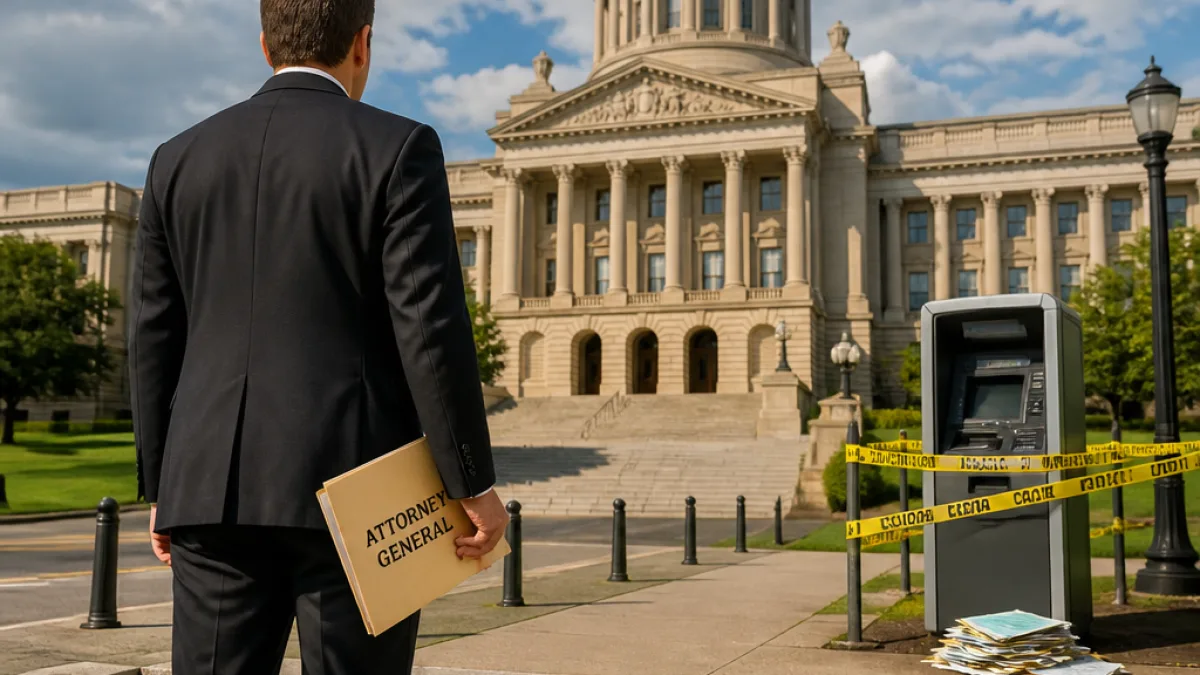
FRANKFORT, Ky. — Kentucky Attorney General Russell Coleman announced Wednesday that he has joined a 15-state coalition urging Congress to pass the Safe Access to Cash Act, legislation designed to expand federal protections for automated teller machines located away from bank branches.
What the legislation would change
The Safe Access to Cash Act seeks to update the Federal Bank Robbery Act of 1934 so that criminal acts targeting ATMs at convenience stores, gas stations, grocery stores and other public locations could be prosecuted under federal law. Supporters say the update would close an existing gap: federal penalties traditionally apply to robberies of banks and other financial institutions but do not uniformly cover off-premises ATMs.
"Safe and reliable access to cash is essential for millions of Americans and our laws should reflect the modernization of our society," Coleman said.
State and national banking representatives say the measure would create consistent legal tools for prosecutors when ATM crimes involve interstate conduct or organized criminal networks, or when repeated attacks span multiple jurisdictions.
Why Kentucky officials back the bill
In his announcement, Coleman framed the measure as an effort to give law enforcement additional authority to target criminals who prey on ATMs outside bank branches. The attorney general’s office said the legislation would allow federal prosecution of theft, destruction and other crimes that affect ATMs in public locations.
Tim Schenk, president and CEO of the Kentucky Bankers Association, also voiced support, noting the variety of ways ATMs can be targeted. "ATMs provide Kentucky’s communities with convenient access to cash and banking services," Schenk said. He cited both physical theft and technological attacks — such as jackpotting — as ongoing threats to ATM security and consumer safety.
Practical effects and prosecutorial reach
Under current federal statutes, prosecutors have robust penalties for robbery of banks and other financial institutions. The Safe Access to Cash Act would extend comparable federal protections to off-site ATMs by doing the following:
- Allowing federal charges for theft, destruction or interference with ATMs located away from bank branches.
- Ensuring crimes that involve interstate elements, organized criminal networks or serial attacks across jurisdictions can be pursued at the federal level.
- Closing a purported loophole for robbing someone who is using an ATM.
Proponents argue that this uniformity would make ATMs less attractive targets and help protect individuals using machines in community settings.
Legislative status and context
The bill has already cleared a congressional committee in a measured but bipartisan step forward: the Senate Judiciary Committee unanimously passed the measure earlier this year. Supporters say that committee approval signals momentum, but the bill must still receive votes in both chambers and be signed by the president to become law.
| Provision | What it does |
|---|---|
| Federal coverage for off-site ATMs | Makes theft/destruction of ATMs in public settings prosecutable under federal law |
| Interstate/organized crime reach | Clarifies federal jurisdiction when crimes cross state lines or involve networks |
| Protection for ATM users | Extends penalties for robbing a person using an ATM |
Local perspective and next steps
For Kentucky residents who rely on ATMs in small towns or at retail locations, the change could mean federal resources become available to investigate and prosecute cases that now may be handled only at the state or local level. Law enforcement agencies and banking officials have argued such a shift could aid in deterring both opportunistic and organized attacks.
Moving forward, Kentucky’s attorney general and allied states will press congressional leaders to move the bill through the House and Senate floors. If enacted, courts and prosecutors would then implement the new standards in federal cases involving ATM-related offenses.
As the measure advances, officials in Kentucky say they will continue coordinating with banks and local law enforcement to monitor ATM security and to inform the public about safer practices when using cash machines.
This report will be updated as lawmakers in Washington take further action on the Safe Access to Cash Act.

















