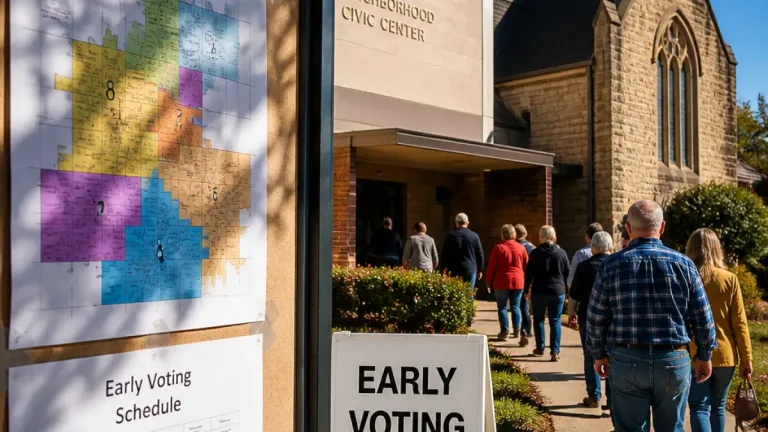
JACKSON — A federal judge has refused a rapid legal bid to dismantle majority-Black judicial districts in northern Mississippi’s DeSoto County, keeping in place the only district the Legal Defense Fund says gives Black voters a meaningful opportunity to elect judges of their choice.
Court cites timing and lack of evidence
U.S. District Judge Sharion Aycock wrote that plaintiffs had not shown sufficient grounds for the court to intervene so close to an upcoming election, a decision that preserves the current judicial district lines for the time being. The order came after a lawsuit filed by Robert Foster, a DeSoto County supervisor and former Republican gubernatorial candidate, sought to strike down majority-Black districts created when the state legislature added judicial seats.
Foster and other local plaintiffs said the new configuration violated the Voting Rights Act. The filings followed the U.S. Supreme Court’s decision in Louisiana v. Callais, a ruling plaintiffs pointed to as changing the legal landscape for race-conscious districting. Still, Aycock said the plaintiffs had not provided the level of evidence needed to justify immediate judicial relief.
"The Plaintiffs have not provided sufficient evidence to justify this Court's involvement," Aycock wrote.
Advocates say ruling preserves voter opportunity
Civil rights advocates welcomed the decision. Ming Cheung, senior staff attorney with the ACLU’s Voting Rights Project, said the order protects DeSoto County voters from "this unfounded, last-minute attempt to take away their only meaningful opportunity to participate in judicial elections." The Legal Defense Fund also said the judge’s move protects what it described as the county’s only district enabling Black voters to elect candidates of their choice.
DeSoto County, located on Mississippi’s northwestern border, is the state’s third-most populous county and was carried by President Donald Trump in 2024 with more than 60 percent of the vote — figures frequently cited in filings about the county’s political dynamics.
| Statistic | Reported figure |
|---|---|
| County population rank in Mississippi | Third-most populous |
| 2024 presidential vote (Trump) | More than 60% |
What the challenge sought and timing concerns
Foster’s lawsuit sought to invalidate recently drawn judicial districts after the state legislature allocated an additional circuit judge and chancery judge to DeSoto County. Plaintiffs argued those changes diluted voting power. Defendants, including voting rights groups, countered that altering lines so close to an election would disenfranchise voters and disrupt an electoral process already underway.
Judge Aycock’s ruling emphasized the practical consequences of mid-election changes. The court cited Supreme Court precedent in explaining why it was reluctant to upend districting on the eve of local contests without stronger evidentiary support from the plaintiffs.
- Preserves the district described by advocates as the only one giving Black voters a meaningful voice in judicial elections.
- Averts last-minute changes that could confuse or disenfranchise voters ahead of November ballots.
- Leaves open the possibility of further litigation on the merits, depending on new evidence or appellate action.
Broader legal context and next steps
The case arrives in the shadow of the Supreme Court’s decision in Louisiana v. Callais, which has prompted renewed challenges and debate over the scope of the Voting Rights Act. Civil rights groups say lower courts must carefully protect minority voters’ opportunities even as high-court rulings reshape legal tests.
For now, DeSoto County voters will head into judicial elections with the contested districts intact. The judge’s order does not resolve the larger legal questions raised by the lawsuit; it simply declined a request for immediate, short-term relief. Further proceedings or appeals could revisit the claims if plaintiffs present additional evidence or if appellate courts weigh in.
The decision underscores the tension between judicial finality and the need to ensure fair electoral opportunity for minority communities — a dispute likely to resurface across Mississippi and other Southern states following recent Supreme Court rulings.
Legal advocacy groups said they will continue to monitor the situation and stand ready to defend voting rights in the county. Local officials and candidates now must operate under the existing district map as campaigns proceed toward the ballot box.