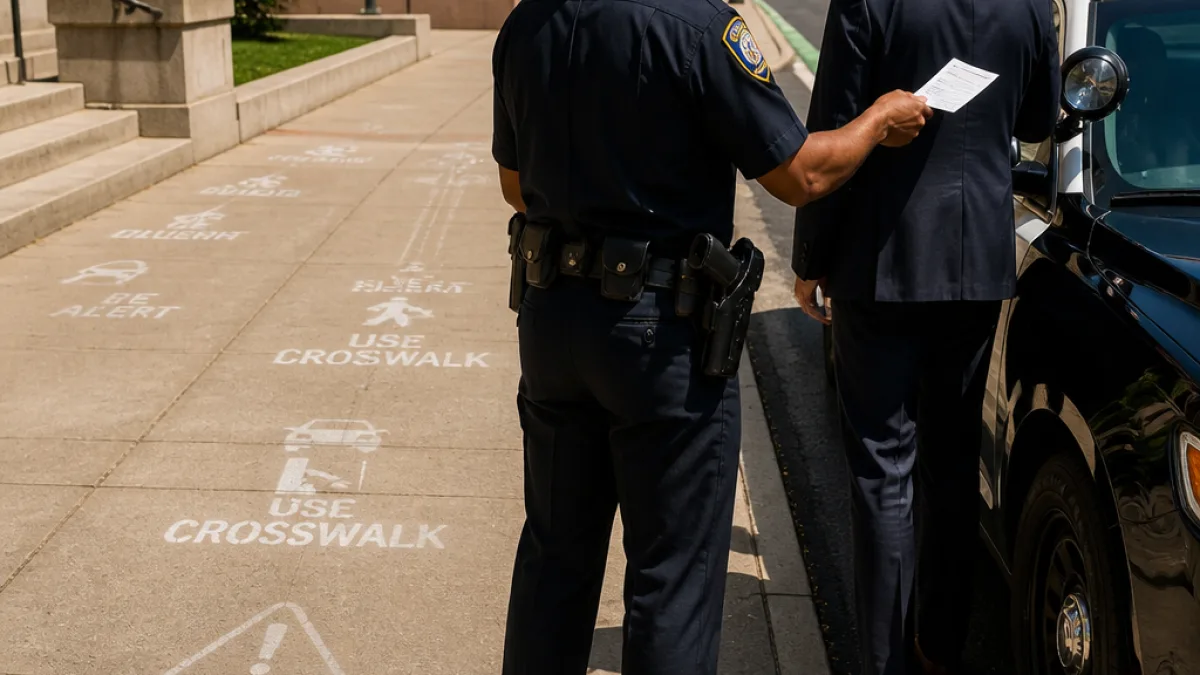
Hartford Mayor Arunan Arulampalam said Wednesday he has directed the Hartford Police Department to issue a citation to the law firm Trantolo & Trantolo after the company placed markings on city sidewalks without city authorization.
Mayor: unauthorized markings are equivalent to graffiti
In a social media statement, Arulampalam said the firm "sprayed advertisements on city sidewalks around Hartford" the previous day and that the action violated city rules governing advertising on public property. He said the firm should be treated the same as any resident who defaces public property.
"If a young person did this in the City of Hartford, we would call it graffiti, and I don't believe that a law firm should be treated any differently," the mayor said.
The mayor's statement reflects a straightforward enforcement stance: city officials view unsanctioned markings on sidewalks as actionable, regardless of the actor or intent.
Firm says campaign focused on road safety, used temporary methods
Trantolo & Trantolo responded Wednesday, saying the sidewalk markings were part of a campaign intended to draw attention to traffic and pedestrian safety issues in Hartford and across Connecticut. The firm said it worked with an outdoor-advertising company to place temporary stencils in Hartford and neighboring West Hartford that featured local and statewide traffic-safety statistics.
The firm asserted the stencils were applied using either power washing or temporary chalk rather than spray paint, and said remaining chalk markings were removed earlier than planned after city concerns were raised. Scott Trantolo, chief executive officer of Trantolo & Trantolo, described the goal as raising awareness about "the very real safety challenges facing pedestrians, motorcyclists, drivers and families throughout our community."
Timeline and methods
- Day 1: Trantolo & Trantolo places stencils on sidewalks in Hartford and West Hartford.
- Day 2: Mayor Arulampalam announces he has directed police to cite the firm for unauthorized advertising.
- After notice: The firm says it accelerated removal of remaining chalk markings.
The differing characterizations — the mayor calling the markings "graffiti" and the firm describing them as temporary chalk or power-wash stencils — underscore a common municipal tension: how to balance civic messaging and safety advocacy against regulations protecting public property and maintaining uniform signage and street treatment.
| Actor | Claim | Action taken |
|---|---|---|
| Mayor Arunan Arulampalam | Markings were unauthorized ads, akin to graffiti | Directed police to cite the firm |
| Trantolo & Trantolo | Campaign intended to raise road-safety awareness; used temporary methods | Worked with outdoor-ad company; removed remaining markings early |
Local context and implications
Hartford maintains ordinances and regulations governing the use of public property for advertising and other markings. City officials have long emphasized preserving public infrastructure and ensuring that signage and pavement markings meet safety and maintenance standards. Unauthorized markings can complicate municipal maintenance schedules and create equity concerns if private entities use public space for promotional or advocacy purposes without permits.
For residents, the episode raises practical questions: who decides what messages may appear on city sidewalks, how temporary interventions should be treated by public works crews, and whether exceptions for safety-focused campaigns should be considered under a permit process. City enforcement of existing codes, as demonstrated in the mayor's directive, signals that private groups will be held to the same standards as individuals.
The law firm's stated focus on pedestrian and roadway safety dovetails with broader public discussions about traffic enforcement, pedestrian infrastructure and outreach in Hartford. Whether the incident prompts policy adjustments for community outreach, a clarification of permitting processes for temporary stencils or stricter enforcement remains to be seen.
Officials from the Hartford Police Department and representatives of Trantolo & Trantolo did not provide additional comment beyond the statements released Wednesday.