
RALEIGH — A new poll by Elon University indicates most registered voters in North Carolina believe next year’s election will be fair, but the survey also found sizable pockets of concern about voter fraud and foreign interference that could shape political debate and public trust.
Overall confidence, but persistent worries
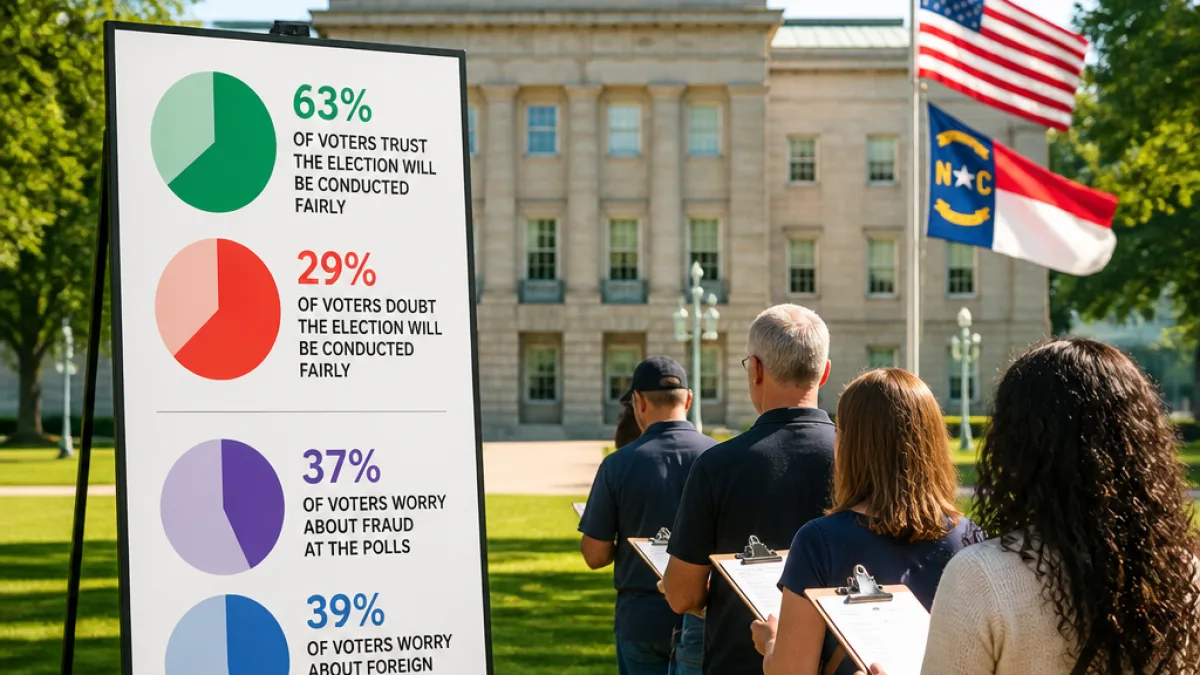
The poll of 800 registered voters conducted last month found that 63% said they were either "very" or "somewhat" confident the upcoming election would be fair. Nearly three in 10 respondents — 29% — said they were "only a little" or "not at all" confident in the process.
Voter enthusiasm was strong on its face: 63% of respondents said they were "absolutely certain" they would vote, and another 20% said they were "very likely" to cast a ballot.
Concerns about fraud and foreign influence
Despite broad confidence in fairness, more than a third of respondents expressed significant concern about the integrity of the system. On the question of voter fraud, 37% of those surveyed called it a "major problem," while 30% described it as a minor problem and 24% said it was "not a problem at all."
Concerns were slightly higher about outside interference: 39% of respondents said foreign-government interference was a "major problem," 35% called it minor and 10% said it was not a problem.
- Sample size: 800 registered voters
- Confidence election will be fair: 63% very/somewhat confident
- Certain to vote: 63% absolutely certain; 20% very likely
- See voter fraud as major: 37%
- See foreign interference as major: 39%
Context: national rhetoric and legal fights
Pollsters and election officials say that anxiety about fraud and foreign interference is not confined to North Carolina and is shaped in part by national rhetoric. The survey comes as President Donald Trump continues to make claims about widespread voter fraud and noncitizen voting and after his administration issued an executive order seeking changes to mail-in voting operations.
The administration’s order prompted lawsuits in more than 20 states, including North Carolina, and a federal judge has since blocked parts of the directive. Those legal fights, along with high-profile statements from national leaders, appear to have left an imprint on voter perceptions in the state, the poll suggests.
State controversies amplify scrutiny
Local developments also contributed to the environment in which the poll was taken. Election officials in North Carolina have been managing the fallout from a personnel controversy involving former GOP operative Dallas Woodhouse, who was hired last year for a role tied to the State Auditor's Office. Leaked texts suggested Woodhouse had urged county election board members to scale back Sunday voting and on-campus polling sites. He has since resigned, according to the poll summary.
Those events, election experts say, can erode confidence for some voters even when evidence of large-scale fraud is lacking. Multiple studies and post-election reviews have consistently found voter fraud to be exceedingly rare both nationally and in North Carolina, a fact not disputed by the poll’s raw numbers but relevant for understanding the public’s concerns.
Why perceptions matter
Public perceptions of election integrity carry practical implications: they can influence turnout, the willingness of voters to accept results, and the pressure legislators and state officials face to alter election procedures. Even if the majority of voters express confidence, the sizable minorities who doubt the system may drive policy debates at the General Assembly or in county election boards.
Officials across North Carolina — from county boards of elections to the State Board of Elections — will be watching these attitudes closely in the months ahead, particularly as campaigns intensify, administrative decisions about voting operations are made, and litigation continues over federal directives.
Poll details
The Elon University poll surveyed 800 registered voters last month. It measured confidence in the election process, intent to vote and concerns about voter fraud and foreign interference. The summary notes the broader national and state-level developments that may have shaped respondents’ views.
| Topic | Percent |
|---|---|
| Very/somewhat confident election will be fair | 63% |
| Absolutely certain to vote | 63% |
| See voter fraud as a major problem | 37% |
| See foreign interference as a major problem | 39% |
As campaigns unfold and state officials make decisions governing elections, these attitudes will help frame both policy discussions and turnout patterns across North Carolina.
















