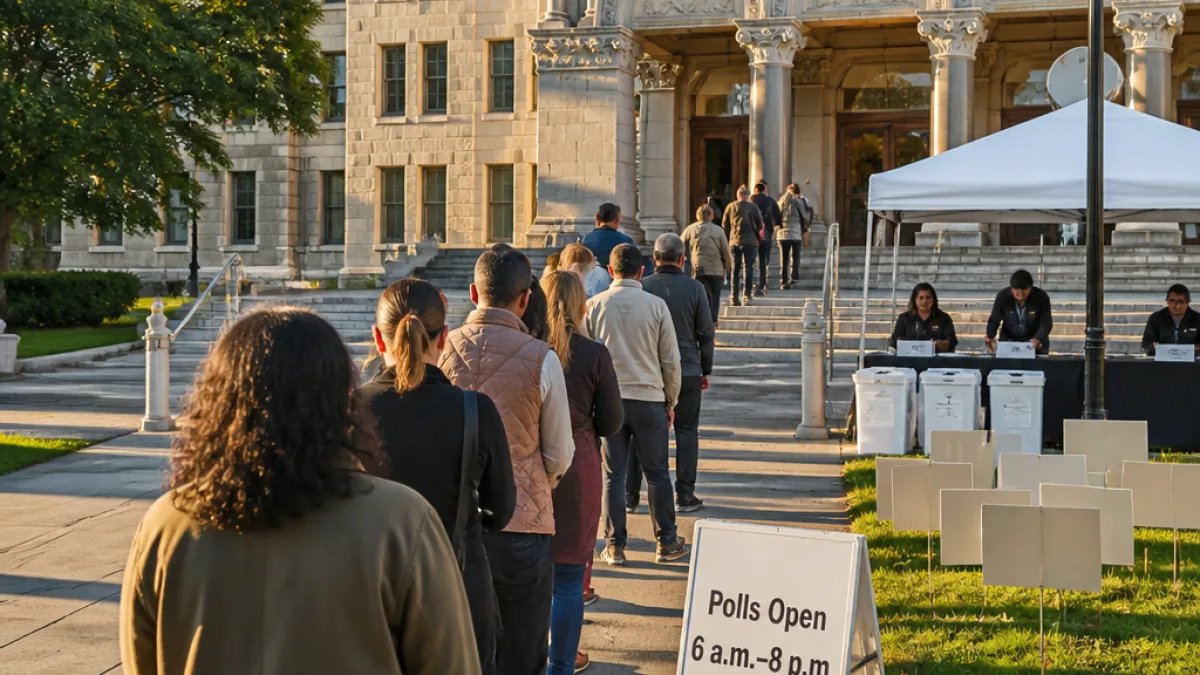
Connecticut Democrats are expected at the polls Tuesday for two consequential primary fights: a rare intra-party challenge to an incumbent governor and a crowded contest in the state's 1st Congressional District that could determine the region's next representative.
When and where to vote
Polls across the state will be open from 6 a.m. to 8 p.m.. Voters who are in line at 8 p.m. will be permitted to cast ballots. About 789,985 registered Democrats were recorded as active on the rolls going into the final day of the primary cycle; roughly 8% of those had already voted either by absentee ballot or during the seven days of early in-person voting that ended Sunday.
Governorship: Lamont vs. Elliott
The only statewide primary pits incumbent Gov. Ned Lamont against challenger Josh Elliott. Public polling ahead of the primary has shown Lamont with a substantial lead among likely voters, but Elliott mounted an aggressive late advertising push aimed at testing the depth of Lamont's support among Democrats.
The primary also has been costly. Campaign finance reports show Lamont, who has largely self-funded his campaign, has spent $9.2 million so far. Elliott’s campaign reported total spending of $3.98 million, bolstered by a $3.75 million public campaign grant.
| Candidate | Total reported spending | Spending, July 29–Aug. 4 | TV during that period |
|---|---|---|---|
| Ned Lamont | $9.2 million | $2.4 million | $1.55 million (65%) |
| Josh Elliott | $3.98 million | $956,000 | $700,000 (73%) |
Both campaigns ran a flurry of television advertising in the final reporting window, underscoring the competitive messaging battle despite Lamont’s polling advantage.
1st Congressional District primary draws attention
In the 1st Congressional District — which includes Hartford and 26 other communities — a four-way Democratic primary could decide a race that is widely viewed as tantamount to election. Republicans have not held the seat since 1956.
Longtime Rep. John B. Larson, a 14-term incumbent, is facing former Hartford Mayor Luke Bronin, who won the party endorsement at the convention, as well as Ruth Fortune and state Rep. Jillian Gilchrest. Bronin has the top line on the ballot by virtue of the endorsement; Larson appears on row D, with the remainder of the ballot ordered alphabetically.
Five of the 10 communities with the most early votes cast are located in the 1st District, reflecting intense voter contact and heavy spending on direct mail and advertising from the better-funded campaigns, particularly Bronin and Larson.
What the races mean locally
The gubernatorial primary represents an ideological test inside the Democratic Party over continuity versus change in statewide leadership. For the 1st Congressional District, the primary outcome will decide who has the advantage in a seat that Democrats have held for seven decades — making the primary effectively decisive in November’s general election.
- Polling hours: 6 a.m. to 8 p.m.
- Registered active Democrats: 789,985
- Early/absentee turnout before Election Day: ~8%
Voters seeking their polling locations can use the Connecticut state polling-place locator or their town clerk's office for details. Results from the primaries are expected to be reported throughout the evening as local registrars tally ballots and absentee returns are processed.
The winners of the Democratic primaries will advance to the general election on Nov. 3. For the governor’s race, the primary victor will face a Republican nominee this fall; in the 1st District, prevailing in the Democratic primary is widely seen as the principal hurdle to holding the seat in November.
As results come in, the contests will be watched closely for what they reveal about party dynamics in Connecticut heading into a pivotal fall campaign season.