
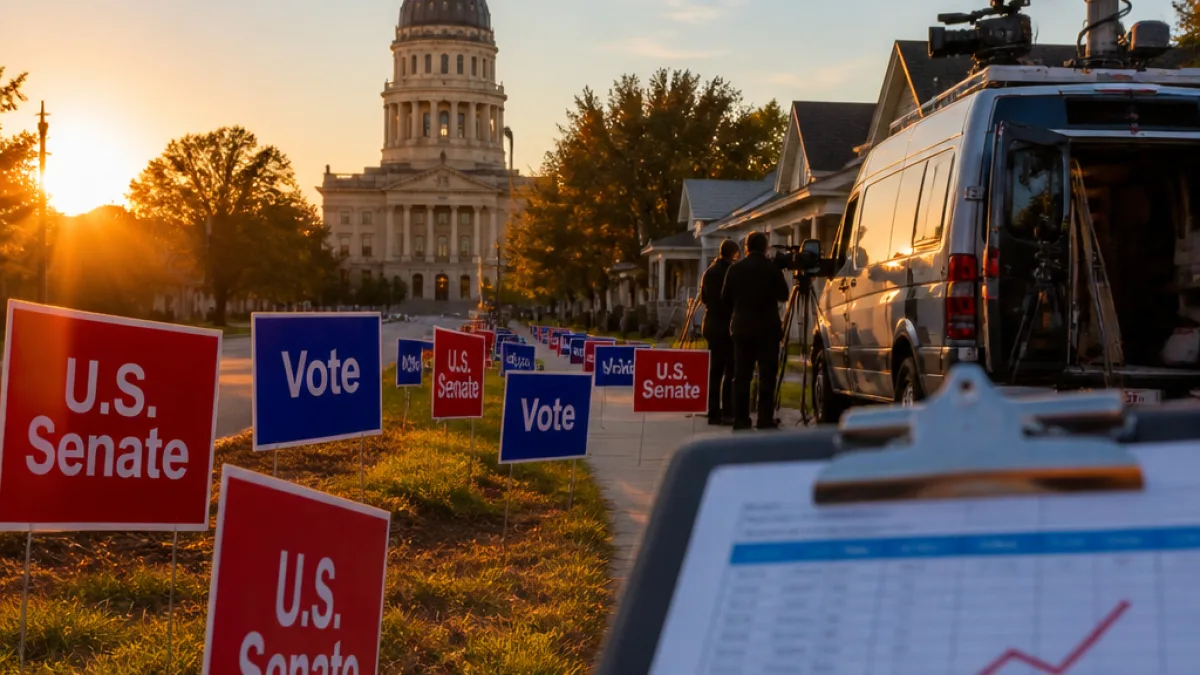
TOPEKA — New polling released this month suggests Kansas’ U.S. Senate contest is unexpectedly competitive, with Democrat Adam Hamilton closing ground on incumbent Republican Sen. Roger Marshall.
Polls show a close contest
Two surveys conducted for Democratic-aligned groups present Hamilton, a 62-year-old theologian who leads the state’s largest church and has authored numerous books, as within striking distance of Marshall.
A poll by GBAO, conducted for Hamilton’s campaign, finds the Democrat trailing by 4 percentage points. A separate survey, carried out by Public Policy Polling for Senate Majority PAC, places the candidates nearly even, with Marshall at 46% and Hamilton at 45%.
What the numbers mean
Those results are notable because they are the first publicly disclosed surveys in this race since April and arrive just after two respected political ratings organizations—Cook Political Report and Sabato’s Crystal Ball—shifted the contest from “Solid Republican” to “Likely Republican.”
Campaign-conducted and party-aligned polls warrant caution. Both new surveys were produced for Democratic groups, and internal polling typically reflects the priorities and resources of the campaigns that commission them. Political analysts say a fuller picture will require additional polling from independent or nonpartisan firms.
Historical context underscores the challenge
Even with encouraging numbers for Democrats, the historical record in Kansas is stark. The state has not elected a Democratic U.S. senator since 1932, a drought that is the longest current party gap for Senate seats in any state. Since 1950, Kansas’ Republican Senate winners have averaged a margin of victory of approximately 27 points, illustrating the longstanding Republican advantage.
That history helps explain why political observers are treating the new polls cautiously even as they acknowledge the implications of tightened numbers in a reliably red state.
Republicans respond as race tightens
There are signs that national GOP organizations are not taking Kansas for granted. As of late July, groups aligned with Republican interests were on pace to spend more in the Kansas Senate contest than in Texas, suggesting they view the race as worthy of national attention and resources.
That spending pattern could reflect multiple calculations, including unease about Republican prospects elsewhere. Still, it also signals that Republican strategists view the Marshall-Hamilton contest as more competitive than past Kansas Senate races.
What voters should watch next
Analysts say several developments will be key to tracking whether Hamilton’s apparent momentum is durable:
- Additional independent public polls from nonpartisan firms for comparison with campaign polling.
- Fundraising and ad-spend levels from both parties and outside groups.
- Voter turnout patterns in the state, particularly among suburban and rural constituencies.
| Poll | Commissioned by | Result |
|---|---|---|
| GBAO | Hamilton campaign | Hamilton down by 4 points |
| Public Policy Polling | Senate Majority PAC | Marshall 46%, Hamilton 45% |
Implications for the fall
For Democrats, Hamilton represents perhaps the most viable statewide pick in decades: a conservative-leaning state, a religious leader with name recognition, and internal polling that suggests the race could be competitive. For Republicans, preserving the seat held by Sen. Roger Marshall will likely require a coordinated national response if outside groups continue to see the race as vulnerable.
Political handicappers’ recent downgrades reflect a cautious recalibration rather than a final judgment. Kansas’ long Republican streak in Senate races makes a Democratic pickup an uphill climb, but the new figures make clear this cycle will draw national attention and resources.
— Wesley Carrington, State Correspondent
















