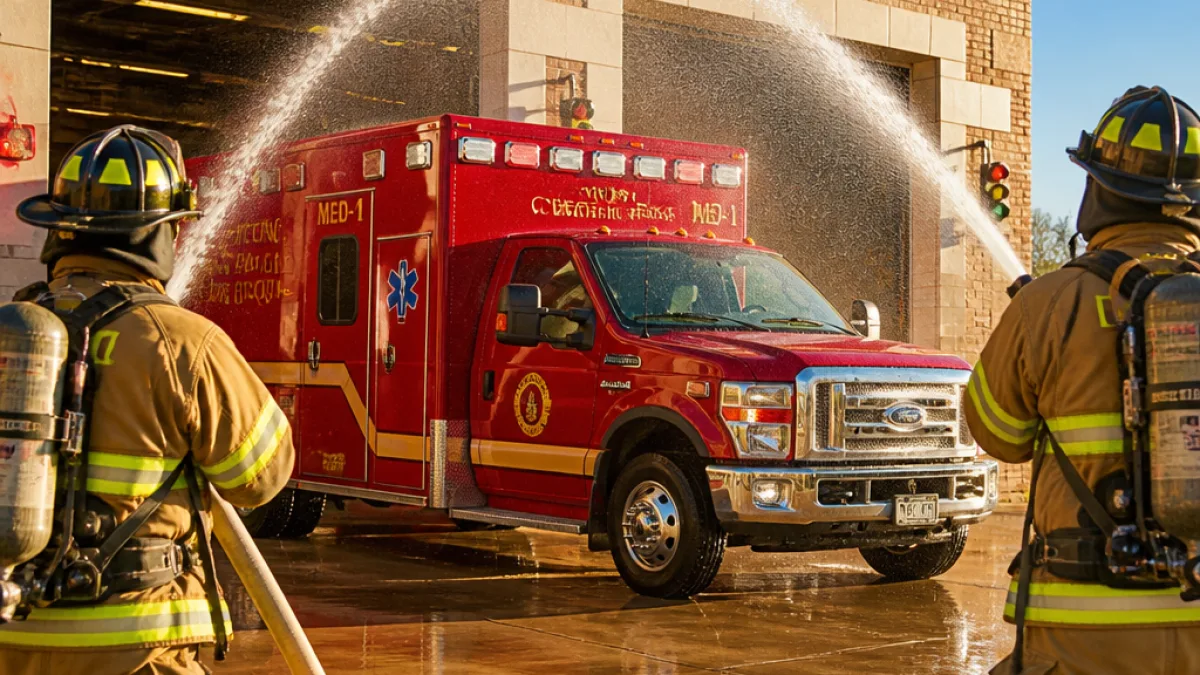
CHEYENNE, Wyo. — For the first time in its history, Cheyenne Fire Rescue has an ambulance of its own, a move city officials and emergency responders say will expand local patient transport capacity when the contracted provider is unavailable.
New ambulance adds surge capacity, not a replacement
The unit, identified as Med-1, was placed into service Tuesday, Sept. 1, during a ceremony at Fire Station 3 that included a traditional washdown and push-in. Department leaders emphasized the vehicle is designed to supplement — not supplant — AMR, Laramie County’s contracted ambulance service.
“This ambulance allows us to be able to respond in a surge capacity to assist our partner, EMS agency, AMR,” said Don Wood, Cheyenne Fire Rescue’s deputy chief of operations. The department has provided advanced life support for years but previously relied on AMR for patient transports.
“When AMR's otherwise tied up with other calls or transfers or something, this ambulance will be able to step in and provide transports to the hospital for patients in need.”
How the new arrangement will work
Under the new model, AMR remains the primary transport provider. When AMR units are busy on other calls or transfers, AMR dispatchers can release a call to Cheyenne Fire Rescue, allowing the fire department to transport the patient to a hospital. The change is intended to reduce delays in transport during busy periods without altering day-to-day operations.
AMR operations chief Cody Schilling explained the coordination: in situations where no AMR ambulance is available, CFR crews will respond and, if necessary, convey patients. “So, the system will work as Cheyenne Fire's ambulance will be going to medical calls,” he said, noting CFR will step in when AMR crews are occupied.
- Med-1: Cheyenne Fire Rescue’s first ambulance
- Primary role: Surge capacity and backup transport
- AMR relationship: AMR remains contracted provider; CFR provides advanced life support
Local context and consequences
The addition arrives against a backdrop in which many communities have faced ambulance shortages during simultaneous calls, transfers and staffing pressures. For Cheyenne residents, the new capability aims to shorten wait times for hospital transport in busy periods and provide a local backup when AMR resources are stretched.
Cheyenne Fire Rescue has staffed emergency medical responders for years, providing advanced life support on scene. Having an owned ambulance now means CFR can complete the chain from on-scene care to hospital transport when needed, potentially improving continuity for patients and easing strain on AMR during surge events.
Officials stopped short of providing detailed operational metrics during the ceremony, such as anticipated annual transports or staffing changes. However, the publicly stated goal is clear: add redundancy to the system to keep patients moving to definitive care without replacing the existing contracted service.
| Item | Detail |
|---|---|
| Ambulance designation | Med-1 |
| Primary function | Surge transport capacity |
| Primary ambulance contractor | AMR (continues as county contract provider) |
What residents should know
For the average Cheyenne resident, most medical calls will continue to be handled by AMR as the contracted transport provider. Cheyenne Fire Rescue’s new ambulance will be most visible when multiple calls occur simultaneously or when ongoing transfers tie up the county’s AMR fleet.
Officials said the new ambulance strengthens coordination between agencies and offers another safeguard against delays in patient transport. Those who wish to follow future developments or learn more about emergency response resources can look for updates from Cheyenne Fire Rescue and AMR as the program is implemented.
This operational shift follows years of collaboration between the fire department and AMR; CFR has provided advanced life support since 2005, while AMR has long been the county’s transport provider. The new ambulance represents a practical, incremental change intended to keep care moving during peak demand.