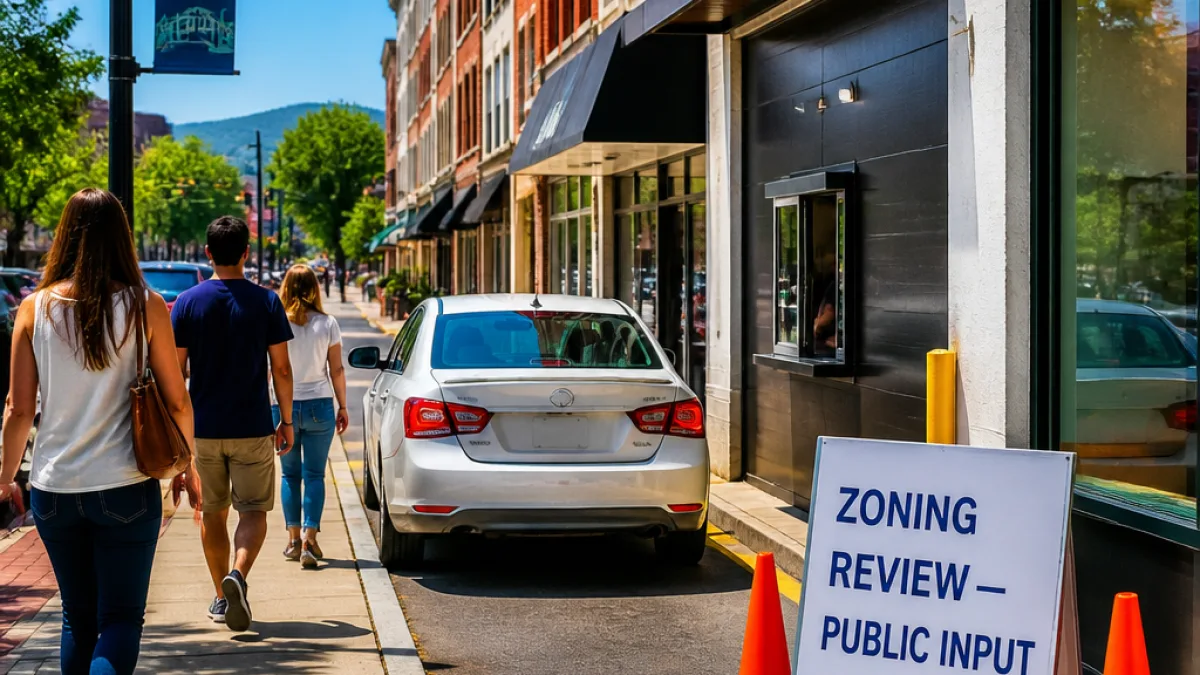
Planning commission moves to a case‑by‑case approach for drive‑throughs
CHATTANOOGA — Chattanooga and Hamilton County officials are again confronting a familiar planning tension: should the city continue to accommodate convenience‑oriented, car‑focused businesses like drive‑throughs along Broad Street, or should it steer development toward more walkable, mixed‑use forms that prioritize pedestrians?
The Chattanooga‑Hamilton County Regional Planning Commission on Monday approved changes that soften a 2024 zoning overhaul in some areas but maintain prohibitions in others. The decision restores the ability to have drive‑throughs as an accessory use in one commercial zoning district while keeping them prohibited in a neighboring commercial district that covers much of South Broad Street.
Commission interim chair Chris Anderson described the action as a compromise. He said the commission intends to weigh each new proposal on its own merits — taking into account traffic safety and impacts on nearby residents — rather than applying a blanket rule.
“What we passed on Monday was a compromise, and it it restored drive‑throughs as an accessory use in one commercial zone, but still prohibits it in another. And those two commercial zones are most of South Broad Street.”
The planning commission’s vote means standalone drive‑through businesses remain barred in the restricted zones, but drive‑through lanes could be allowed if they function as part of a broader business, such as a restaurant attached to a main building. The commission also signaled it will review the traffic and neighborhood impacts of proposed drive‑throughs before granting approvals.
Why Broad Street is central to the debate
Broad Street is a major arterial corridor that connects neighborhoods and commercial districts across Chattanooga. Planners and city leaders have been rethinking land use along such corridors since a 2024 zoning reform that sought to promote smaller lots and mixed‑use development. One visible consequence of the 2024 restrictions has been vacant former drive‑through sites, including an empty, deteriorating lot that once housed a Popeye’s restaurant.
Supporters of limiting new drive‑throughs argue that reducing auto‑oriented uses along major corridors can create safer, more attractive environments for walking, biking and transit, encouraging new housing and street‑level businesses. Opponents say drive‑throughs supply convenient services for motorists on heavily traveled roads and can be a legitimate part of commercial activity when designed to minimize negative impacts.
- Current status: Standalone drive‑throughs prohibited in much of South Broad Street.
- Change adopted: Drive‑throughs restored as an accessory use in one commercial zone; allowed on a case‑by‑case basis subject to traffic and neighborhood review.
- Ongoing concern: Vacant former drive‑through sites and how best to activate those parcels.
Local consequences and next steps
The commission’s compromise leaves several practical questions for city officials, property owners and developers. Property owners who own vacant former drive‑through sites will need to determine whether redevelopment proposals that include accessory drive‑through lanes can meet the commission’s traffic and neighborhood impact standards. For cities pursuing a long‑term shift toward walkable corridors, the decision also raises questions about how to incentivize redevelopment that fits mixed‑use goals while not leaving sites blighted.
Because approvals will now be evaluated individually, the planning commission and its staff will likely see more permit applications and traffic analyses tied to proposed drive‑throughs. That could extend review timelines but also offer neighbors a clearer avenue to raise concerns at public hearings.
| Issue | Commission stance |
|---|---|
| Standalone drive‑throughs | Prohibited in much of South Broad Street |
| Accessory drive‑throughs | Allowed in one commercial zone; case‑by‑case approvals |
| Review factors | Traffic safety and neighborhood impact |
For residents, the outcome will shape the feel and utility of Broad Street in the years ahead. The compromise aims to strike a balance between preserving corridor capacity for convenient services and advancing broader city goals for pedestrian‑oriented development. The planning commission’s action does not end the debate; it reallocates decision‑making to a parcel‑level review that will unfold in public forums as developers bring forward proposals.
As Chattanooga continues to reassess how its major corridors should function, the choices made about Broad Street will serve as a bellwether for future zoning decisions elsewhere in the city and county.