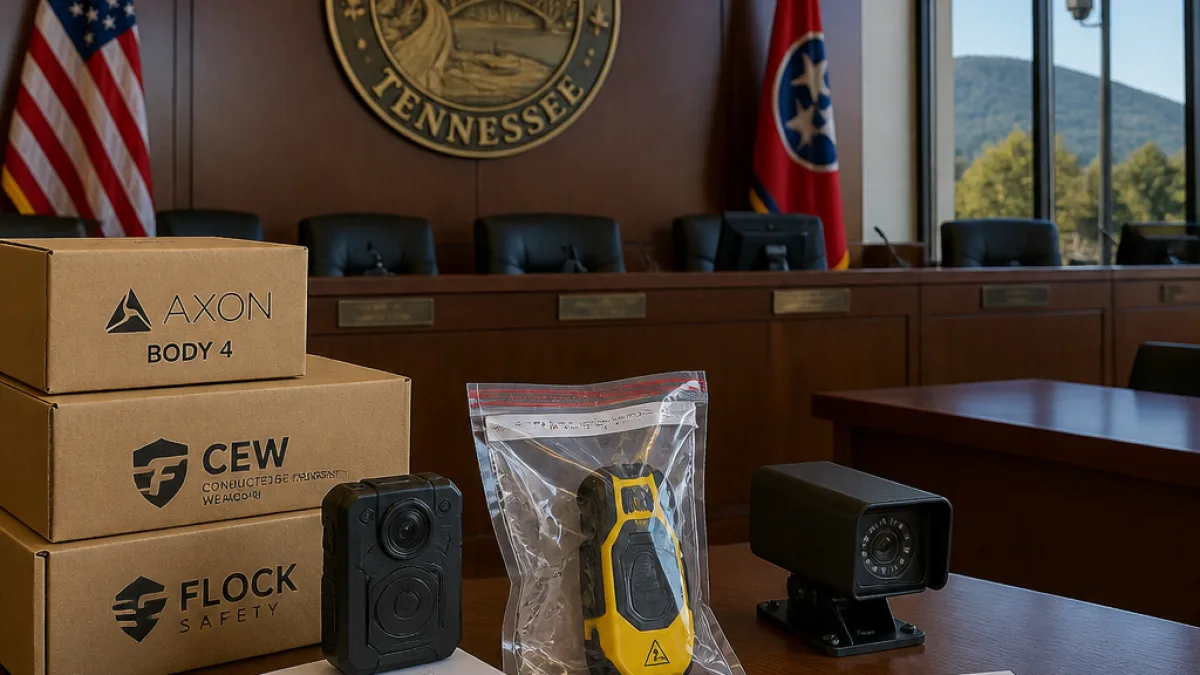
The Chattanooga City Council on Tuesday approved a five-year contract with Axon Enterprises, Inc. that will allow the Department of Technology Services to acquire equipment for the city’s public safety agencies — including body-worn cameras with artificial intelligence features and conducted-energy devices. Council members also added an amendment to ensure any deployment of Automated License Plate Readers (ALPRs) would require separate Council review and approval.
Contract details and council safeguards
The contract approved by the Council covers a range of hardware and services that the Chattanooga Police Department and Fire Department may obtain from Axon. Officials specifically mentioned:
- Body cameras with artificial intelligence capabilities that can translate conversations with people who do not speak English;
- Tasers (conducted-energy devices); and
- Up to 36 Automated License Plate Reader (ALPR) cameras — equipment Axon included as part of the sale, according to city officials.
City staff and several Council members stressed that the contract does not automatically authorize the city to install or operate ALPR units. Instead, the agreement sets a ceiling — the city could request any number of ALPR units up to 36 from Axon, but deployment would be contingent on a separate governance decision and policy review by the City Council.
“There was ‘no way’ the city would use or implement them without a change in governance or ALPR policy,”
At the meeting, Assistant Chief of Special Operations Rusty Morrison told the Council that the ALPR cameras were not requested by the Chattanooga Police Department, but were included by Axon as part of the vendor’s offering. City officials described the inclusion of the ALPRs as a “sales pitch” by Axon intended to showcase its technology.
Council action and voting
Before the main vote, District 6 Councilwoman Jenni Berz successfully moved to introduce an amendment specifying that any ALPR equipment and service would be subject to final review by the City Council prior to deployment. The amendment — which requires the Council to review the installation and service of ALPRs before they can be put into use — passed unanimously.
Following that amendment, the motion to approve the Axon contract passed with one dissenting vote. Cody Harvey of District 4 voted against the contract; the rest of the Council voted in favor.
Public safety perspectives and caution
During the discussion, opinions among Council members reflected a balance between using technology to aid policing and protecting community oversight and privacy. District 5 Councilman Dennis Clark said the technology could help reduce crime and be beneficial to his district, while Vice Chair Ron Elliott of District 9 warned against installing devices in his district without prior notice to him.
City officials emphasized that the Council and city staff have not yet decided to acquire ALPRs, and they do not plan to move forward without first understanding the specific capabilities of the Axon ALPR technology and establishing governing policies that would guide any use.
What Chattanooga residents should know
Key takeaways for residents:
- The Council approved a five-year contract with Axon that permits acquisition of body cameras, AI translation features, tasers and up to 36 ALPR units.
- Any decision to deploy ALPR cameras in Chattanooga requires a separate vote and an approved ALPR policy by the City Council.
- The amendment requiring Council review passed unanimously; the full contract passed with a single dissenting vote.
| Item | Status |
|---|---|
| Five-year contract with Axon | Approved by Council |
| ALPR units (up to 36) | Included in contract but require separate Council approval before deployment |
| Amendment requiring ALPR review | Passed unanimously |
The Council’s action preserves the city’s ability to modernize public safety tools while ensuring elected officials retain oversight over technologies that raise privacy and civil-liberties concerns. Council members indicated future meetings and policy discussions will be needed before the city moves to deploy any ALPR systems.