Visual performance aims to inspire a new generation of players
The American violinist and performer Lindsey Stirling brought her Duality tour to Blossom Music Center on Tuesday night in a pavilion-only concert that blended electronic violin, choreography and theatrical staging. The show — part concert, part Cirque du Soleil-style spectacle — drew a mixed audience that included parents with elementary and middle school children and groups of young orchestra players.
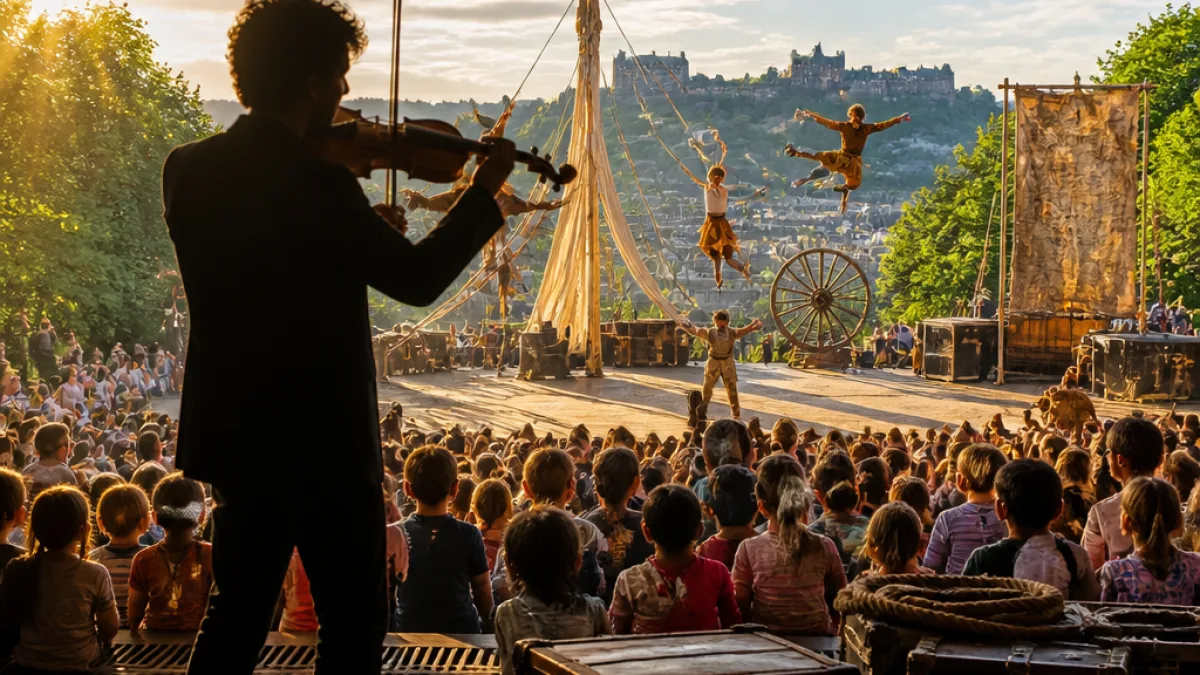
Stirling, the 39-year-old Utah native who rose to prominence after appearing on America’s Got Talent, is known less for classical virtuosity than for an energetic stage persona that pairs bowed violin with dance, acrobatics and elaborate visuals. Backed by a two-piece band augmented with backing tracks, four dancers and several props, she presented a sequence of set pieces that emphasised movement as much as sound.
- Audience makeup: several hundred elementary and middle school children attended with their parents.
- Performance elements: acrobatics, costume changes and a double-decker stage were featured.
- Set scope: the performance comprised around 18 songs or set pieces, each often framed as a short theatrical scene.
For many young people in the crowd the evening functioned as more than entertainment. Numerous pupils from local orchestras and string programmes watched intently as Stirling combined visible athleticism with her instrument. One reaction noted in reports was a recurring, almost tangible spark among budding musicians — a recognition that playing could be adventurous and performative as well as musical.
She said the show was about The Hero’s Journey—and also, that we’re all heroes in our own journey.
The show opened with an introductory film sequence and Stirling’s entrance on a raised, double-decker stage. She performed a mix of original material and arrangements, including a truncated take on Led Zeppelin’s “Kashmir”, and material from her fifth album Artemis. Numbers shifted rapidly between high-energy EDM-inflected beats and calmer interludes, with costume and staging changes marking each section.
Critics and reviewers have long noted Stirling’s particular knack for combining choreography with live playing. While she is not presented as a traditional classical soloist, her act is designed to appeal to a broad popular audience — drawing on visual theatre, dance and electronic pop production. Her online presence and published arrangements have also contributed to her profile: sources cite her substantial following on social media and a catalogue of published music arrangements for violin and piano.
For Stirling’s younger fans — many of whom were visibly present on Tuesday night — the concert offered a distinct message about possibility. The sight of a performer who can both move athletically and sustain her instrument’s part without obvious compromise resonated with parents and teachers who bring pupils to live music to broaden their horizons.
| Aspect | Detail |
|---|---|
| Performer age | 39 |
| Approximate number of set pieces | 18 |
| Notable audience group | Elementary and middle school children (several hundred) |
Locally, the concert illustrated how large touring productions can intersect with community arts education: by exposing young players to a different mode of presenting music, the event may encourage new forms of participation in local ensembles and schools. It also highlights a recurring trend on the live circuit in which popular-classical crossover acts programme visually driven shows to reach wider, family-oriented crowds.
While debate continues in musical circles about the balance between spectacle and musical substance, the evening at Blossom underlined Stirling’s central appeal: she offers an aspirational example for young musicians and a highly produced show for audiences seeking a combination of movement, theatre and sound.