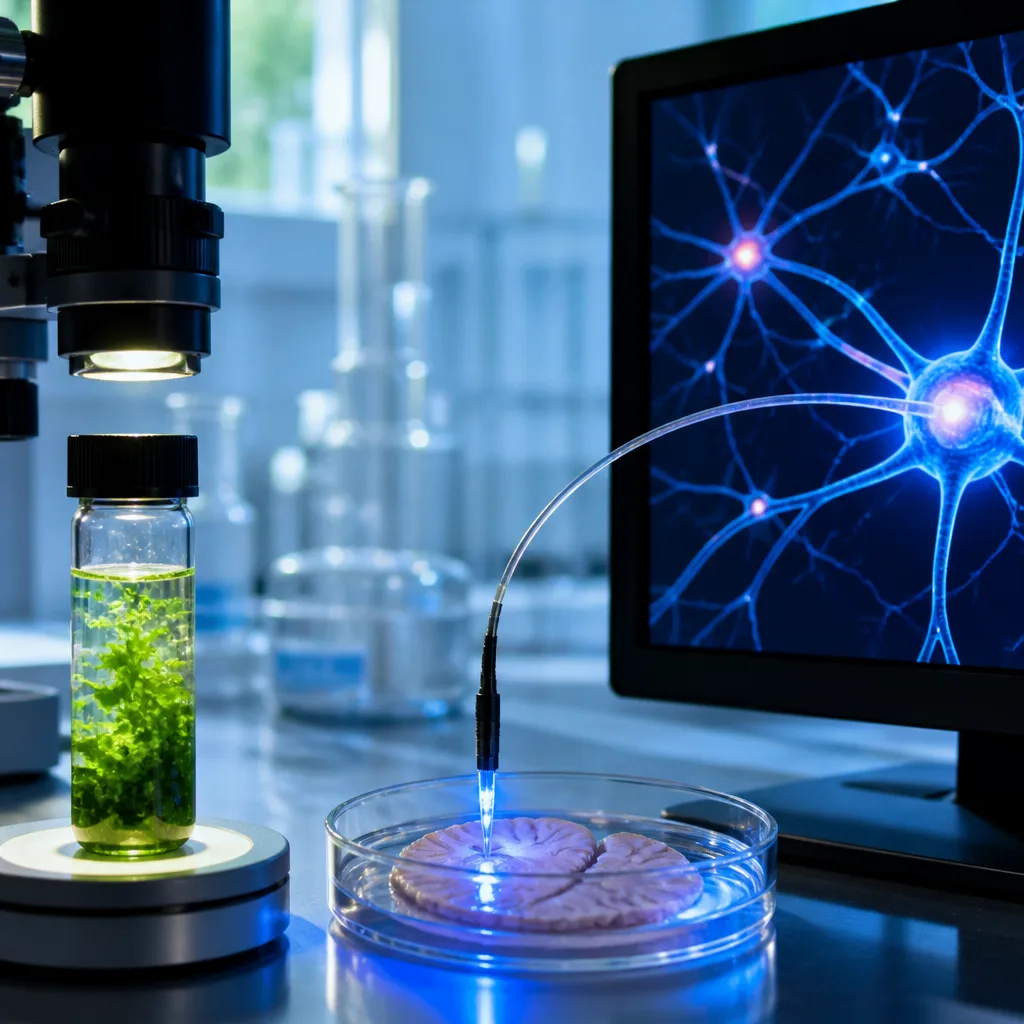
Karl Deisseroth, Peter Hegemann and Georg Nagel were awarded the 2026 Nobel Prize in Physiology or Medicine for the development of optogenetics — a set of techniques that uses light-gated proteins to control the activity of neurons in living tissue. The work, which began with studies of light-sensitive proteins in algae, has become a foundational tool in modern neuroscience.
From algae to brain circuits
The breakthrough at the heart of optogenetics is straightforward in concept and elegant in execution. Researchers identified a protein on the surface of certain algae that reacts when exposed to light. That same protein, when inserted into neurons, can be triggered by light to cause those cells to fire.
As described by commentator Luke O'Neill, the early experiments made the point plainly: light applied to a targeted brain region could cause specific behaviours. O'Neill recounted how researchers placed the protein in a mouse's motor cortex and, by shining light on that patch of brain, observed the animal's whiskers move — a direct demonstration that light-activated proteins can drive neural activity with millimetre-scale precision.
"They put a protein in the brain that light could trigger and fire the brain through activating this protein. If you follow the logic there, it's light activated neurons and you can manipulate the mouse,"
What optogenetics gives researchers
Optogenetics is powerful because it combines three properties researchers prize:
- Temporal precision — light can be switched on and off in milliseconds, matching neuronal firing timescales.
- Spatial specificity — light can be delivered to defined brain regions, and genetic targeting confines expression to particular cell types.
- Functional control — different light-sensitive proteins can either excite or inhibit neurons, allowing experiments that both activate and silence circuits.
These features transformed basic research. Rather than inferring function from correlative measures, scientists can now test causal relationships between the activity of defined neuronal populations and behaviour, perception or disease states.
Technology, medicine and limits
The prize underscores a path from basic discovery to a versatile experimental toolkit and points to emerging clinical ambitions. O'Neill highlighted early translational steps such as attempts to restore light responsiveness in a blind patient's retina by introducing light-sensitive proteins into retinal cells and stimulating them with light. That example illustrates the twofold promise of optogenetics: to answer fundamental questions about the brain and to suggest routes to intervention.
But the technique has practical constraints. Delivering light to deep brain regions requires implanted optical fibres or specialised hardware, and long-term expression of foreign proteins raises safety and immunological issues that must be addressed in clinical development. Moreover, translating optogenetic control from animals to humans is a complex process that calls for rigorous testing in controlled clinical trials.
Why the origin story matters
The route from algae photoreceptors to human neuroscience is a reminder of how basic research can yield technologies with outsized impact. Peter Hegemann's work on algal phototaxis — how single-celled organisms move in response to light — supplied the raw material. Scientists then repurposed those molecules as tools to manipulate excitable cells in animals.
That evolutionary detour — from single-cell behaviour to the orchestration of mammalian neural circuits — is an example of technological serendipity. It also illustrates why funding and supporting foundational science, even when immediate applications are unclear, remains essential for long-term progress.
| Aspect | Impact |
|---|---|
| Temporal control | Millisecond precision aligns with neuronal firing |
| Spatial targeting | Controlled delivery to specific brain regions or cell types |
| Translational potential | Early clinical experiments in vision restoration; broader therapeutic prospects remain exploratory |
The Nobel recognition cements optogenetics as a foundational methodology for neuroscience. For researchers and clinicians, the immediate challenge is to convert experimental control into safe, effective interventions. For the public, the prize is a signal that a deceptively simple observation about algae has matured into a technology that can switch brain activity on and off — and with it, open new avenues to understand and perhaps treat complex brain disorders.