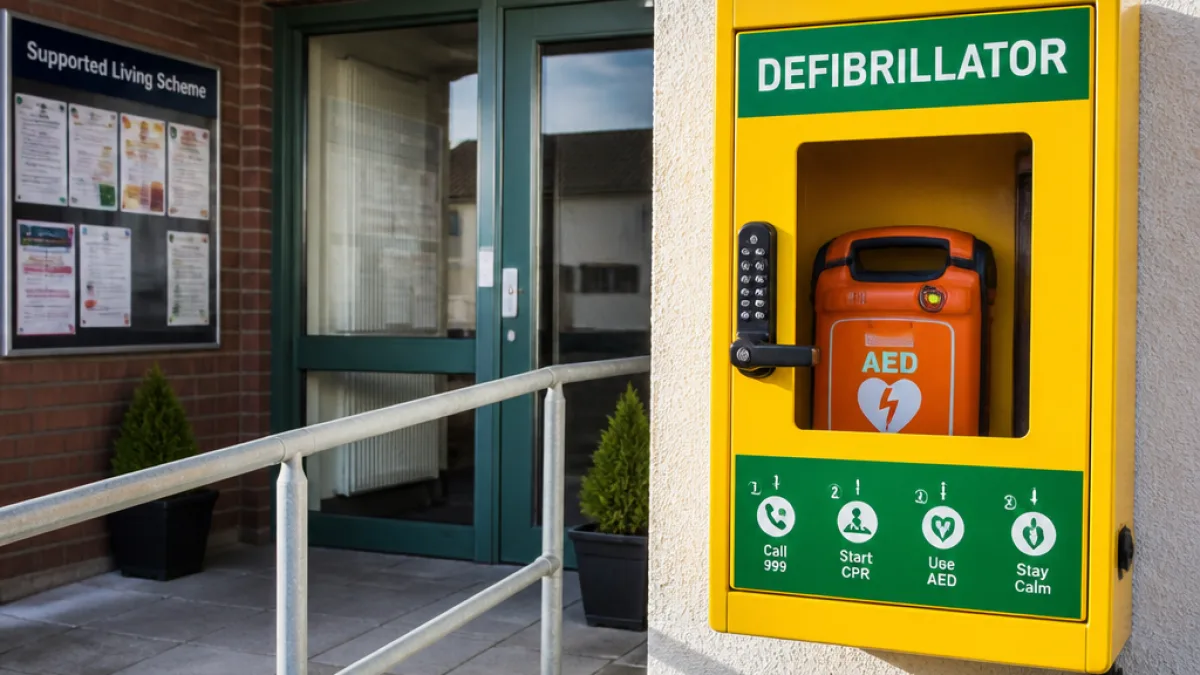
APEX Housing Association has completed the installation of Automated External Defibrillators (AEDs) across all 24 of its supported living schemes in the North, including premises in Omagh, the organisation has announced.
Immediate access to life‑saving equipment
The move is intended to give tenants, staff and visitors rapid access to devices that can deliver a controlled electric shock to restore a normal heart rhythm while emergency services are en route. Medical research indicates that administering a shock within four minutes of cardiac arrest can raise survival rates to as much as 80%, a figure cited by the organisation.
APEX provides supported housing for people with a range of needs and vulnerabilities. The association said the scheme covers those with mental ill health, learning disabilities, addictions, physical disabilities, older people and young people in need of support, placing it among the longer‑established providers of specialist housing in the region.
Organisational comment and delivery partner
Deirdre Walker, APEX Executive Director of Supported Living, underlined the priority the association places on tenant safety. She said:
“The safety and wellbeing of our tenants and residents is at the heart of everything we do, and we are delighted to have installed AEDs across all of our supported living schemes. While we hope these devices are never needed, having them readily available provides reassurance for tenants, residents, staff and visitors should an emergency arise.”
The project was delivered with the support of MKB Medical, the supplier named by APEX.
Local implications for Omagh residents
For Omagh, an urban centre that provides services to a wide rural hinterland, the presence of AEDs in supported living schemes offers an extra layer of immediate response capacity in the event of a cardiac emergency within those properties. Tenants and staff in these settings are often among the most vulnerable to medical emergencies because of age, long‑term conditions or disabilities; having equipment on site reduces the interval before potentially life‑saving intervention.
- Coverage: AEDs installed across 24 supported living schemes operated by APEX across the North, including Omagh.
- Purpose: Provide immediate access to life‑saving equipment for tenants, staff and visitors in the event of cardiac arrest.
- Delivery: Project completed with support from MKB Medical.
APEX’s statement did not specify which Omagh schemes received devices or whether additional measures such as staff training, device registration with ambulance services, or community awareness sessions would accompany the installations. Those operational details often determine how effectively AEDs are used in practice, and local providers and emergency services commonly coordinate on such matters.
Community safety and reassurance
The association framed the initiative as a precautionary measure: the organisation stressed it hopes the devices will not be required but said their availability offers reassurance to residents and relatives. In supported housing settings, the presence of emergency equipment can reduce anxiety among tenants and families about access to immediate care.
| Detail | Information |
|---|---|
| Number of schemes fitted | 24 |
| Included locations | Across the North, including Omagh |
| Delivery partner | MKB Medical |
| Survival statistic cited | Shock within four minutes can increase survival to up to 80% |
Local health partners and community groups in Omagh who work with people living in supported housing may be interested to learn more about how the equipment will be maintained and whether it will be linked into wider community defibrillator maps. These operational arrangements affect the likelihood that bystanders can make effective use of the AEDs in an emergency.
The installation is the latest in a series of steps by housing and health organisations across the UK and Ireland to increase public access to defibrillators. For residents of Omagh who live, work or visit supported living schemes run by APEX, the presence of on‑site devices represents an additional safeguard should a cardiac emergency occur.