Record entry and international flavour at Clandeboye near Bangor
An international ploughing championship held at Clandeboye Estate, close to Bangor in County Down, attracted a record entry when it took place in October 1961, organisers reported. The event brought together competitors from across the globe and was billed as one of the most ambitious agricultural contests ever held in Northern Ireland.
Contemporary reports said 97 competitors had entered — a figure described at the time as a record for the championship — and predicted large crowds for the spectacle laid out on more than 100 acres of prepared land at Clandeboye. The contest was expected to follow in prestige only behind the world match staged in Ulster two years earlier.
International representation and traditional methods
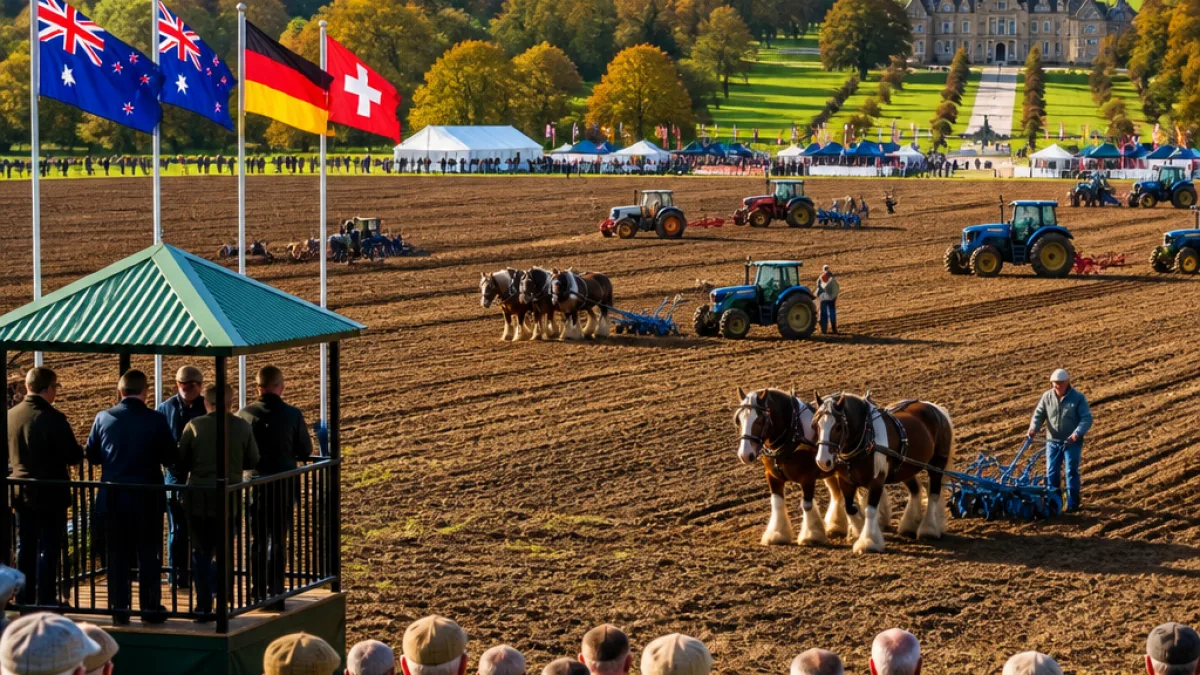
Competitors travelled from countries including New Zealand, Australia, Germany and Switzerland, alongside entries from within these islands: Scotland, England, Wales, the Isle of Man and Éire. The breadth of participation underlined the event’s international reach and its appeal to both modern and traditional ploughing practitioners.
A feature of the meeting was the continuation of horse-drawn classes alongside tractor events. Eleven horse teams were due to perform, with horse ploughing scheduled to begin at 10am on the first morning and tractors to follow an hour later. Organisers expected the ploughing to conclude early in the afternoon, with prizewinners announced as soon as the judges made their decisions.
"provided a perfect setting of more than 100 acres of ideal land for this contest,"
The phrase above, used in coverage at the time, emphasised the scale and suitability of Clandeboye for such an event. Organisers also highlighted the appeal of horse teams, both for their practical demonstration and for their visual presentation; classes judged on style and appearance were expected to draw particular interest.
Demonstrations, safety and young entrants
Alongside competitive ploughing, the programme included a range of supporting attractions intended to engage visitors while judges deliberated. These were listed as:
- a tractor safety competition;
- displays of contemporary farm machinery;
- practical demonstrations illustrating modern farming techniques.
Interpreters were to be present for competitors without English, a nod to the international make-up of the field. Coverage noted specifically that one Swiss ploughman would use horses and, while he did not speak English, his team would respond to "a worldwide language - the rein."
The championships also featured a young farmers’ section for Northern Ireland and an international young farmers’ contest. Ploughing for the young farmers was scheduled to begin on the Thursday morning, with eight competitors entered — including participants drawn from England and Sweden, according to reports.
| Category | Number |
|---|---|
| Total competitors | 97 |
| Horse teams | 11 |
| Young farmers' entrants | 8 |
Local significance and legacy
For Bangor and the surrounding area, the staging of an international agricultural event at a prominent local estate underscored the region’s continuing association with rural life and farming expertise. The mix of traditional horse-ploughing and contemporary tractor demonstrations reflected the transitional nature of mid-20th-century agriculture and provided a public forum for showcasing both craft and innovation.
While the account is rooted in a particular moment — October 1961 — it resonates with present-day interests in heritage farming events, agritourism and community showcases. Clandeboye’s role as a venue able to host large-scale outdoor competitions remains part of the estate’s local identity and the historical record of Bangor’s engagement with agricultural culture.
Contemporary planners and community groups often look back to such events when considering how best to programme rural exhibitions and competitions that attract international visitors while celebrating local skills.