
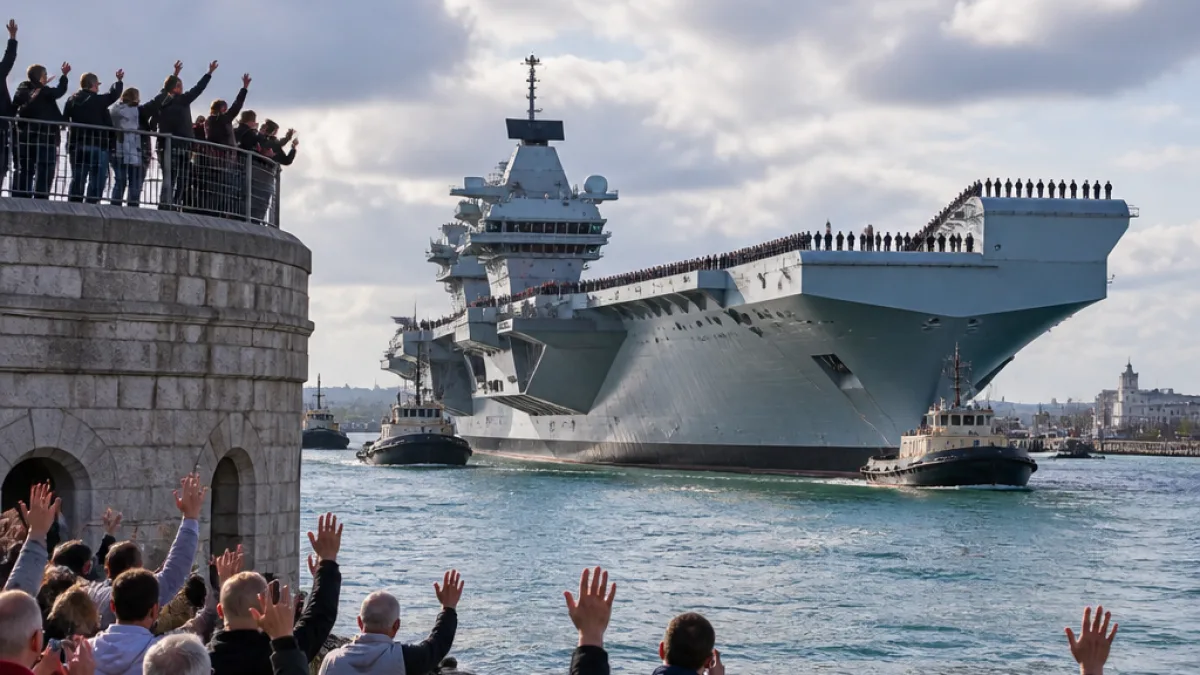
HMS Prince of Wales departed HMNB Portsmouth on Sunday to take command of the UK Carrier Strike Group on Operation Firecrest, drawing emotional farewells from families who gathered on the Round Tower and around the harbour.
Portsmouth farewells as carrier returns to wider operations
The warship, which previously returned to Portsmouth on 24 July after the first phase of the mission, will head north to train with Nato partners in the North Atlantic and High North – regions where activity by Russia has been described as increasing.
Local scenes around Old Portsmouth saw relatives and friends watching the vessel leave. Mitch Ballard, who had travelled from Birmingham, went to the Round Tower to wave off his daughter Meghan Ballard, a weapons engineer on her second deployment aboard the ship. He said: “She’s feeling fine - we’ve come from Birmingham today to wave her off.”
“He’s very nervous but excited too to take the step in his career.”
Another family member, identified only as Ruby, stood at the Round Tower to say goodbye to her partner James, also a weapons engineer, who is preparing for his first deployment after three years with the Royal Navy. Her comment underlined the mix of hope and anxiety that accompanies such send-offs: “He’s very nervous but excited too to take the step in his career.”
Operational record from earlier deployment
The ship’s earlier phase of deployment was substantial. According to the information released, during the previous four-month deployment the vessel:
- covered 15,684 nautical miles;
- logged 7,890 hours of watchkeeping by sailors on the bridge;
- supported aviators conducting more than 750 deck landings, including the ship’s 9,000th deck landing since entering service;
- operated alongside 19 allied nations in Nato and the Joint Expeditionary Force.
Those figures underline the scale of the carrier’s activity and the role Portsmouth plays as a home port for one of the Royal Navy’s principal vessels. The strike group’s work with allies is described as strengthening regional partnerships and the defence of the Euro‑Atlantic.
| Statistic | Figure |
|---|---|
| Distance sailed (previous phase) | 15,684 nautical miles |
| Bridge watch hours | 7,890 hours |
| Deck landings | 750+ (including the 9,000th) |
| Allied partners | 19 |
| Ship cost (build) | £3.2bn |
What leaving Portsmouth means locally
For Portsmouth, the departure is more than a military movement: it affects families, local economy and the visible presence of the Royal Navy in the city. Sailors’ partners and relatives routinely gather on harbour vantage points such as the Round Tower and the Historic Dockyard to say farewell, and the emotional scenes highlight the human side of extended deployments.
Those attending the send-off included Jasmine, who watched her fiancé Ryan Parker leave as he joined the ship. Accounts from relatives show a familiar mixture of pride and concern as personnel prepare for months away.
- Families say goodbyes around Old Portsmouth and the Round Tower.
- The carrier will operate in regions where Russian activity has reportedly increased.
- Portsmouth remains the ship’s home port and a focal point for carrier operations.
The operation underlines the strategic role that Portsmouth continues to play as a naval base for carrier strike operations, while also serving as a reminder of the personal cost carried by service families whenever a major ship sails. Local residents who wished to view the departure were able to do so from traditional vantage points, and the ship’s movement will now take it into higher-latitude training and patrol areas with Nato allies.
Further details about the timings and specific training exercises for Operation Firecrest were not disclosed in the material provided at the time of sailing.