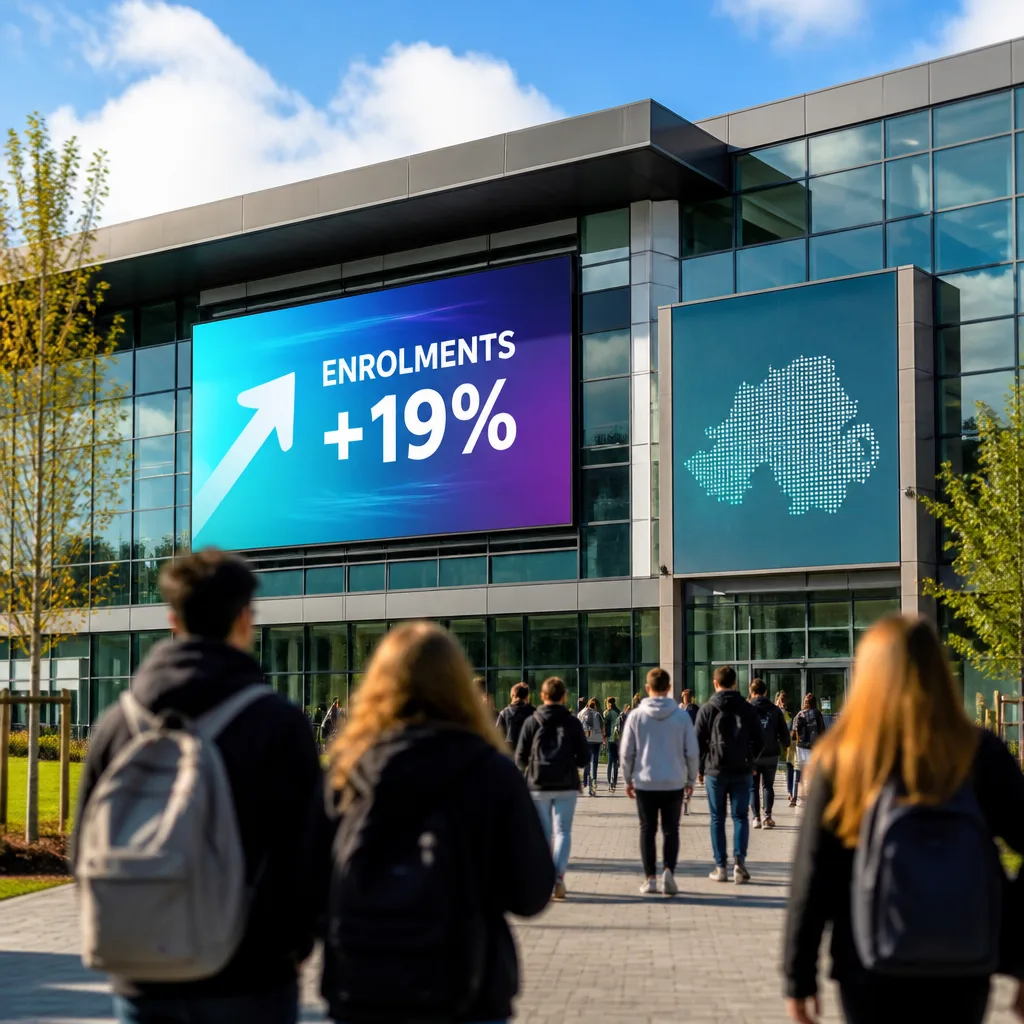
Further Education (FE) colleges in Northern Ireland saw a net increase of 19% in student numbers across five years, the Department for the Economy and the Northern Ireland Statistics and Research Agency (NISRA) report reveals. That means enrolments rose from 55,970 in 2020/21 to 66,690 in 2024/25, including a 5% rise in the latest recorded year.
Growth concentrated in career‑focussed pathways
The figures cover the six FE colleges that operate across 29 campuses in Northern Ireland, offering academic, professional and technical education and training. College leaders say the climb in student numbers demonstrates an increasing recognition of FE as a legitimate and effective route into careers and higher education.
Individual student stories capture that shift. Aoife Harvey, who studied a Level 3 Art and Design course at North West Regional College after GCSEs, described how the college provided an accessible route towards creative industry opportunities and university progression.
"It was amazing. It was just on my doorstep and every day I could just go into this creative world," she said.
Equally, vocational courses are translating directly into employment for some. Caleb Turley, who completed a Level 3 National Diploma in Sport, Fitness and Personal Training at South Eastern Regional College, said the college’s on‑site learning prepared him for his role as a personal trainer.
What the numbers show
The headline changes reported are:
- Net increase of 19% in FE students across five years (2020/21 to 2024/25).
- Absolute rise from 55,970 to 66,690 students.
- 5% uplift in the most recent academic year (2024/25).
| Academic year | FE students (NI) |
|---|---|
| 2020/21 | 55,970 |
| 2024/25 | 66,690 |
Implications for learners, employers and policy
The rise in FE participation has several practical consequences for classroom provision, employer engagement and routes into higher education. Colleges typically emphasise hands‑on delivery, employer placements and technical accreditation — features that support both immediate labour market entry and progression to university for those who choose that path.
From a learner perspective, FE can be attractive because it often combines applied learning with clearer links to employment. For families and advisers, the numbers reinforce the message that post‑16 pathways are not limited to traditional school‑to‑university routes.
For employers, a growing FE sector offers a deeper talent pool with job‑ready skills. For policy makers and college leaders, sustained growth raises questions about capacity, capital investment and curriculum planning across multiple campuses to ensure quality teaching and work‑based learning continue to meet demand.
College staff and students involved in vocational courses emphasise the value of practical learning environments. One student described how the structure of delivery — with increasing time in practical settings as courses progressed — directly supported the transition into work.
What remains to be seen
While the statistics signal stronger uptake, they do not on their own explain the full drivers behind the shift. Factors likely include changing labour market signals, targeted recruitment by colleges, perceptions of value for money and the attractiveness of applied courses. Further breakdowns by subject area, age group and progression outcomes would help illuminate which pathways are expanding fastest and how many learners use FE as a springboard to higher education versus immediate employment.
For now, the figures underline that FE remains a vital and growing part of Northern Ireland’s post‑16 landscape, offering diverse routes for young people and adults seeking vocational, technical and academic qualifications.