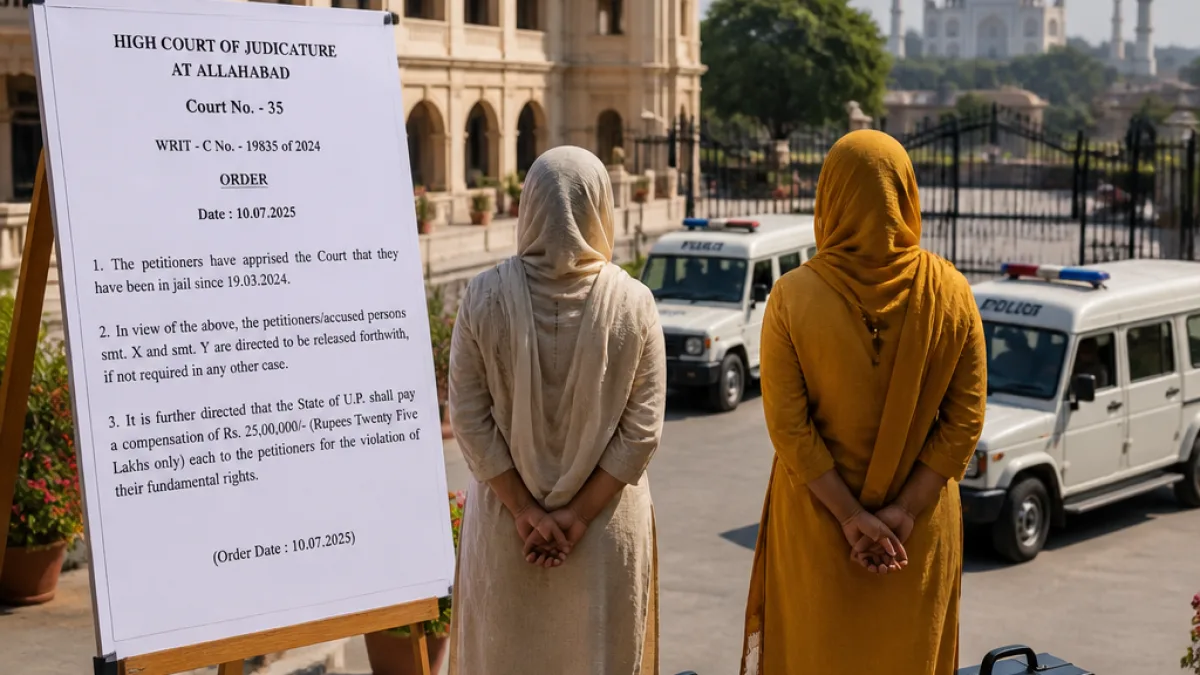
High Court calls confinement "wholly illegal", awards monetary relief
The Allahabad High Court has ordered the release and granted compensation to two women from Agra who, the court found, were allegedly confined by their father for around a year after they embraced Islam. A single bench of Justice Sandeep Jain said the detention of the adult sisters amounted to an "unlawful deprivation of fundamental rights" and directed the father and the Uttar Pradesh government to jointly pay ₹25 lakh to the aggrieved women.
The two sisters, aged 35 and 20, are reported to have embraced Islam in 2020 and 2021 respectively. Agra police traced them to Kolkata in West Bengal last year and, during that operation, arrested at least a dozen people from another community on allegations of abduction and forced marriage, the court record shows. After being brought back to Agra, the women were handed over to their father, according to the petition filed before the High Court.
"The Constitution does not confer upon parents a licence to incarcerate their major children merely because they disapprove of their faith, beliefs or personal choices," Justice Sandeep Jain observed in his order dated August 6.
The sisters later recorded statements before the court alleging confinement and harassment by their father for choosing to convert. The bench described the episode as "wholly illegal" and held that constitutional liberties of adult individuals cannot be curtailed by parental authority, social morality or majoritarian sentiment. The court added that any forcible attempt to suppress liberty invites constitutional scrutiny and public law consequences, including monetary compensation.
Charges invoked after Agra police traced the sisters
Following their retrieval from Kolkata, the police registered a case that included stringent provisions. The FIR is reported to have invoked offences reportedly related to "purposely or knowingly endangering the sovereignty, unity and integrity of the country, being part of an organised syndicate", and also cited sections of the Uttar Pradesh Prohibition of Unlawful Conversion of Religion Act. The dozen or more accused arrested in that action have remained in custody, according to the case record cited in the court order.
- Victims: Two women from Agra, ages 35 and 20.
- Allegation by family: Confined at home for about one year after embracing Islam.
- Police action: Located the sisters in Kolkata; arrested at least a dozen persons on abduction/forced marriage and other charges.
- High Court relief: Release and joint compensation of ₹25 lakh from the father and the state government.
| Event | Detail |
|---|---|
| Conversion dates | Reportedly 2020 and 2021 |
| Tracing and arrests | Traced to Kolkata; at least a dozen arrested |
| Court order | Release and ₹25 lakh compensation (jointly from father and UP government) |
The woman's lawyer, Ali Bin Saif, informed the court that the sisters had been handed over to their father after the police brought them back, and that they alleged repeated confinement and harassment. The High Court's direction reflects a judicial insistence on protecting the individual liberties of adults even where family or community pressures exist.
Legal observers say the case highlights tensions that arise at the intersection of familial control, community disputes and state legislation on religious conversion. The Uttar Pradesh law on unlawful conversion has been invoked in several high-profile matters across the state and its application has frequently been contested in courts on constitutional grounds. While the current order does not address the merits of every criminal charge registered, it emphasises that fundamental rights of adults cannot be subordinated to parental authority.
The Agra police and the Uttar Pradesh government were parties to the proceedings referenced in the bench's order. The court's financial award aims both to compensate the sisters for the infringement of their rights and to mark the public law consequence the bench said such confinement attracts. The accused persons who remain in custody continue to face the criminal charges listed in the FIR; the prosecution and defence will have to meet the evidence thresholds prescribed by law in subsequent hearings.
The matter is likely to have local implications for policing, community relations and the enforcement approach to the state's anti-conversion statute in Agra, where such cases have prompted public debate. The High Court's ruling reaffirms that courts will scrutinise alleged infringements of liberty and may direct state action or compensation where fundamental rights are found to have been violated.