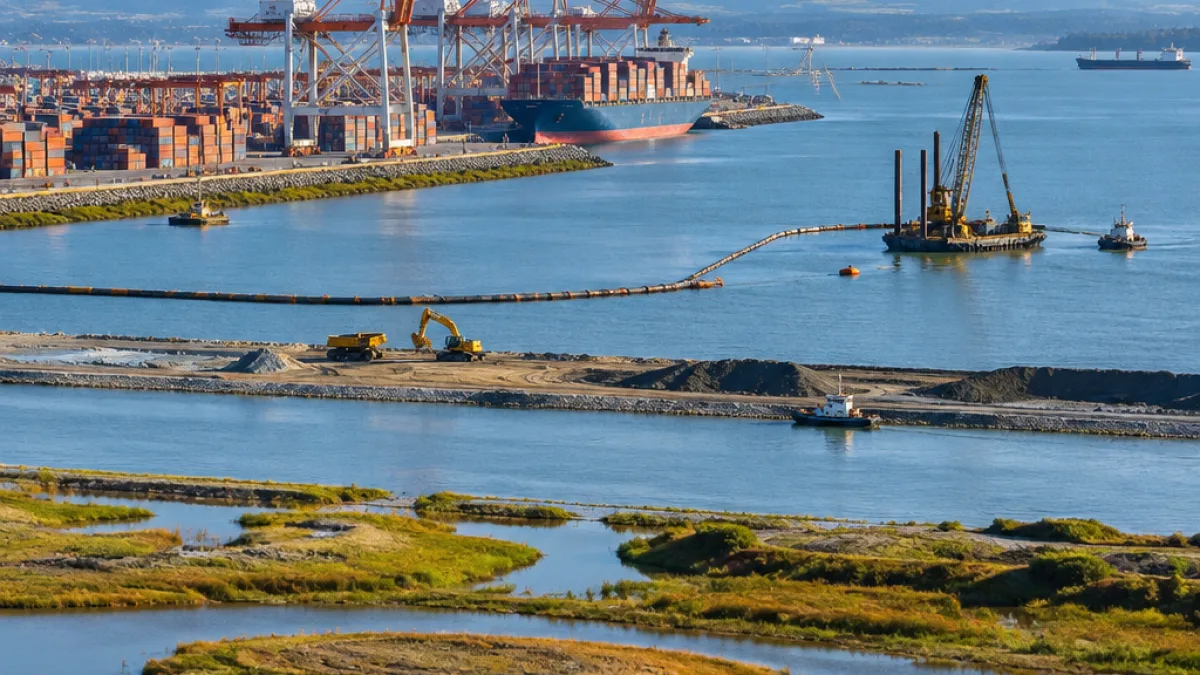
Ottawa has placed the planned Roberts Bank Terminal 2 expansion on its list of projects deemed to be of national interest, giving new momentum to a proposed container facility in Delta while leaving significant questions about the Fraser River Estuary and the Salish Sea.
The federal designation applies to a three-berth expansion beside an existing container terminal at Roberts Bank. The project is expected to add 2.4 million containers of capacity at the Port of Vancouver, Canada’s largest port, and could move into commercial operation by 2035 — as much as four years sooner than previously anticipated, according to the federal government.
Transport Minister Steven MacKinnon said the country needs additional capacity to avoid rising costs for businesses and consumers. Without the expansion, he said, congestion could push shipping costs beyond $800 million annually by 2035.
“That’s a cost that would have to be borne by Canadian businesses and consumers, but that is a cost they should not and cannot afford to bear.”
The federal government’s case for the project rests on its role in moving goods through Canadian supply chains. Ottawa says the expansion could support approximately 17,000 jobs across those supply chains, add about $3 billion a year to Canada’s gross domestic product and produce more than $630 million in annual tax revenue.
A faster path for a major port project
The estimated capital cost is $5.9 billion. Ottawa said the project is on a viable path toward a final investment decision by the middle of next year, though the designation does not itself amount to a final construction or investment decision.
Instead, the national-interest listing is intended to accelerate the project’s schedule. The Vancouver Fraser Port Authority is the project proponent, and the facility would be built beside an existing container operation. The federal government says the designation could shorten the timeline to commercial operation by up to four years, bringing the target date to 2035.
| Project detail | Figure or status |
|---|---|
| Estimated capital cost | $5.9 billion |
| Additional container capacity | 2.4 million containers |
| Target commercial operation | 2035 |
| Potential supply-chain jobs | 17,000 |
For B.C., the announcement also marked the first appearance alongside federal officials by premier-designate Lorne Doerkson since the B.C. Conservatives won a decisive victory in the Oct. 24 election. Doerkson described the expansion as preparation for future trade rather than a response to an immediate shortfall.
“For British Columbia, these benefits are particularly significant. The project will help cement our province’s role as Canada’s leading trade gateway, attracting investment and ensuring our economy remains competitive on the world stage.”
That argument places Roberts Bank at the intersection of provincial growth and Canada’s broader trade ambitions. The port’s future capacity is being presented as a question of competitiveness, with the potential costs of congestion ultimately reaching companies and households through the prices attached to moving goods.
Treaty rights and estuary health remain central
For Tsawwassen First Nation, however, the project cannot be measured only in containers, jobs or economic output. Chief Laura Cassidy said the nation’s position is one of consent, but not unconditional support, after years of consultation about the expansion’s possible effects.
“We continue to have concerns about the impacts of the project and the long-term health of the Fraser River Estuary and the Salish Sea. At the same time, years of consultation have resulted in a deeper understanding of those impacts and how they can be addressed.”
Tsawwassen First Nation has focused on protecting its treaty rights and keeping the surrounding environment healthy and productive for future generations. Cassidy said the nation had previously sought assurances related to the Building Canada Act, the federal legislation under which the project has been listed, although the available information does not set out the full details of those assurances.
The unresolved balance is familiar in the Lower Mainland: a region seeking greater trade capacity while depending on an estuary and coastal waters that support communities and ecosystems. The federal and provincial economic projections provide one measure of the project’s importance, but the nation’s position makes clear that the environmental and legal dimensions will continue to shape the expansion’s path.
With a final investment decision anticipated by the middle of next year, the Roberts Bank proposal now enters its next phase with stronger federal backing and an accelerated timetable. The designation raises the project’s national profile, but it does not erase the conditions attached to local consent. Whether the promised economic gains can proceed alongside protections for treaty rights and the Fraser River Estuary will remain a defining test for the expansion.