
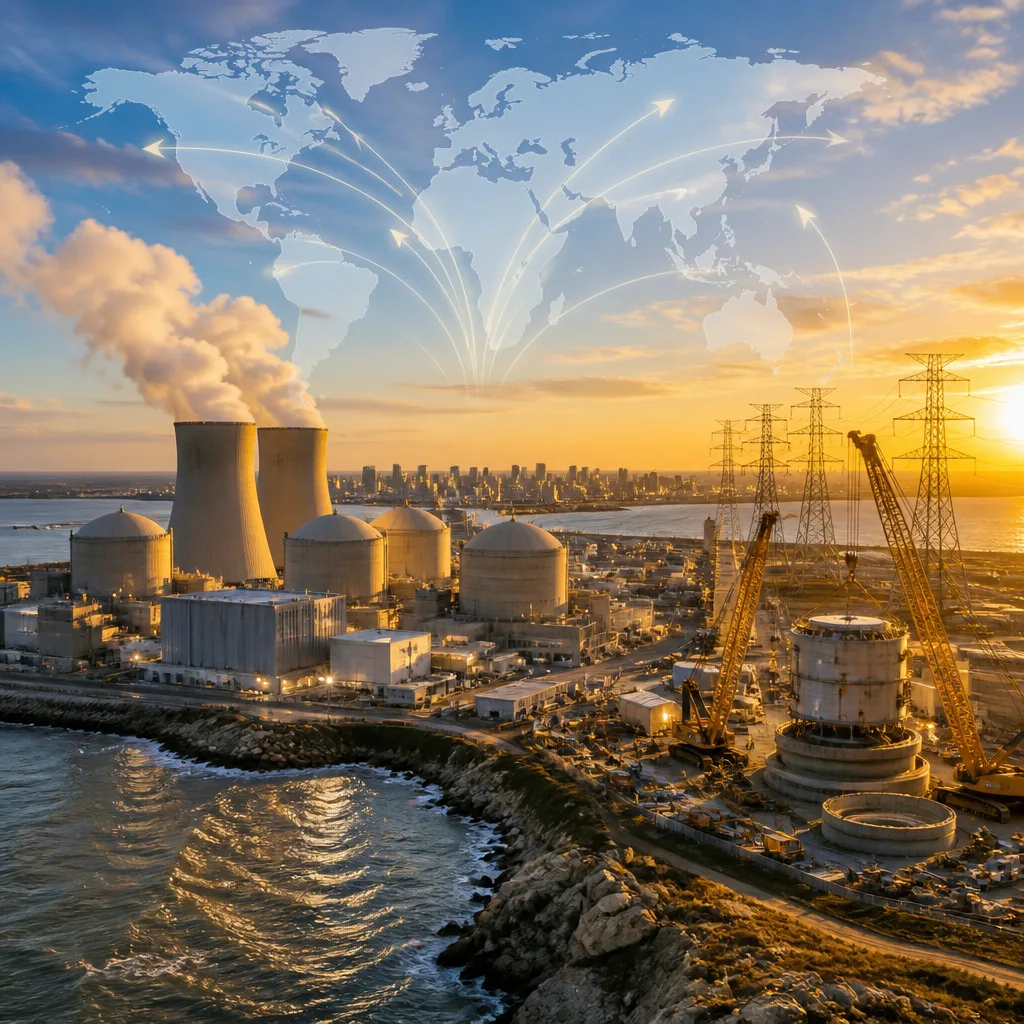
Global nuclear power plants generated a record 2,702 terawatt-hours (TWh) of electricity in 2025, surpassing the previous high of 2,667 TWh, according to a new assessment from the World Nuclear Association. The report says that, should countries meet their stated nuclear targets, worldwide nuclear capacity could expand to roughly 1,457 gigawatts-electric (GWe) by 2050 — more than three times the present operating fleet.
Backlog and construction trends
The association’s analysis paints a picture of renewed activity around the existing reactor fleet and a modest uptick in new starts. At the end of 2025, the global operating base stood at about 423 GWe. Projects currently under construction added 82 GWe, including eleven reactors that broke ground during 2025.
Beyond projects already underway, the report separates the pipeline into planned, proposed and potential projects, which together amount to 416 GWe. That reduces—but does not eliminate—the gap between concrete projects and governments’ ambitions: roughly 550 GW of capacity that has been announced or proposed by 2050 still lacks clear project-level commitments.
| Metric | Figure |
|---|---|
| Electricity generation (2025) | 2,702 TWh |
| Electricity generation (2024) | 2,667 TWh |
| Operating capacity (current) | 423 GWe |
| Projected capacity (if targets met by 2050) | 1,457 GWe |
| New capacity under construction (2025) | 82 GWe |
Performance and geography
The report highlights that nuclear plants continue to perform reliably. The global average capacity factor — a measure of how fully reactors operate relative to their maximum potential — was 83.7 per cent in 2025. Notably, the analysis observes that capacity factors tend to remain strong as reactors age beyond 50 years.
Geographically, the greatest share of future capacity is expected to come from nations that already rely heavily on nuclear power. The association identifies the United States, China, France, Russia and India as the principal contributors to projected growth.
- Record generation: 2,702 TWh in 2025, up from 2,667 TWh a year earlier.
- Current fleet: 423 GWe operating capacity, high reliability with an 83.7% capacity factor.
- Pipeline: 82 GWe under construction; 416 GWe planned/proposed/potential; ~550 GW still without firm projects.
While the headline projection — more than tripling capacity by mid-century — assumes that governments follow through on their stated targets and that the existing fleet remains in operation, the report underscores the difference between political goals and concrete projects. The roughly 550 GW of proposed capacity that has not yet been converted into concrete plans presents a central challenge for the pathway the association outlines.
For policy-makers, investors and communities weighing the future of low-carbon electricity, the findings offer both reassurance and a warning: nuclear generation today is reliable and growing modestly, but reaching the association’s vision for 2050 will require turning a substantial portion of ambition into construction and financing realities.
The World Nuclear Association report also sets out policy recommendations intended to smooth that transition, emphasising the importance of stable frameworks and predictable financing to translate national targets into built capacity.