
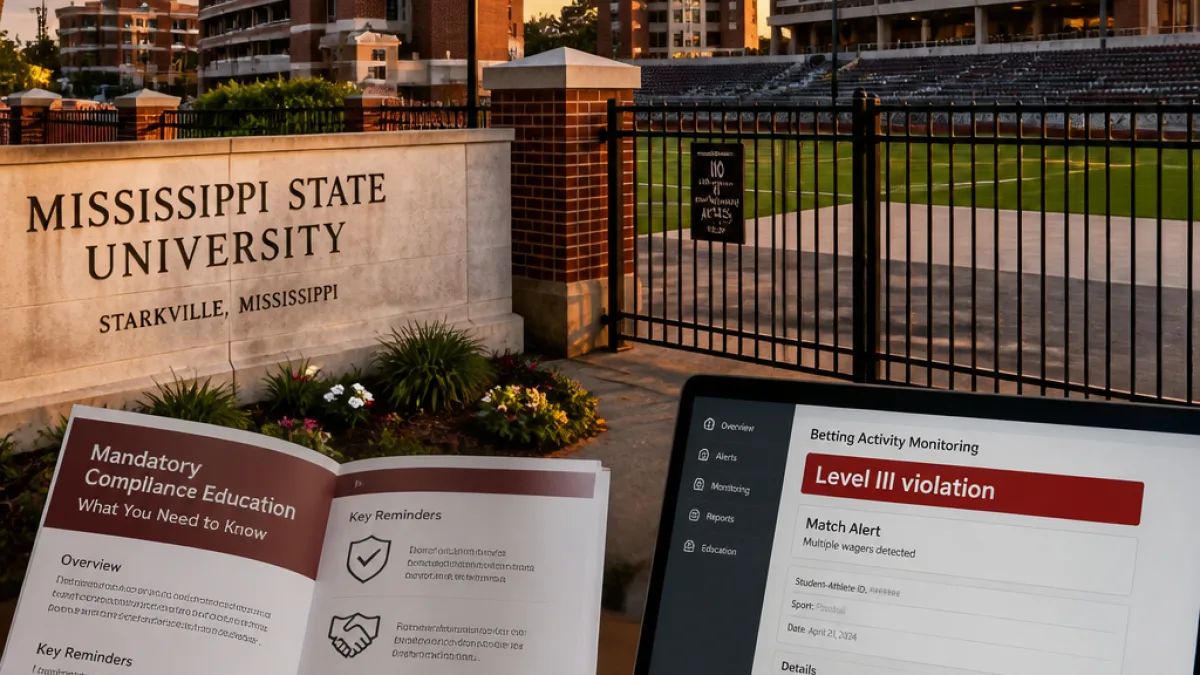
MISSISSIPPI STATE — Two Mississippi State football players were cited this year for violating NCAA sports-wagering rules after campus monitoring flagged bets placed during the Super Bowl and NBA All-Star weekend, according to a Clarion Ledger report.
How the violations were detected
The university uses a third-party monitoring service called ProhiBet to screen for suspected betting activity among student-athletes and staff. On Feb. 8 — the day of the Super Bowl — the system generated an alert that identified a bet placed by an athlete. The incident prompted an internal review that identified two separate student-athletes whose activity ran afoul of NCAA bylaws governing sports wagering.
The report said the NCAA categorized both incidents as Level III violations, the lowest tier of infraction under the association’s enforcement structure. Each athlete received what the record describes as minor penalties and was required to undergo additional rules education.
What was wagered
Details provided to the Clarion Ledger outline the specific wagers tied to the alerts: a $50 Super Bowl bet and two smaller NBA All-Star–related wagers. The Super Bowl pick was for the New England Patriots and lost when the Seattle Seahawks won. The NBA bets included a successful $10 wager on the 3-point contest — which reportedly paid out $64 — and another novelty wager on an announcer saying certain words that did not win.
The athlete who collected the $64 payout was required to donate that amount to a charity of his choosing, the report said. Both players then completed additional education about NCAA gambling rules.
Penalties and NCAA context
Level III violations typically involve breaches of rules that warrant corrective action but not severe sanctions. In this case, university officials pursued remedial measures rather than suspensions or more serious punishments. The Clarion Ledger's reporting did not identify the athletes involved.
| Date | Wager | Amount | Outcome | Penalty |
|---|---|---|---|---|
| Feb. 8 | Super Bowl winner | $50 | Lost (Patriots pick) | Level III violation; rules education |
| NBA All-Star weekend | 3-point contest; announcer words | $10; other amount unspecified | $64 payout; other bet lost | Donation to charity; Level III violation; rules education |
Broader debate over athletes and wagering
The incidents at Mississippi State mirror a larger national conversation around sports gambling and college athletics. Earlier this year the eligibility of Texas Tech quarterback Brendan Sorsby drew attention after the player acknowledged involvement in betting activity.
Texas coach Steve Sarkisian has been outspoken about the issue, arguing coaches and institutions now face complicated new realities as gambling becomes more accessible. On a spring radio appearance, Sarkisian framed the problem in stark terms:
“I said in a press conference, does this sound like a good idea? We’re paying the players. We j”
The full context of Sarkisian’s remarks touches on concerns that expanded access to legal betting markets, along with the high-profile nature of college sports, increases the risk of rule violations and undermines program integrity.
Local implications and university response
Mississippi State’s response — using monitoring software, enforcing minor penalties and requiring education — reflects steps other institutions are taking to comply with NCAA directives designed to limit athlete involvement in wagering. For fans and families in Starkville and across Mississippi, the disclosures serve as a reminder that even seemingly small, informal bets can trigger compliance reviews and disciplinary actions.
- Monitoring tools such as ProhiBet are increasingly used by athletic programs to detect potential wagering.
- Even modest wagers are subject to NCAA rules and can be classified as violations.
- Educational penalties remain the most common corrective measure for first-time, low-level infractions.
What to watch next
The Clarion Ledger report did not indicate further punishments or systemic findings beyond the two athletes’ cases. University officials have not released identifying details about the players. As legal sports betting continues to expand nationally, university compliance offices and coaches in the state will likely face growing pressure to monitor and educate athletes to prevent future violations.
Mississippi State and other programs face the immediate task of balancing competitive goals with enforcement of NCAA rules that still prohibit student-athlete participation in sports wagering. For now, the school’s handling of these low-level incidents suggests a focus on correction and prevention rather than punitive measures.
Curtis Whitfield is the state correspondent for WE NEWS.

















