
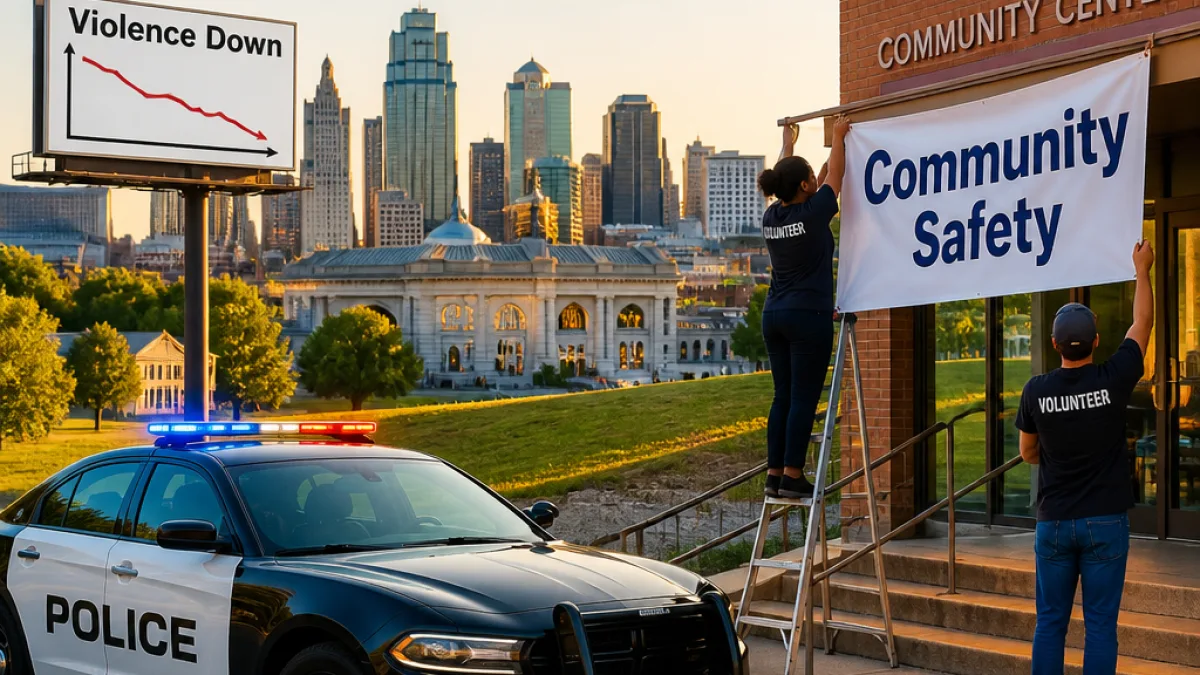
Kansas City recorded fewer homicides and an overall decline in violent crime during the first half of 2026 compared with the same period a year earlier, according to a twice-yearly survey from the Major Cities Chiefs Association.
Key figures show drops across major violent-crime categories
Police logged 68 homicides in the first six months of this year, down from 82 during the same span in 2025. Robberies fell sharply — from 513 to 378 — while reported rapes decreased from 220 to 173. Aggravated assaults, incidents where serious injury is intended, dropped by about 5%.
| Crime category | First half 2025 | First half 2026 |
|---|---|---|
| Homicides | 82 | 68 |
| Robberies | 513 | 378 |
| Rapes | 220 | 173 |
| Aggravated assaults | — | ↓5% |
More recent internal reporting from the Kansas City Police Department shows the city had recorded 79 homicides as of last Friday, compared with 102 at the same point in 2025.
What police and partners are pointing to
Kansas City police officials attribute the improvement, in part, to a focused-deterrence model the department rolled out in 2024. Rather than deploy resources evenly across the entire city, the strategy concentrates attention on people and places believed to drive the bulk of violent incidents.
- Aim 4 Peace, a violence-prevention initiative run through the health department.
- KC 360, a local outreach and reentry program.
- Save KC, an effort led by the Jackson County prosecutor’s office.
Local officials cited neighborhood-level results: areas that historically saw multiple killings a year, such as Santa Fe and Oak Park, reported none during the period referenced by community organizers and program leaders.
"Violence is easing almost everywhere," said Adam Gelb of the Council on Criminal Justice. "It’s happening across the map."
Gelb’s observation highlights a complicating factor for evaluating Kansas City’s tactics: many U.S. cities are experiencing declines in homicides and shootings, making it difficult to isolate the impact of any single program or policing change.
Local data and national trends
The Major Cities Chiefs Association survey compiles data from the nation’s largest police departments. Across those agencies, homicides fell by about 17.2% in the same reporting window. A separate analysis of 30 cities found an 18% decline in killings beginning in late 2022.
Kansas City’s nonfatal shootings also ticked down. The KCPD reported 183 nonfatal shootings through mid-July, compared with 217 for the same timeframe in 2025.
Limits of the data and what’s next
Researchers and law-enforcement analysts caution against drawing firm conclusions from a single snapshot. National declines in violence complicate efforts to credit local policies. The Council on Criminal Justice plans to convene researchers next month to study what is driving the broader downturn.
Later this year, the FBI will release its annual crime statistics, which may provide a wider context for the recent reductions and clarify whether the trends seen in Kansas City align with larger national patterns.
Practical effect for residents
For residents, the numbers may bring cautious optimism but not cause for complacency. Police leaders have emphasized targeting high-risk individuals and neighborhoods while sustaining partnerships with community groups and prosecutors.
Officials and community organizations working on prevention say continued investment in outreach, social services and prosecution strategies will be important to maintain momentum.
As investigators and academics study the causes of the decline, city leaders face the dual challenge of protecting gains in short-term safety while addressing longer-term factors that contribute to violence, including housing, employment and access to mental-health and substance-use services.
State and local policymakers will be watching forthcoming reports closely to determine which interventions merit expansion and which declines reflect broader national forces beyond local control.
Wesley Carrington, State Correspondent.
















