
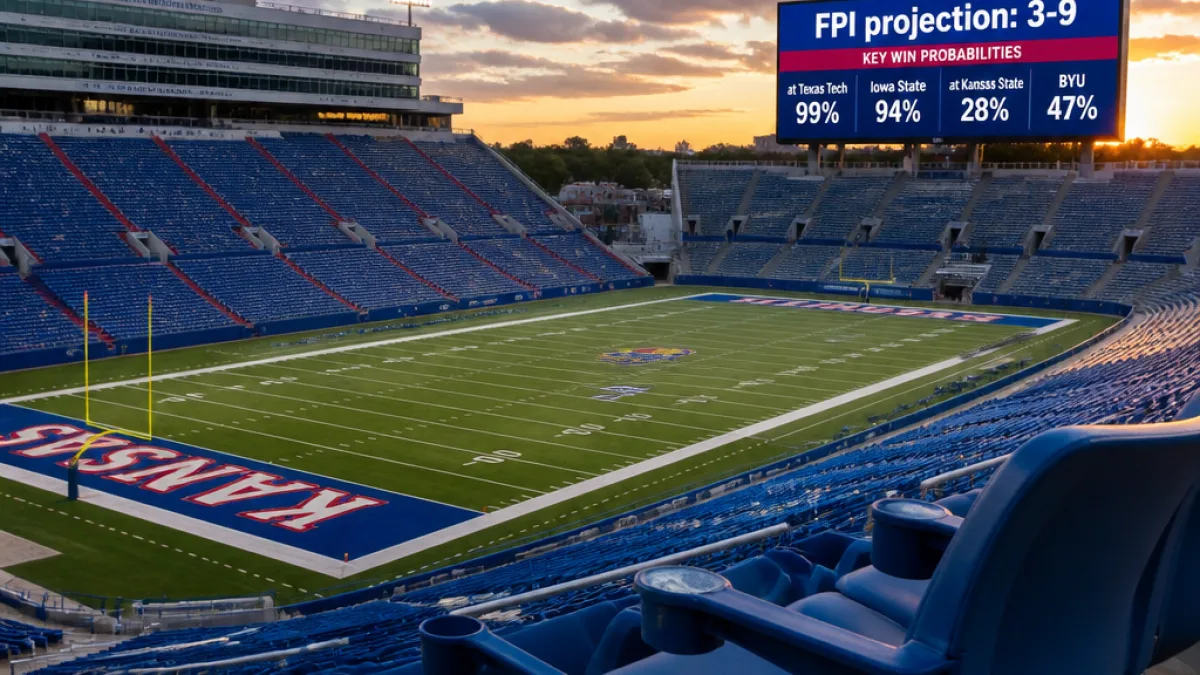
The ESPN Football Power Index, commonly called FPI, projects a difficult 2026 season for the Kansas Jayhawks, ranking KU 13th among the Big 12's 16 teams with a rating of 2.8 and forecasting a 3-9 overall record.
Method and context
FPI is a predictive model released before the season that factors in returning production, transfer additions and other team metrics to generate win probabilities. The model’s composite ratings put Kansas well below the Big 12 average — FPI places the conference’s middle around a 5.0 rating, while Texas Tech sits notably higher with a 20.0 rating and a No. 10 conference ranking in the FPI output.
Game-by-game probabilities
The model assigns KU modest chances in nonconference tuneups but low probabilities in many Big 12 matchups. Below are the win probabilities FPI currently gives the Jayhawks:
- Game 1 — vs. Long Island University: 99.0%
- Game 2 — vs. Missouri: 28.0%
- Game 3 — vs. Arizona State: 47.4%
- Game 4 — vs. Middle Tennessee State: 94.1%
- Game 5 — at Utah: 23.4%
- Game 6 — at Kansas State: 37.4%
- Game 7 — vs. Baylor: 45.7%
- Game 8 — at TCU: 32.7%
- Game 9 — vs. UCF: 61.0%
- Game 10 — at West Virginia: 49.6%
- Game 11 — vs. BYU: 28.1%
- Game 12 — at Oklahoma State: 42.0%
| Opponent | FPI Win Probability |
|---|---|
| Long Island University | 99.0% |
| Missouri | 28.0% |
| Arizona State | 47.4% |
| Middle Tennessee State | 94.1% |
| Utah | 23.4% |
| Kansas State (road) | 37.4% |
| Baylor | 45.7% |
| TCU (road) | 32.7% |
| UCF | 61.0% |
| West Virginia (road) | 49.6% |
| BYU | 28.1% |
| Oklahoma State (road) | 42.0% |
What the numbers suggest
FPI’s projection indicates Kansas is expected to be competitive in only a handful of games. The model gives KU near-certain wins in the two nonconference tune-ups: Long Island University (99.0%) and Middle Tennessee State (94.1%). Outside of those matchups, Kansas hovers near or below the 50 percent mark in most contests, with several conference games projected as uphill battles.
Notably, three conference games sit within a few percentage points of a 50-50 split — the games against Arizona State (47.4%), West Virginia (49.6%) and Baylor (45.7%) — suggesting a handful of tilts that could swing KU’s fortunes if circumstances fall the right way.
Local implications
For fans in Lawrence, the FPI outlook underscores continued skepticism about Kansas’ ability to climb the Big 12 standings in 2026. The projection also carries implications for coaching staff evaluations, recruiting messaging and ticket-sales momentum as the season approaches. Home games seen as winnable — including matchups against Baylor and UCF — will take on added importance as opportunities to build confidence and secure victories in front of the David Booth Kansas Memorial Stadium crowd.
Model limits and what to watch
Predictive models like FPI are useful snapshots that blend measurable inputs but cannot account for every variable — injuries, late-breaking transfer moves, in-season development or game-specific quirks. Small differences in win probability (several games here are within 5 percentage points of a toss-up) mean a few plays or an injury can reshape the season narrative quickly.
Key early-season indicators to watch that could alter expectations include:
- Quarterback play and offensive consistency in the first two games.
- Health status entering the Big 12 slate — particularly across the offensive line and secondary.
- How the coaching staff responds in close games projected by FPI as near toss-ups.
As the season approaches and rosters settle, FPI will update and likely move around a few probabilities. For now, the model offers a sobering view: Kansas faces a challenging path to a winning season in 2026, with the best early chances coming against its two nonconference opponents.
Wesley Carrington, State Correspondent

















