Police say drones will provide immediate eyes on 911 calls while officers respond
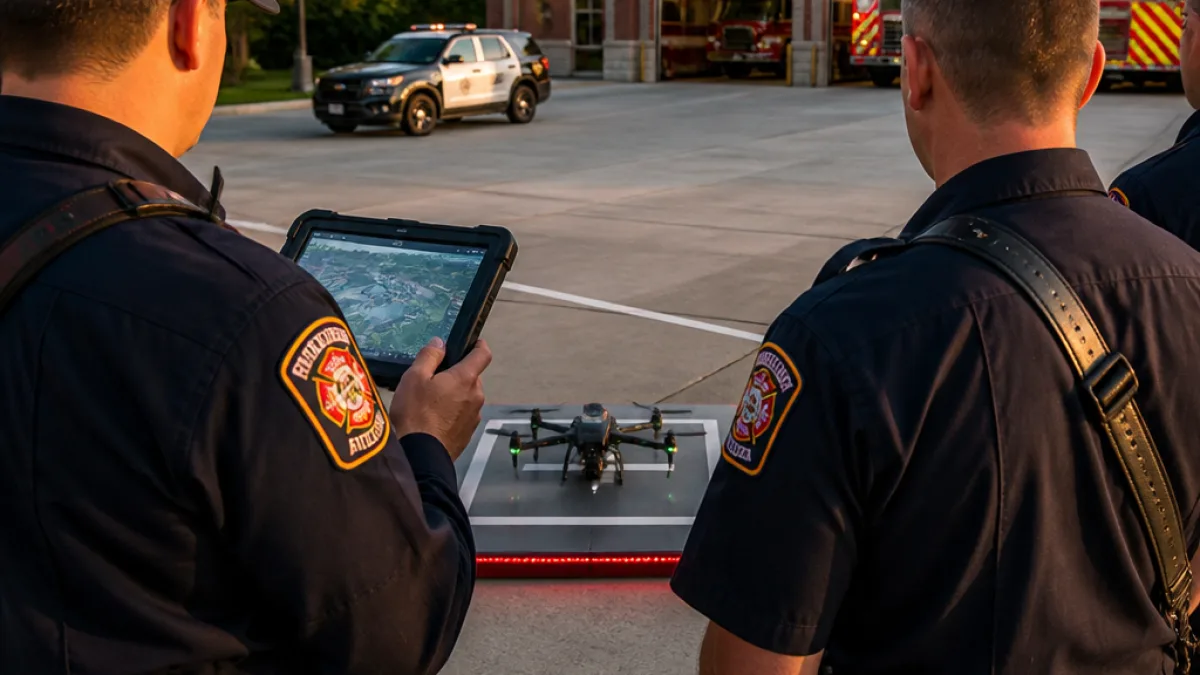
The Chattanooga Police Department this week rolled out a pilot program that will use unmanned aircraft as first responders, launching the devices from fire stations to deliver real-time video to officers and dispatchers as they head to emergency calls.
Chief John Chambers said the drones will be flown by trained pilots working in the department's Real Time Intelligence Center. The craft are intended to arrive at scenes faster than officers can by ground, give accurate situational awareness and relay that information to responding personnel.
"Having that real-time accurate information is imperative to the type of response," Chambers said during a press conference at the intelligence center. "And that type of response, a lot of times, can dictate how everything goes after that."
Officials said the pilot initially stations two drones at Chattanooga Fire Department stations chosen using crime data. The units are docked at:
| Fire Station | Address | Primary coverage |
|---|---|---|
| Station 4 | 2181 Curtis St. | East Chattanooga and Avondale |
| Station 9 | 3250 Eighth Ave. | East Lake / south-central Chattanooga |
Chambers said each drone can operate within a three-mile radius of its dock. Sgt. Jeff Miller, the department's drone program coordinator, said the locations were selected based on analysis of where violent crime occurs most often in Chattanooga.
Capabilities and limits: cameras only, not surveillance for routine patrols
Department leaders were explicit about how the drones will be used and what they are not. The craft carry only cameras that stream live video back to the intelligence center; they do not bear weapons.
"Tennessee has one of the strictest laws in place under the Freedom of Unwarranted Surveillance Act that actually dictates what police agencies can and cannot do with this type of technology," Miller said. "We also have incorporated those laws and federal regulations into our own internal policy that all of our drone operators and DFR (drones as first responders) operators abide by when utilizing this technology."
According to the department, the drones are not intended for routine patrolling or general surveillance. A police news release said they will be deployed specifically in response to 911 calls so that officers can have immediate visual information while en route.
- Operators: Trained pilots in the Real Time Intelligence Center will launch and control flights.
- Purpose: Provide quick, accurate video to improve officer safety and response decisions.
- Legal compliance: Program follows Tennessee law and applicable federal regulations on surveillance.
Questions for residents and oversight considerations
While city officials have framed the program as a tool to speed information to responders, drone deployments by police have drawn scrutiny in other communities over privacy and oversight. The Chattanooga department said it built its policy around state and federal rules and that the drones will not serve as continuous surveillance devices.
Additional details about when a drone will be launched for different types of calls, how long video is retained, and what level of public or civilian review will apply to footage were not released at the press conference. Department officials said the pilot will allow them to test the technology and its policies before any broader rollout.
For Chattanooga residents, the immediate effects will be felt in neighborhoods reached by the drones’ initial docks — East Chattanooga, Avondale and the East Lake and south‑central areas. If the pilot shows the intended benefits, officials said they could consider expanding coverage, though any expansion would remain subject to the same legal and internal-policy constraints emphasized by police leaders.
The department's approach highlights an increasing role for unmanned systems in public safety, coupled with an effort to balance operational utility against legal and civil‑liberties concerns. As the program proceeds, residents and civic groups may seek further information about deployment criteria, data retention and independent oversight.