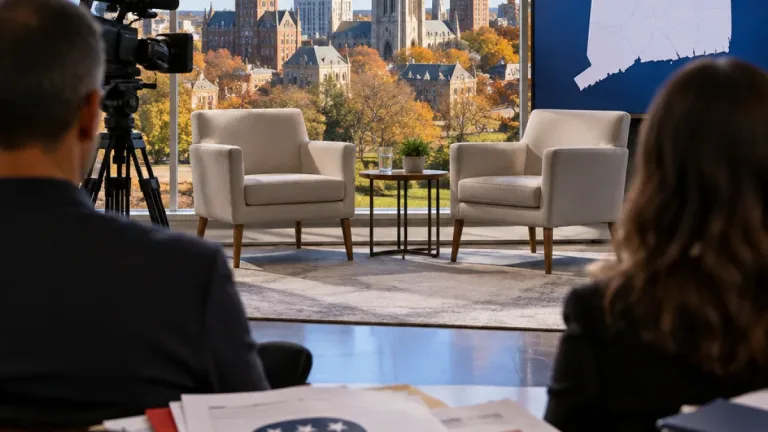
KENTUCKY — Republican Andy Barr and Democrat Charles Booker met Monday evening in what both campaigns acknowledge will be their only one-on-one debate in the contest for the open U.S. Senate seat left vacant by Sen. Mitch McConnell’s decision not to seek re-election. The forum, carried live at 6 p.m. by 14 News on Fox, offered voters a concentrated look at competing prescriptions for issues such as inflation, energy and national security ahead of the Nov. 3 general election.
Debate setting and stakes
The matchup comes after a campaign season that began in earnest when McConnell announced he would not run again. Booker, who entered the race in December and captured the Democratic nomination in May, squared off against Barr, who won a crowded Republican primary after securing former President Donald Trump’s endorsement.
| Detail | Information |
|---|---|
| Date | Monday (debate aired live at 6 p.m.) |
| Network | 14 News on Fox |
| Candidates | Andy Barr (R), Charles Booker (D) |
| Election Day | Nov. 3 |
Core differences on display
The candidates framed the contest as a contrast over both tone and policy. Booker sought to paint the campaign as a referendum on the “chaos and corruption” he said describes Washington, while Barr said the contest is a practical evaluation of who can best advocate for Kentucky’s assets and economic interests in the Senate.
“Everyone is tired of the chaos and corruption in Washington. They are tired of the status quo when Trump said he was going to drain the swamp. We want the swamp to be drained,”
Booker emphasized pocketbook issues and promised to focus on lowering grocery costs and getting more money into Kentuckians’ hands. Barr repeatedly pointed to national security and energy policy as the route to broader economic relief, stressing support for an “energy dominance” agenda and the foreign policy moves he credited to Trump.
“This is a job interview. So I know I have to earn it. If I am offered the job I cannot wait to advocate for the assets and capabilities of Kentucky,”
Trump’s influence and campaign positioning
President Trump’s shadow loomed over the exchange. Booker accused Barr of trying to distance himself from Trump, asserting that the former president’s popularity in Kentucky should have Barr leading comfortably. Barr pushed back by linking his approach to Trump-era policies, telling viewers those policies reflect the priorities of many Kentuckians.
Both men used the debate to reinforce messages to different segments of the electorate: Booker to independent and undecided voters focused on inflation and cost-of-living concerns, and Barr to conservative voters emphasizing energy, national security and continuity with Trump-aligned policy positions.
Voters’ concerns and local context
Individuals interviewed around the debate highlighted rising gas prices and grocery inflation as primary concerns — themes the candidates addressed with differing prescriptions. Booker framed his proposals as common-sense measures to put money back in residents’ pockets. Barr pointed to energy production and domestic infrastructure as leverage to reduce costs long-term.
Kentucky’s open Senate seat has attracted attention nationally because it represents an opportunity to shift Senate dynamics and because McConnell’s departure leaves a high-profile vacancy. While this debate was billed as the only one between the major-party nominees, both campaigns will now turn to closing arguments and get-out-the-vote efforts ahead of Election Day.
What to watch next
- How quickly each campaign translates debate lines into TV ads and voter outreach.
- Whether either campaign alters messaging to appeal to swing voters identified during the debate.
- Voter turnout patterns on Nov. 3, especially in suburban and rural counties that could decide the outcome.
With the debate behind them, both campaigns will have just weeks to sway undecided voters. The next major milestone for Kentucky voters is the general election on Nov. 3, when they will decide who will represent the state in the U.S. Senate.
Marcus Ellison is the state correspondent for WE NEWS.