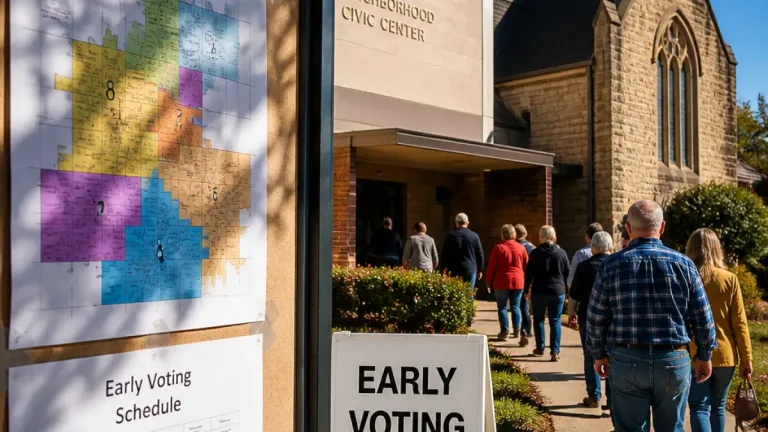

MONTGOMERY — Alabama voters will head to the polls Tuesday in a special set of primaries for U.S. House seats conducted under a newly drawn congressional map that reduces the state’s majority-Black representation and reshuffles several districts ahead of the 2026 general election.
Why the special primaries were moved
Primaries for all seven of Alabama’s U.S. House districts had been scheduled for May 19, but Gov. Kay Ivey postponed contests in the 1st, 2nd, 6th and 7th Districts after a U.S. Supreme Court decision triggered map changes in several Southern states. The shift follows a broader national effort by Republican lawmakers and allies to redraw boundaries mid-decade, a move designed in part to bolster the party’s prospects of holding its slim House majority.
The state’s current members of Congress will continue serving the constituents elected under existing lines through the end of 2026. The boundaries being used for Tuesday’s nominating contests, however, are the Republican-backed districts that will take effect in January 2027.
Impact on Black voting power and incumbents
The new map eliminates one of Alabama’s two majority-Black districts. That change directly affects U.S. Rep. Shomari Figures in the 2nd District, where the Black share of the population declines from roughly 50% under the current plan to about 40% under the proposed boundaries.
Figures, a Democrat, is seeking a second term and is unopposed in his primary. Under the current district lines, Democratic Vice President Kamala Harris carried the district in 2024 by a margin of 53% to 46%. Under the new configuration, analysts estimate former President Donald Trump would have carried the district by about 57% to 42% if those lines had been in place last year.
U.S. Rep. Terri Sewell, the state’s other Democratic member, remains in a district where Black residents retain a slight majority under the redrawn map. Sewell is running for a ninth term and has no primary opposition. In 2024, Harris beat Trump handily in the current 7th District, and the new map would have reduced that margin only slightly.
Candidates and contests to watch
The altered lines have prompted competitive Republican primaries in some districts. In the 2nd District, six Republicans are vying for the chance to challenge Figures in November, including state Rep. Rhett Marques, Army veteran Joshua McKee and real estate broker Hampton Harris. Marques has received an endorsement from former President Donald Trump and leads the field in fundraising.
Other districts included in Tuesday’s special primaries — the 1st and 6th — also feature contested Republican fields, reflecting the party’s effort to flip or secure vulnerable seats under the new map. Democrats in Alabama are concentrated in fewer districts after the change, making the remaining Democratic-held districts more heavily contested ground for Republicans.
- Districts voting in the special primary: 1st, 2nd, 6th and 7th.
- Primary date: Tuesday, Aug. 11 (polls open 7 a.m. to 7 p.m.).
- Map effective: New boundaries will take effect in January 2027.
Practical information for voters
Alabamians unsure of their congressional district or polling location can check the Secretary of State’s website by providing their name and date of birth to confirm registration details and precinct information. Voters should be aware that the contests on Aug. 11 are party primaries that will determine November nominees under next year’s map, not a reallocation of representation for the months remaining in 2026.
Broader context
The Alabama redistricting move follows similar actions in Louisiana and Tennessee after a Supreme Court ruling prompted Republican-controlled states to revisit congressional boundaries. Legal fights and legislative changes around redistricting have become more frequent in recent election cycles, as both parties seek maps that maximize their electoral prospects.
For Alabama, the immediate consequence is clearer: fewer districts where Black voters constitute a majority, more Republican-leaning lines in some areas and several competitive primaries this week that will set the stage for the November general election.
| District | Current Black population share | New map Black share (approx.) |
|---|---|---|
| 2nd | ~50% | ~40% |
| 7th | Majority | Slight majority |
The outcomes of Tuesday’s primaries will not change who represents Alabamians through the rest of 2026, but they will decide the party nominees who will compete in November under boundaries that will govern future representation. Observers in Alabama and around the country will be watching how these contests play out as part of a larger national map fight that could shape control of the U.S. House.