
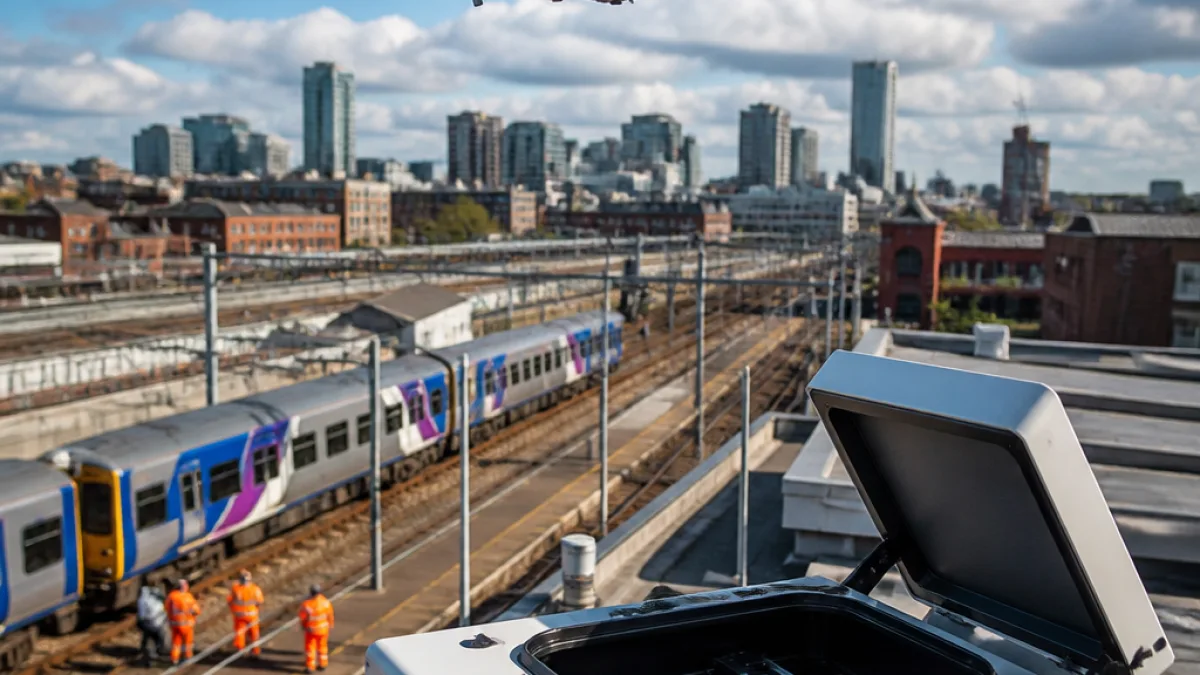
Remote drones giving officers new eyes across Manchester rail network
British Transport Police (BTP) have brought a new form of surveillance to Greater Manchester with the launch of a remote-operated drone site based at Network Rail’s Rail Operating Centre on Wolverton Street. Operated from a flight centre in central London, the system has already been used in the city this summer to help officers and rail staff respond faster to incidents.
The initiative — described by the force as a ‘Drone in a Box’ operation — puts airborne cameras on immediate standby over parts of the rail network. Each Manchester site houses two drones, each capable of about 25 minutes flight time, that can be launched within seconds from an automated housing unit on the building roof.
Since the Manchester operation began in early April, BTP says the drones have assisted with roughly 20 incidents in the area. Two of those deployments in August were released by the force to illustrate the technology in action: one saw officers locating and comforting a vulnerable woman at Ashburys station in Openshaw, the other monitored the scene as passengers were taken from a broken-down train in central Manchester.
"It is a new and modern way to help us prevent criminality on the railway."
The flights are not piloted locally. Instead, images and live video feed are relayed back to a flight operations centre in London where trained drone pilots control the aircraft. The visual intelligence is then fed in real time to officers and Network Rail staff working on the ground, enabling quicker, evidence-led decisions about how to respond.
How the technology works and what it does in Manchester
- Automated launch: drones are housed in rooftop boxes and can deploy rapidly.
- Remote pilots: aircraft are flown by operators based at a central London flight operations centre.
- Live relay: video and location data are shared instantly with on-site officers and rail staff.
For Manchester commuters and those who work on the railways, the project is intended to improve situational awareness during incidents such as trespass, track obstruction or passengers stranded by train failures. BTP says real-time aerial imagery can speed up responses and reduce the time lines are disrupted.
| Metric | Figures |
|---|---|
| Operational sites (current) | 7 |
| Drones per site | 2 |
| Approx. flight duration | 25 minutes |
| Manchester incidents assisted (since April) | ~20 |
While BTP has already introduced similar capability elsewhere — the project was first launched in Leeds just over a year ago — the Manchester roll-out means the region is now part of a growing network of sites intended to provide fast aerial support across the rail system.
Critics of police drone usage typically raise concerns about privacy and oversight. The force has not released detailed policies in the footage shared, but said the capability strengthens its ability to locate trespassers and respond to emergencies. For frontline officers in Manchester, the promise is clearer eyes on scenes where access can be difficult or where time is critical.
Network Rail staff in the city welcomed the immediate utility of having live aerial footage when they were removing passengers from a disabled train in central Manchester this month. The images allowed both BTP and rail staff to coordinate on-the-ground activity with a better overview of the platform and track situation.
For passengers and local residents, the introduction of the Manchester drone site is likely to mean faster resolution of some railway incidents and potentially fewer prolonged delays when the technology can rapidly identify where help is needed. The long-term effect will depend on how often the drones are deployed and the safeguards BTP puts in place around data and public accountability.
Greater Manchester’s rail network carries thousands of commuters every day. Any tool that shortens disruption or helps protect vulnerable people on stations will attract attention from passengers, unions and privacy campaigners alike. BTP will need to balance operational gains with public confidence as the programme expands.















