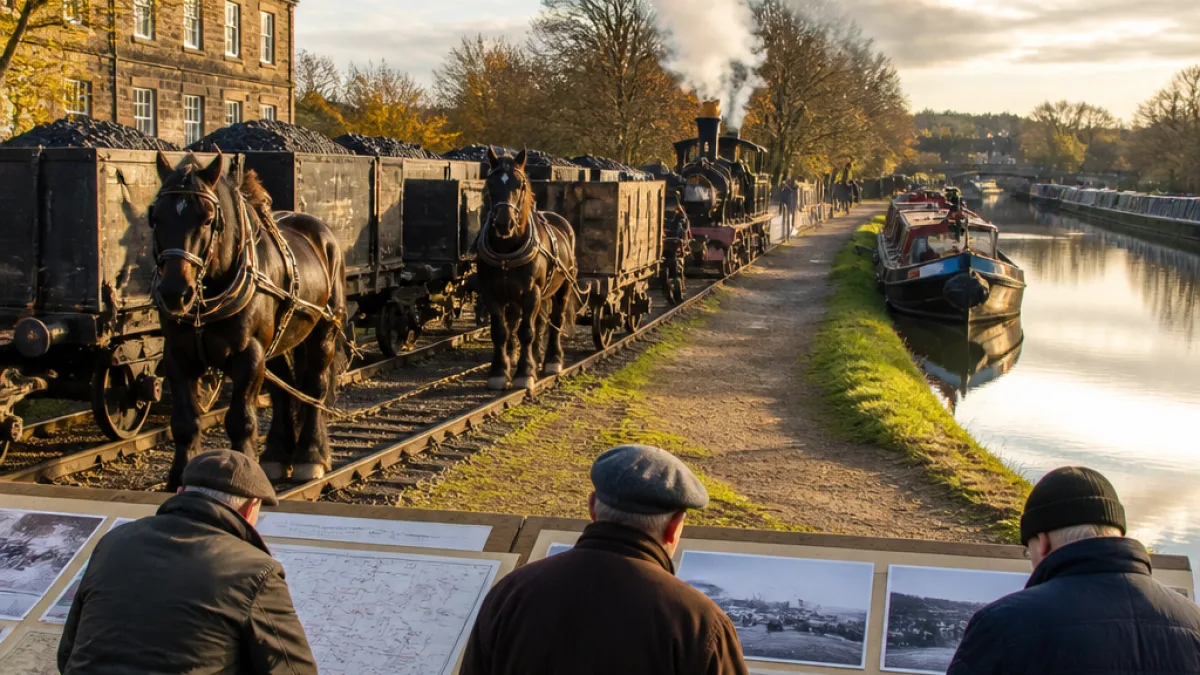
The community of Kirkintilloch is being invited to reflect on two centuries of industrial change as the Monkland and Kirkintilloch Railway marks its 200th anniversary in 2026. Opened in 1826 to convey coal from the Monklands to the Forth and Clyde Canal at Kirkintilloch, the line played a formative role in the transport networks that underpinned the region’s industrial expansion.
From horse-drawn wagons to steam
The railway originally operated with horses; contemporary accounts show horse-drawn coal trains moving along the route in 1826. It was not until 1831 that steam locomotives were introduced, a change made possible by stronger, malleable iron rails capable of carrying the new engines.
The provenance of the line is local as much as it is industrial. While October 1826 is often cited as the opening month, newspapers of the time record earlier activity: "a trial run on the railway" was described in the Caledonian Mercury on 29 May 1826, and North Lanarkshire museum material notes coal trains being seen on parts of the route in spring that year. Those early movements point to a gradual shift from waterways and primitive wagonways towards integrated rail-and-canal freight systems centred on Kirkintilloch.
What the railway meant for local families
For residents of Kirkintilloch and surrounding parishes, the railway was not an abstract achievement of engineering but an economic engine that altered where people lived and how they worked. The line linked coalfields, ironworks and construction sites to the canal network, creating employment opportunities that reshaped communities.
Family historians and local researchers will find the bicentenary an apt moment to trace how occupations and addresses evolved across generations. Census records from the mid-19th century onwards detail transitions from agricultural labour to mining, ironworking and railway employment. Archivists point to gaps and starts in the documentary record, but the broad pattern is clear: industrial transport concentrated labour in towns such as Kirkintilloch and nourished new neighbourhoods and services.
- 1826: Railway in operation, initially horse-drawn.
- May 1826: Contemporary newspapers report trial runs on parts of the route.
- 1831: Steam locomotives introduced following rail improvements.
Records, museums and local memory
Local museums and specialist archives are encouraging residents to use the bicentenary as a prompt to examine surviving sources. Organisations with holdings relevant to the Monkland and Kirkintilloch Railway highlight census material covering 1841–1901 as particularly useful. Original census images, employment registers and contemporary newspapers can help reconstruct the lived experience of those who worked on and around the line.
"For family historians, the important question is what this expanding industrial economy meant for the people who lived nearby."
That observation, drawn from recent commentary on the anniversary, underlines the human consequences of transport innovation: not only how coal moved, but how people moved and how communities were remade. Museums in North Lanarkshire already interpret parts of the story, and local history groups in Kirkintilloch may mount exhibitions or talks during 2026 to broaden public engagement.
Local legacy and commemorations
While the physical traces of early railway infrastructure have in places disappeared beneath later development, the line’s imprint remains in street patterns, place names and in the population history of the town. The bicentenary presents an opportunity for schools, community groups and families to explore those links.
| Aspect | Significance |
|---|---|
| Transport innovation | Early example of a railway linking coalfields to canal transport |
| Local employment | Shift from rural labour to mining, ironworking and railway jobs |
| Heritage resources | Census records, newspapers and museum collections for research |
As 2026 unfolds, Kirkintilloch will join other communities across Scotland in recognising how early railways helped shape modern life. For many residents the anniversary will be a matter of personal history as much as public history — an occasion to follow family threads from croft and farm to pit, yard and canal basin, and to place those stories within the broader narrative of Scotland’s industrial transformation.