
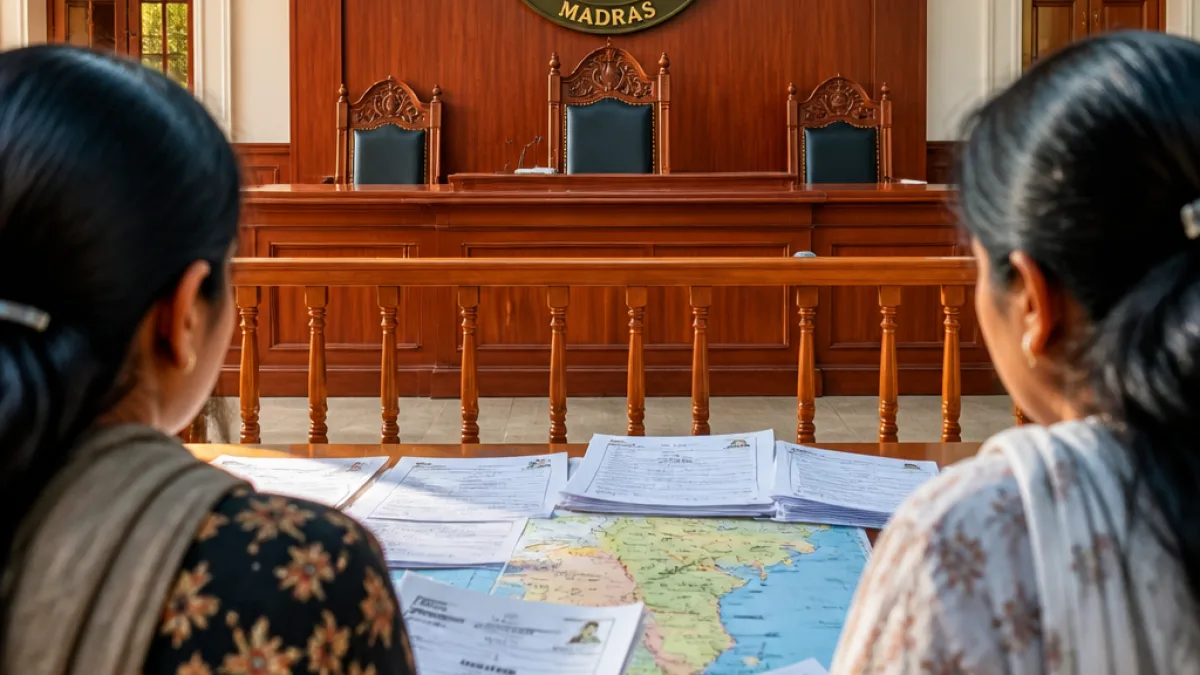
The Madras High Court on August 27 held that children born and brought up in Puducherry can claim Scheduled Caste (SC), Most Backward Class (MBC) or Other Backward Class (OBC) status through their native mothers, rejecting the Puducherry administration's contention based on a "patriarchal" lineage rule.
Judgment emphasises social disadvantage over lineage
Justice D Bharatha Chakravarthy, hearing a batch of 28 petitions concerning community certificates and reservation benefits in education and employment, said the central question is whether the child was brought up in a disadvantaged social milieu and suffered the indignities attached to that community. The court underlined that whether caste is traced patrilineally or matrilineally is not determinative for conferring reservation.
“The basis of reservation is only social disadvantage and the sufferings and stigma attached to the child; that is the primordial factor for conferring the benefit. Whether it is patrilineal or matrilineal makes no difference,” the court observed.
The petitions concerned candidates who were born and educated in Puducherry. Their mothers held Puducherry origin-status certificates identifying them as members of SC, MBC or OBC communities, while the fathers were largely migrants from neighbouring districts in Tamil Nadu. In some instances fathers asserted Puducherry origin but could not produce documentary proof such as a grandfather’s certificate.
Administrative practice questioned
The court's ruling directly challenges the administrative practice in Puducherry where claimants were denied reservation benefits if the paternal line was not demonstrably native to the Union Territory, even when the child had been raised in the mother's community locally.
By focusing on the lived social condition of the child rather than formal lineage rules, the judgment signals that administrative authorities must look beyond documentary lineage and consider the real-world stigma and disadvantage experienced by the applicant.
Practical implications for certification and benefits
The decision will have immediate consequences for how community certificates are issued and how reservation entitlements are assessed in Puducherry. Key administrative implications include:
- Certificate eligibility: Children whose mothers are Puducherry natives with origin-status certificates may now be able to obtain community certificates even if fathers are migrants.
- Documentation standards: Reliance on paternal lineage documents such as grandfather certificates may be reduced where the child demonstrably belongs to and was brought up in the mother's community.
- Review of past rejections: Candidates previously denied reservation on the basis of paternal non-nativity could seek reconsideration or legal remedy in light of the ruling.
What the court considered
The court examined whether the children in question had been born, raised and educated in Puducherry and whether they had experienced the social disabilities associated with their mother's community. Justice Chakravarthy noted it would be inequitable to permit reservation benefits when the male spouse hailed from another State but deny the same benefit when the female spouse did so, if the child is otherwise integrated into the mother's community in Puducherry.
Scope and limits of the ruling
The judgement was delivered on a set of petitions presented against administrative decisions under the Puducherry administration concerning community certificates and reservation in education and employment. It clarifies the legal approach but does not itself prescribe the detailed administrative procedures to be adopted by the Puducherry government in implementing the principle.
| Item | Detail |
|---|---|
| Bench | Justice D Bharatha Chakravarthy |
| Petitions | 28 (community certificate/reservation cases) |
| Communities involved | SC, MBC, OBC |
| Core issue | Whether child can claim caste status through mother when father is a migrant |
Next steps and likely administrative response
The Puducherry administration will need to rework its approach to certification and may have to issue fresh guidelines reflecting the court's emphasis on social disadvantage. Affected applicants may pursue administrative review or litigation to obtain certificates and access reservation benefits in education and employment.
The ruling aligns with a principle that protection under reservation is meant to address social stigma and disadvantage, not merely documentary lineage, and could influence similar disputes in other jurisdictions where maternal nativity has been overlooked.
Stakeholders, including educational institutions, recruitment authorities and local civil registrars, will require clarity from the administration on implementing the court's guidance in day-to-day certificate issuance and verification procedures.