The Communist Party of India (Marxist) on Sunday demanded that the Puducherry government ensure uninterrupted distribution of subsidised essential commodities through ration shops and immediately clear rice supplies pending since February 2026, party Puducherry secretary S. Ramachandran said in a statement.
Background of ration shop disruption
The CPI(M) said the closure of ration shops from September 2015 and the subsequent switch from the free rice scheme to Direct Benefit Transfer (DBT) had adversely affected food security among the poor. According to the party, ration shops were reopened by the Department of Civil Supplies on 21 October 2024 following sustained public protests and campaigns.
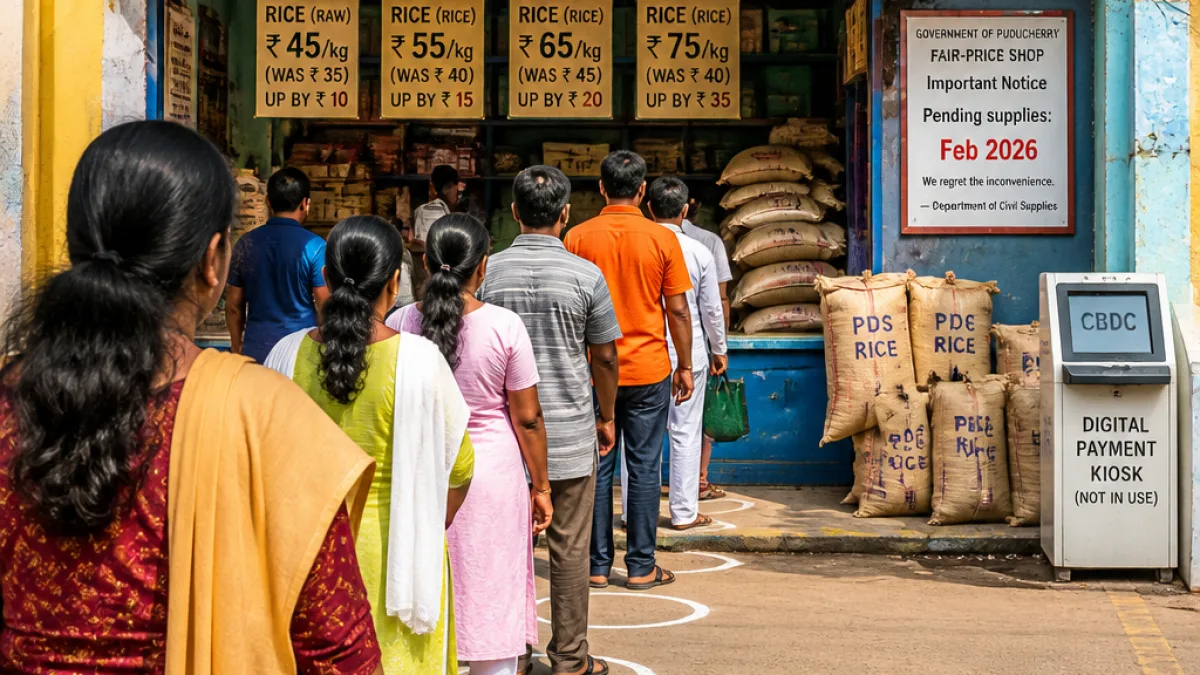
While welcoming the reopening of outlets, the CPI(M) said the promised steady supply of subsidised essential items — rice, dal, wheat, sugar, rava and cooking oil — had not been delivered as assured by the Chief Minister. The party claimed that only the rice allocation for January 2026 had been distributed recently and supplies due from February 2026 remain pending.
Allegations on procurement and price rise
The party alleged that the Union Territory’s direct paddy procurement scheme, designed to procure paddy from farmers so that rice could be sold at controlled prices, had remained inactive. It also said that the set of 14 essential commodities earlier announced for distribution through ration shops had not been supplied.
Referring to market conditions, the CPI(M) noted an increase in open-market rice prices by between ₹10 and ₹35 per kg, saying this had imposed an additional burden on low-income households that depend on subsidised supplies.
Concerns over CBDC-based subsidy proposal
The CPI(M) also opposed a proposed Central Bank Digital Currency (CBDC)-based food subsidy distribution programme being considered for Puducherry. The party alleged that the scheme, under which food subsidies would be credited digitally for use at authorised outlets, could weaken the public distribution system (PDS) and result in the eventual closure of ration shops.
The Centre has proposed the CBDC scheme in Puducherry as an alternative mechanism for delivering subsidies. The CPI(M) urged the government to continue operations through the reopened ration shops and to supply all essential commodities at subsidised prices.
Demands and appeal to the Chief Minister
The party demanded immediate distribution of the pending rice stocks and revival of the direct paddy procurement programme for farmers. The CPI(M) asked Puducherry Chief Minister N. Rangasamy to intervene and take permanent measures to secure food supplies for vulnerable sections of the population.
According to the statement, the party wants the administration to ensure uninterrupted operations of the more than 500 reopened ration shops and to restore the full basket of subsidised items previously announced.
- Reopening date: 21 October 2024 (ration shops)
- Distributed recently: Rice allocation for January 2026
- Pending since: February 2026 rice allocation
- Number of reopened shops: More than 500
- Price rise cited: Open-market rice up by ₹10–₹35 per kg
| Item | Status (as per CPI(M) statement) |
|---|---|
| Rice (Jan 2026) | Distributed recently |
| Rice (Feb 2026) | Pending |
| Other essentials (dal, wheat, sugar, rava, cooking oil) | Not regularly supplied |
The demand highlights continuing tensions between different modes of subsidy delivery — in-kind distribution via the public distribution system and cash transfers or digital credits. The CPI(M)’s objections reflect wider debates around the ability of DBT and digital payment mechanisms to reach the poorest beneficiaries without disrupting access to essential staples.
Officials from the Department of Civil Supplies and the Puducherry government did not issue an immediate response to the CPI(M)’s statement. The party’s appeal places pressure on the administration to clarify the status of procurement, stock availability and distribution schedules ahead of any move towards piloting a CBDC-based subsidy arrangement.
For residents dependent on subsidised rations, timely clarification of supply schedules and the modalities of any new digital subsidy system will be critical to avoid shortfalls in basic food availability, the CPI(M) warned.