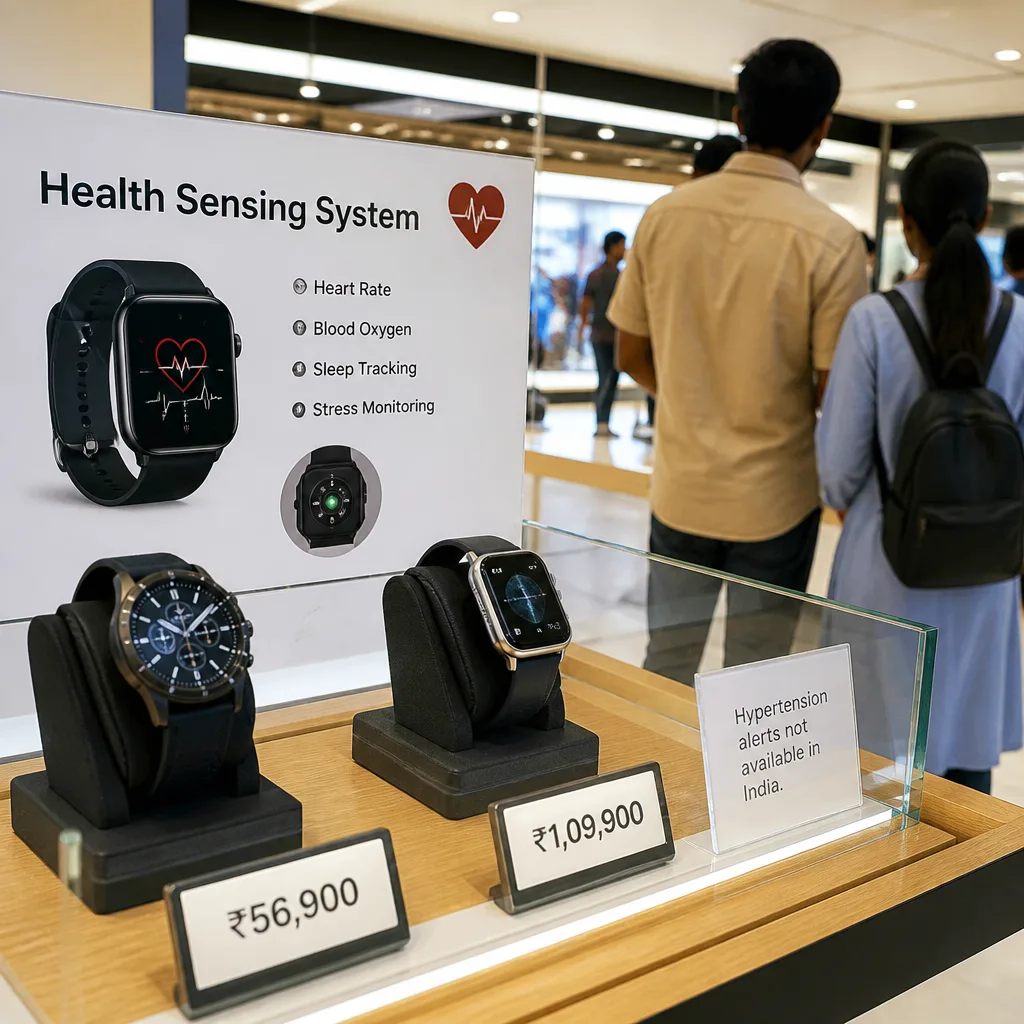
Apple on Thursday unveiled the Watch Series 12 and the Watch Ultra 4 for the Indian market, positioning both devices around a new Health Sensing System powered by the S11 chip. The devices go on pre-order immediately and are due in stores on Friday, September 18, with the Series 12 priced from ₹56,900 and the Ultra 4 from ₹1,09,900, as reported.
What the new watches measure
Apple says the updated sensors allow the watches to sample heart rate far more often than previous models. The company claims continuous heart-rate readings every five seconds during the day and substantially higher-frequency sampling of heart rate variability (HRV). According to reporting, Apple describes this as its most accurate heart-rate sensing in a wearable, citing a study involving more than 1,000 people against rival devices.
- Heart monitoring: optical and electrical heart sensors with larger green LEDs and a wider electrode surface.
- Readiness score: a daily metric from 0 to 10 synthesising recent activity, training load, vitals and sleep.
- Privacy and audio features: on-device processing for certain audio intelligence tools using the S11 chip.
The new Readiness feature calculates a single score each morning and gives a plain recommendation—such as to recover, pace yourself, or go for it—based on the aggregated inputs. The score updates as fresh data arrives through the day and allows users to inspect the contributing factors. Apple built the underlying algorithm from its Heart and Movement Study, the reports said.
"Readiness gives Apple a daily score its rivals have offered for years," the report noted.
Battery, tracking and usage
Apple has also revised battery claims for the line-up. The Watch Ultra 4 is now promoted as capable of more than two days of use, with up to 45 hours of workout tracking in its longest mode. The Series 12 is stated to hold at around 24 hours of everyday use and up to 10 hours for outdoor workouts, with short charging bursts advertised to deliver substantial extra runtime.
| Model | Everyday battery | Longest workout tracking | Starting price (India) |
|---|---|---|---|
| Watch Series 12 | ~24 hours | ~10 hours (outdoor) | ₹56,900 |
| Watch Ultra 4 | More than 2 days | Up to 45 hours | ₹1,09,900 |
Regulatory and clinical context for India
Importantly for Indian consumers, hypertension notifications—a software feature that assesses elevated blood pressure patterns—will not be available on either watch at launch. Apple reportedly expects clearance for that functionality in India next year. The absence underscores the role of national regulatory review for health-related device functions; such clearances typically depend on data, validation and classification under medical-device rules.
Wearables that provide health information can help with long-term monitoring and self-awareness, but they are not substitutes for clinical diagnosis. Readers are advised to consult a qualified doctor for interpretation of any health metric and before making changes to treatment or medication based on wearable data. Public health bodies such as the Indian Council of Medical Research and the Union Health Ministry continue to recommend formal blood-pressure checks in clinical settings for diagnosis and treatment decisions.
Privacy and on-device processing
Apple emphasised privacy as it introduced new audio-related features that leverage the S11 chip. The company said certain functions process raw sound inside an isolated part of the chip and do not store it, stressing that the implementation is designed to avoid external transmission or retention of audio. As reported, features slated for the S11 later this year include sound recognition for alarms and doorbells, the ability to rewind short conversation snippets and concise summaries of discussions via Siri.
Health and fitness features in modern wearables prompt questions around clinical validity, privacy and regulatory oversight. Consumers planning to use these watches for health monitoring should weigh claimed benefits against current regulatory approvals in India and should verify with healthcare professionals when monitoring chronic conditions. WE NEWS recommends consulting a medical practitioner for personalised advice and not relying on consumer wearables as a sole source of medical information.