
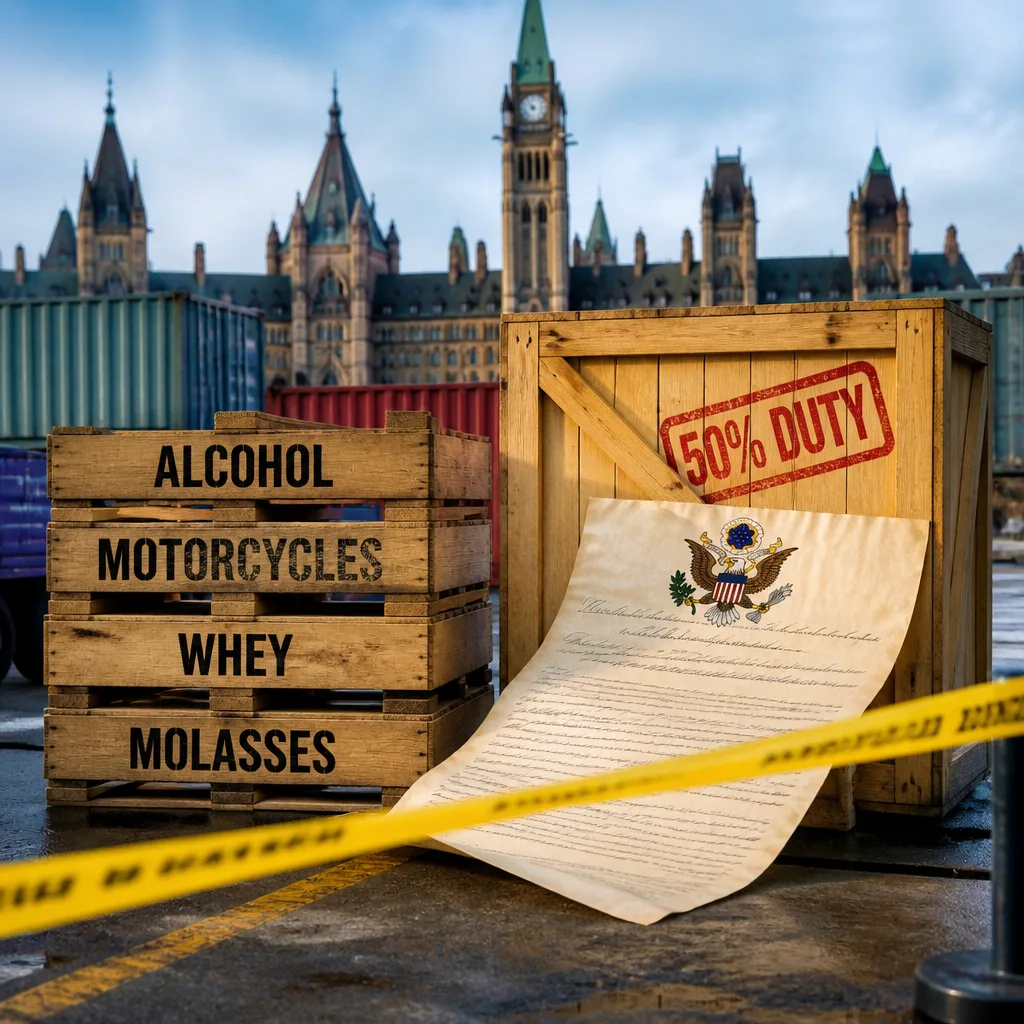
The White House late Tuesday enacted a package of trade measures that will bar certain Canadian imports and impose steep new duties on others, intensifying an already heated dispute between Ottawa and Washington.
What the U.S. announced
U.S. President Donald Trump signed five proclamations that do two things: place an outright ban on a selection of Canadian products and apply 50 per cent tariffs to another group of goods. Among the items named for prohibition are Canadian alcohol and motorcycles. The measures also include bans on whey products and molasses, while the half‑point levies target categories such as certain dairy products, paper and wood products, furniture and mattresses.
The action comes after Canadian retaliatory tariffs took effect earlier Tuesday, following the collapse of recent bilateral trade talks. U.S. officials framed the proclamations as a response to those Canadian measures, signaling an escalation in tit‑for‑tat trade restrictions between the two neighbours.
Immediate implications
The new U.S. steps will carry immediate economic consequences for affected Canadian exporters and could widen damage to integrated supply chains, particularly in sectors such as food and beverage, furniture manufacturing and forest products. Producers of goods singled out for a ban face the prospect of losing direct access to a major export market; those facing the 50 per cent tariff will face sharply higher costs to compete in the United States.
- Banned imports: Canadian alcohol, motorcycles, whey products, molasses and other items.
- Tariffed imports: Certain dairy items, paper and wood products, furniture and mattresses subject to 50 per cent levies.
- Context: Measures follow Canadian retaliatory tariffs imposed after trade talks broke down last month.
Political context and risks
Trade disputes between Canada and the United States carry heightened political stakes given the depth of economic integration between the two countries. Any sustained restrictions threaten jobs and output in export‑dependent regions, and they typically reverberate into federal political debate, pressuring the government in Ottawa to respond both on trade policy and in support for affected industries.
Ottawa's options range from pursuing dispute settlement through existing North American trade mechanisms to imposing reciprocal measures of its own. The latter would further inflame relations while the former can be slow and legally complex. The short‑term pressure on companies and workers in targeted sectors could force more immediate fiscal or programmatic responses from the federal government to help mitigate disruption.
Numbers at a glance
| Measure | Examples | Rate |
|---|---|---|
| Import ban | Alcohol, motorcycles, whey products, molasses | Prohibited |
| Tariff increase | Certain dairy, paper and wood products, furniture, mattresses | 50% |
As details are implemented, companies and trade associations will be scanning the fine print to determine exact classification and enforcement dates. Even where exemptions or carve‑outs exist, market uncertainty is likely to depress investment and planning in the near term.
What to watch next
The coming days should reveal several key developments: how Ottawa responds formally, whether Canada pursues dispute resolution through trade institutions and how businesses adapt supply chains or seek government relief. The measures also raise questions about the timing and prospects for any renewed talks to de‑escalate tensions.
For Canadians, the dispute highlights the vulnerability that comes with deep integration with the U.S. economy — and the political leverage that can be exercised when relations sour. The federal government will be under pressure to protect jobs and exports while balancing the broader bilateral relationship that touches virtually every corner of the economy.
The situation remains fluid and will be updated as more official details and reactions emerge.