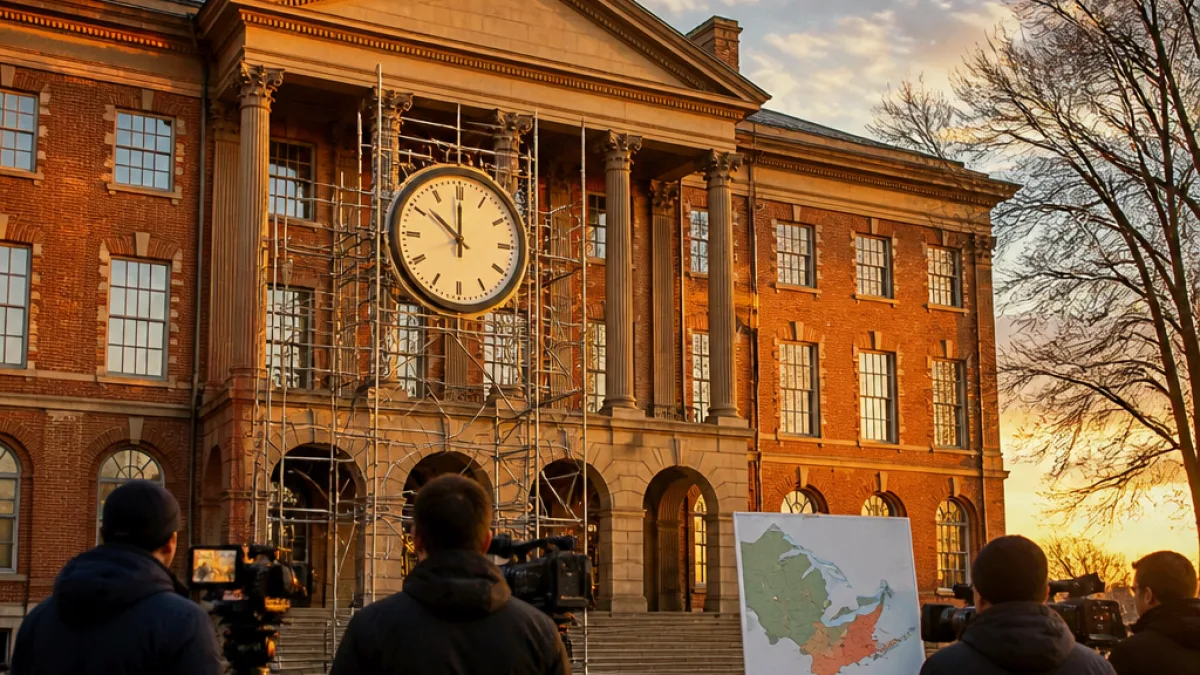
Prince Edward Island's premier plans to ask Islanders whether the province should stop changing clocks twice a year, saying any move would be pursued in concert with neighbouring Maritime governments.
Premier seeks Islanders' view
Rob Lantz told reporters he will "take the pulse of Islanders" to see how they feel about potentially remaining on one time year‑round. The announcement follows decisions by several western provinces and territories to stay on daylight time, creating a patchwork of time‑setting practices across Canada.
"We'll take the pulse of Islanders to see how they feel about it," Lantz said. "Then I'll continue the conversation with my Maritime colleagues and, if all goes well, we could move forward together."
The premier said he has already spoken with his counterparts in Nova Scotia and New Brunswick and that they agreed on a principle: if one Maritime province were to change how it handles clocks, the others should do so together to avoid disruption across the region. That regional coordination was a central theme in his remarks.
Why the question matters to Islanders
The question touches daily life across the Island — from school and work schedules to business hours and cross‑border travel. Some Islanders may welcome longer evening daylight if the province were to remain on daylight time year‑round; others may prefer lighter mornings during winter months or fear complications for travel and commerce.
Provincial officials have not yet released details about how the public consultation will be conducted, what precise options will be presented, or a timeline for any decision. Lantz’s comments indicate, however, that any shift would not be unilateral and would depend on discussions with neighbouring governments.
Options and regional coordination
Across Canada, approaches to clock changes now vary. Western provinces and some territories have signalled they will stay on daylight time, while many other jurisdictions will continue to set clocks back to standard time this autumn. That divergence has prompted renewed debate about the benefits and drawbacks of changing clocks twice yearly.
For the Maritimes, alignment matters because of shared economic ties and daily cross‑provincial connections. Islanders commute for work, attend events and conduct business with partners in Nova Scotia and New Brunswick; diverging time rules could complicate scheduling, broadcast times and freight logistics.
- Potential benefits of staying on one time year‑round include more evening daylight in winter months and elimination of the biannual clock adjustment.
- Potential drawbacks include darker winter mornings and the need to coordinate with jurisdictions that choose a different approach.
- Any change would require conversations among provincial governments and engagement with residents and businesses to assess the local appetite and practical implications.
What to expect next
Officials have not set a public consultation schedule or specified the format of the poll the premier mentioned. Islanders can expect to hear how the province plans to solicit feedback in the coming weeks as the government works with its Maritime counterparts to determine a common approach.
| Option | Key considerations for P.E.I. |
|---|---|
| Remain on daylight time year‑round | Longer evening daylight in winter; must coordinate with Nova Scotia and New Brunswick; potential mismatch with jurisdictions that revert to standard time. |
| Continue twice‑yearly clock changes | Keeps consistency with provinces that still change clocks; avoids darker winter evenings; potential divergence from western provinces that stay on daylight time. |
The premier highlighted the importance of a unified regional approach rather than isolated action. That stance mirrors concerns raised elsewhere in Canada, where differing provincial decisions have prompted proposals for coordinated policies to reduce cross‑border confusion.
Public and business perspectives
Reactions in other jurisdictions have been mixed, reflecting differing priorities among residents, industries and service providers. Islanders involved in tourism, shipping or broadcasting may raise particular concerns about synchronization of schedules, while families and workers could focus on sunlight patterns and health or safety effects.
As the province moves toward a public outreach phase, community groups, employers and local governments will likely weigh in. The format and questions in the premier's planned poll will shape the public debate and help determine whether the province pursues further legislative or administrative changes.
For now, Islanders should expect that the clocks will be set back this autumn as in past years until any coordinated change is finalised.
Reporting from Charlottetown.