
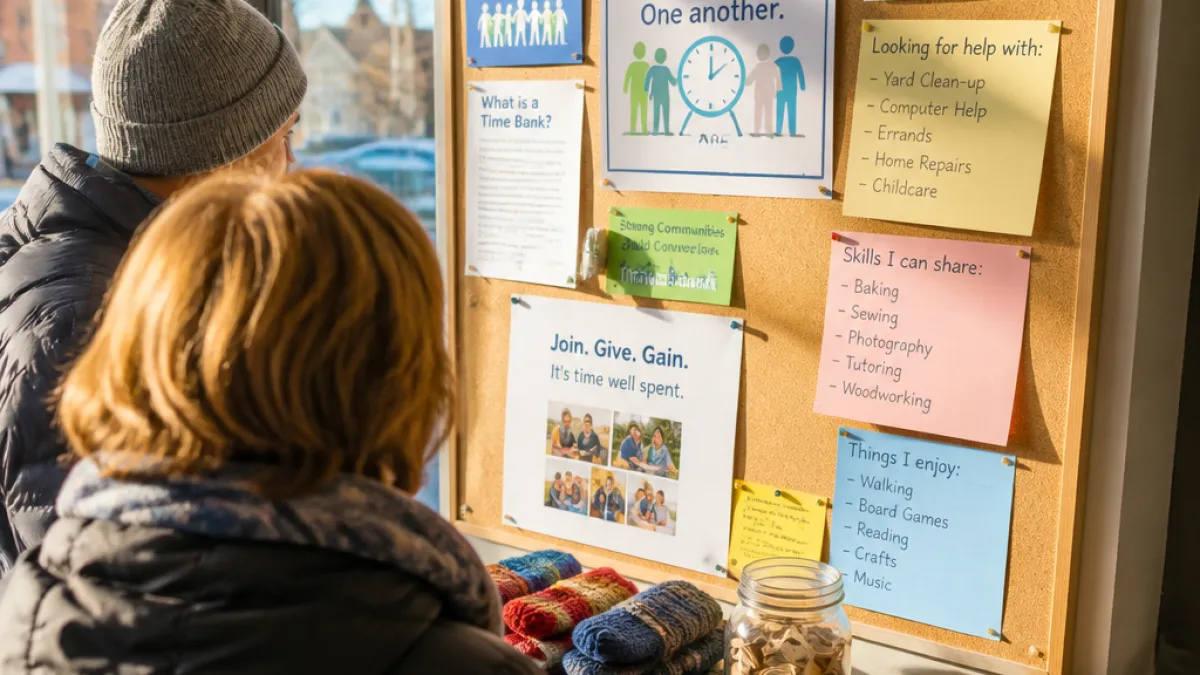
ST. STEPHEN, N.B. — A community-run time bank in southwestern New Brunswick is building neighbour-to-neighbour supports by letting people trade hours of help rather than cash. The Charlotte County Time Bank, founded last year, allows members to list skills, offer services and earn credits they can spend on assistance from others.
How it works
The model is straightforward: for every hour a member spends helping someone else, they receive one time credit. Those credits can then be redeemed for an hour of someone else's time. The system is designed so that all hours are equal, whether someone provides heavy lifting, baking, tutoring or companionship.
"It's a bit like a barter system," said the group's founder, reflecting on the kinds of exchanges the network has supported.
The founder, who launched the Charlotte County chapter after a personal recovery that required extra help around the home, said the scheme has reduced barriers to accessing help and made it easier to learn new skills without out-of-pocket expense.
Local examples and impact
Members have reported a range of exchanges since the group's inception. Activities include basic household maintenance and manual labour, creative skills such as baking, seasonal jobs like snow clearing, and attention to clothing repairs such as hemming. Because the scheme treats time uniformly, a neighbour who spends an hour clearing a driveway earns the same credit as someone who spends an hour offering conversation or craft instruction.
The initiative responds to two local realities: household budgets under pressure and social isolation in smaller communities. By valuing everyone's time equally, the time bank aims to strengthen social ties and increase access to everyday supports.
- Every hour of service earns one time credit
- Members post offers and requests on the group's online platform
- No money changes hands — exchanges are recorded as credits
Roots in a broader movement
The concept of time banking was first articulated in the United States in the 1980s by a law professor who promoted the idea of trading time as a currency to value care work and community support. Since then, chapters have appeared across Canada, the United States and the United Kingdom, adapting the model to local needs.
Locally, the Charlotte County Time Bank has aimed to keep its operations simple: registration, a listing of skills and an online ledger tracking credits. Participation is voluntary and framed as both a practical resource and a way to build neighbourly connections.
Practical information for residents
Residents interested in joining must become members and create a profile listing the services they can offer and the help they need. The group's platform keeps a running tally of hours earned and spent. The founder noted that participation does not require formal qualifications for most activities, though members are expected to be transparent about any limitations to their skills.
Organizers say the project is particularly useful for people recovering from illness or injury, those on fixed incomes, and anyone who wants to share a talent or learn from others without the expense of formal classes.
Challenges and safeguards
Time banks commonly face logistical and trust issues: matching requests with available volunteers, ensuring reliability, and safeguarding vulnerable participants. The Charlotte County group relies on clear online listings, community vetting and informal references to help manage expectations. Organizers stress that members should communicate openly about abilities and limitations.
| Type of Exchange | Typical Examples |
|---|---|
| Practical help | Snow clearing, yard work, moving assistance |
| Domestic tasks | Baking, meal preparation, sewing repairs |
| Companionship & learning | Conversation, tutoring, craft lessons |
What members say
Participants describe the scheme as a low-cost way to meet needs and an opportunity to contribute skills they enjoy using. The founder pointed out that most people can spare an hour a week or month to help a neighbour — and in return receive services that might otherwise be costly or inaccessible.
Organizers hope the time bank will continue to grow as more residents learn about the concept and see the practical benefits of exchanging time.
The Charlotte County Time Bank is one example of how communities in New Brunswick are experimenting with local solutions to strengthen social fabric without adding financial strain.