Initial program yields new geological information for Aurora targets
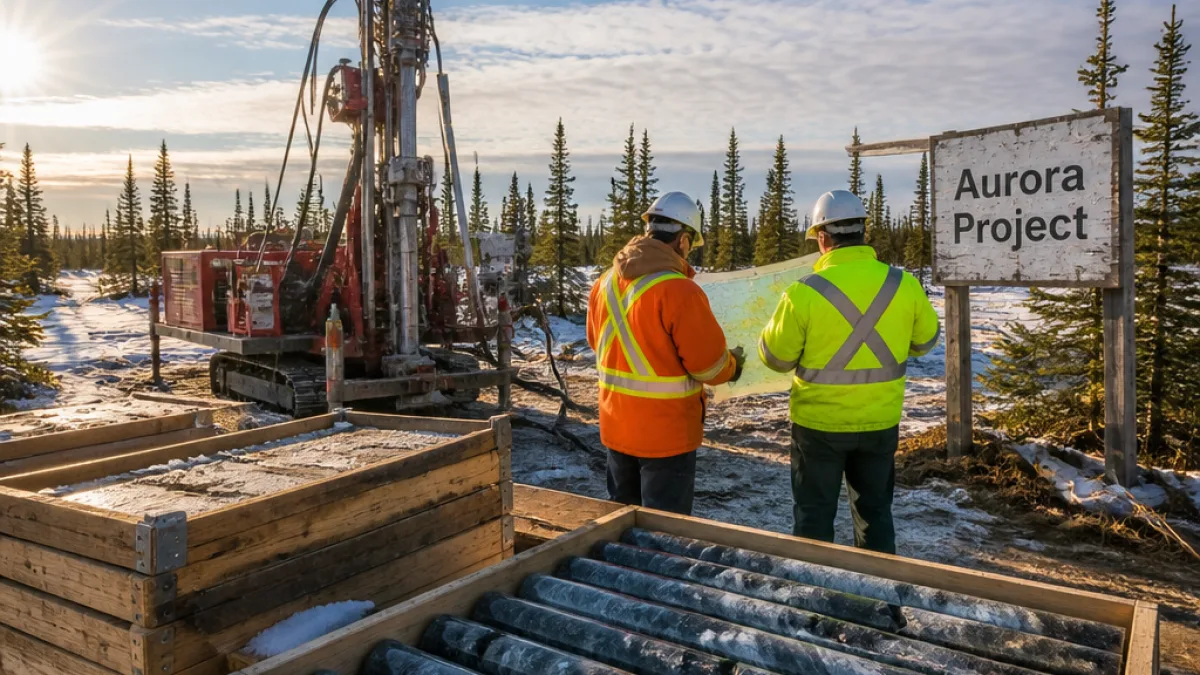
The junior explorer Traction Uranium Corp. has completed its initial diamond drilling campaign at the Aurora Uranium Project in Saskatchewan’s Athabasca Basin region, reporting that two holes totalling 541 metres intersected graphitic basement rocks with intervals of brittle faulting. The company said significant hydrothermal alteration was not observed and that geochemical results are pending.
The work was carried out by Cosa Resources Corp., the owner-operator of the Aurora property, with funding from Traction under an option agreement dated Feb. 10, 2026. Under that agreement Traction may earn up to an 80 per cent interest in the project by funding $9.15 million in exploration expenditures and completing required cash and share payments.
What the drilling tested
The program focused on the southern portion of the property, testing two conductive anomalies within the A1 target area. The anomalies were identified from a 2024 airborne VTEM electromagnetic survey carried out by Cosa and lie up-ice of radiometric anomalies highlighted in a property-wide magnetic and radiometric survey funded by Traction earlier in 2026. Those radiometric anomalies were interpreted by the companies as potentially indicating uranium-bearing source rocks.
Both holes were drilled outside the mapped edge of the Athabasca Basin and did not intersect Athabasca sandstone. Core logging identified basement rocks interpreted as metasedimentary in nature, including graphitic units that contain brittle fault zones with locally increased graphite content. One borehole, AU26-01, also intersected a granitic gneiss unit overlying the metasedimentary sequence.
"These are the first known drill intersections of faulted graphitic basement at Aurora."
That observation gives the exploration teams new geological constraints when evaluating conductive targets in the area. The presence of graphitic units and brittle faulting can be significant because such zones commonly act as conductors on airborne electromagnetic surveys, and they can play a role in focussing mineralising fluids in other Athabasca-area systems. Traction cautioned, however, that significant hydrothermal alteration was not observed and that full geochemical assay results are needed to assess the significance of the intersected rocks and structures.
Program decisions and next steps
After extending the first hole based on encouraging results, Traction said higher-than-anticipated mobilization costs and a desire to manage expenditures within the program budget led to the decision to conclude the campaign after the second hole. The company has indicated laboratory geochemistry is still outstanding and will be used to help determine the next phase of work.
The program tested two specific conductive anomalies within the A1 target area. The companies describe the radiometric anomalies from the property-wide survey as potentially reflecting uranium-bearing source rocks, but the drilling to date has not yet produced the hydrothermal alteration patterns commonly associated with immediate proximity to high-grade Athabasca-hosted uranium mineralization.
| Hole | Length (m) | Notable intersections |
|---|---|---|
| AU26-01 | unknown individual length (part of total 541 m) | Graphitic metasedimentary units, brittle fault zones; granitic gneiss overlying metasediment |
| AU26-02 | unknown individual length (part of total 541 m) | Graphitic basement with increased graphite content and brittle faulting |
- Program size: Two diamond drill holes, total 541 metres.
- Ownership/earn-in: Traction can earn up to 80% by funding $9.15 million in exploration and completing cash/share commitments.
- Key observations: First known drill intersections of faulted graphitic basement at the Aurora property; no significant hydrothermal alteration logged; assays pending.
For readers in Ontario, the result underscores the continuing interest in uranium exploration across Canada and the careful, stepwise approach adopted by junior explorers when chasing Athabasca-style targets. The Athabasca Basin remains one of the world's most important regions for uranium discovery, and new drilling that clarifies the local structural and lithological framework is a necessary early step before any larger program or investment decision is made.
Traction and Cosa will await geochemical data before outlining any follow-up work or budget changes that might test the neighbouring conductive anomalies or expand the drilling footprint on the Aurora property.