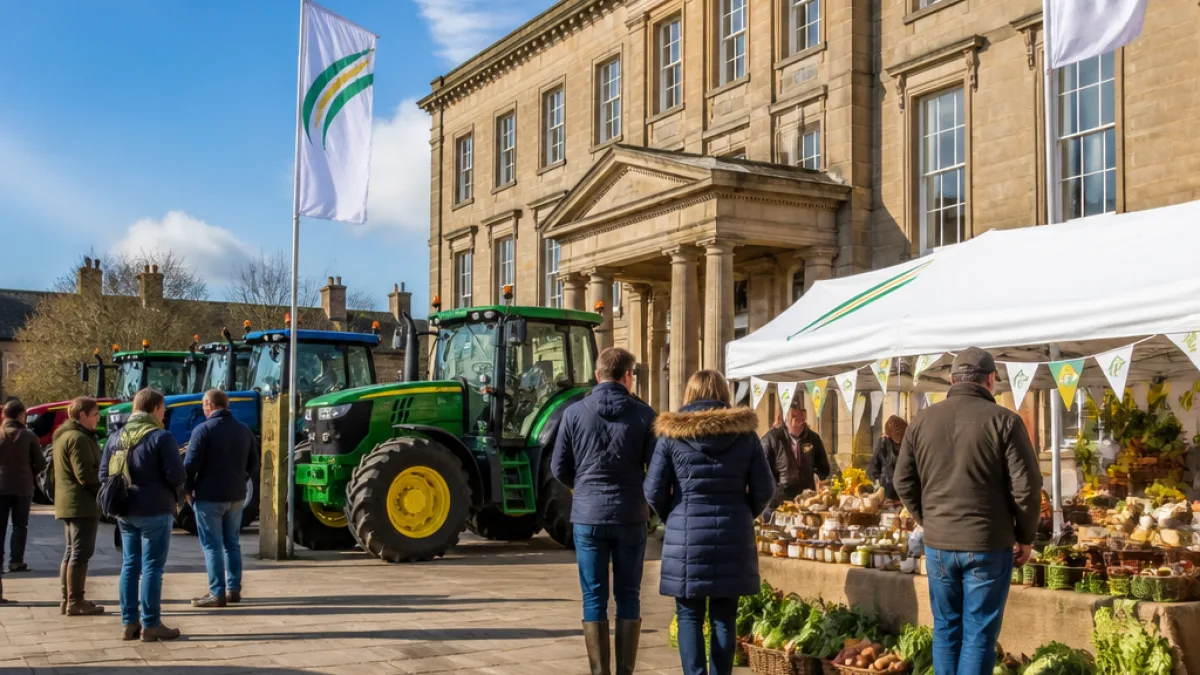
Farmers and supporters gathered outside Morpeth County Hall on Wednesday for a Back British Farming Day event aimed at celebrating local produce and drawing attention to growing concerns about the UK's long-term food security.
Public display and conversations about farming's challenges
The midday event, which ran between 12pm and 2pm, featured a tractor display and a stall showcasing goods from members of the National Farmers Union (NFU). Visitors had the chance to meet producers from across Northumberland, sample local food and discuss the pressures confronting the sector.
Organisers said the day was designed both as a celebration of food produced in the county and as a prompt for debate about how farming can be supported to provide for the country in future.
"Back British Farming Day is a fantastic opportunity to celebrate the food produced by farming families across Northumberland and thank the public for the continued support they show our industry."
The comment above was made by NFU Northumberland County Chair Mac Young, who urged residents to visit, meet their local farmers and learn more about food production. He underlined that homegrown food supplies are a vital part of the county's economy and environment, and stressed the importance of public support at a time of international uncertainty.
NFU analysis and the call for government action
At the core of the NFU's message is recent analysis showing a long-term decline in the UK's self-sufficiency across most major food categories. According to the union, self-sufficiency has fallen in 10 of 11 key food groups over the past 30 years while dependence on imports has increased.
The NFU is urging government to respond by setting ambitious food production targets and creating stable conditions that allow farming businesses to invest. Those calls were reflected in the conversations at the County Hall event, where producers outlined several immediate pressures on their livelihoods.
- Environmental and climatic pressures — farmers pointed to one of the driest recent summers affecting yields and livelihoods.
- Animal health threats — outbreaks such as bluetongue were cited as major concerns for livestock keepers.
- Rising costs and policy uncertainty — higher production expenses, unclear future environmental schemes and squeezed profitability were raised repeatedly.
| Issue | Local effect |
|---|---|
| Dry summer | Reduced yields; higher irrigation and feed costs |
| Bluetongue and disease threats | Increased animal health controls; potential movement restrictions |
| Rising production costs | Lower margins and greater financial insecurity for farms |
Speakers at the event said that without clearer support and targets from Westminster, farming businesses will find it more difficult to plan long-term investment in equipment, staff and environmentally sustainable practices.
Local significance and wider implications
For Morpeth and surrounding communities, the stakes are immediate. Local food producers supply markets, shops and catering businesses in the town and across Northumberland — and their viability affects employment, landscape management and the availability of local, seasonal food for residents.
Attendees were encouraged to use the event as an opportunity to ask questions and form a better understanding of how everyday food reaches plates, and what trade-offs farmers face between production, environmental stewardship and economic survival.
While Back British Farming Day is designed as a public celebration, it also served as a visible reminder that agricultural communities are trying to balance multiple pressures. NFU representatives said they will continue to press for policy changes intended to bolster the resilience of farms across the north-east and nationally.
For those who missed the County Hall gathering, local NFU members said information on produce and upcoming events is available through NFU Northumberland channels and that many farmers are happy to meet customers at markets and farm gates to discuss how they produce food sustainably and responsibly.